
Similes for loneliness are creative comparisons that help describe the feeling of being alone, isolated, forgotten, or emotionally disconnected. Instead of simply saying “I feel lonely,” a simile makes the emotion easier to imagine. Understanding how similes work and how loneliness can be expressed through them helps students, writers, speakers, and content creators communicate deep emotions clearly and effectively.
Comparison Overview
The phrase “similes for loneliness” combines two related ideas: similes, which are figures of speech used to compare one thing with another using words such as like or as, and loneliness, which is the emotional experience of feeling alone or disconnected.
For example:
“He felt as lonely as a single star in an empty sky.”
This sentence does more than state that someone is lonely. It gives the reader a mental picture of a person who feels isolated in a vast environment.
Similes for loneliness can be useful in:
- Creative writing
- Poetry
- Essays
- Stories
- Speeches
- Songs
- Social media captions
- Journaling
- Personal reflections
- Descriptive writing
- Emotional dialogue
The strongest similes usually connect loneliness to something familiar, such as an empty room, a deserted road, a fading star, or a forgotten object.
Definition of Similes

A simile is a figure of speech that compares two different things using words such as “like” or “as.”
For example:
“She was as lonely as a bird without a flock.”
The person is not literally a bird. The bird comparison helps communicate the person’s feeling of isolation.
Similes are often used because emotions can be difficult to explain directly. Instead of saying:
“He felt extremely lonely.”
A writer might say:
“He felt like a lone tree standing in the middle of a vast field.”
The second version creates an image and allows the reader to experience the emotion more vividly.
Purpose of a Simile
A simile can:
- Make writing more descriptive
- Create vivid mental images
- Explain difficult emotions
- Add personality to writing
- Make poetry more memorable
- Help readers connect emotionally with a character
- Turn an abstract feeling into something concrete
Definition of Loneliness
Loneliness is a feeling of being alone, emotionally disconnected, or lacking meaningful companionship or connection.
Loneliness does not always mean physical isolation. A person can be surrounded by people and still feel lonely.
For example:
“She sat in a crowded classroom, yet she felt as lonely as an island in the middle of the ocean.”
Here, the person is physically surrounded by others but emotionally feels separated from them.
Loneliness can be associated with feelings such as:
- Isolation
- Emptiness
- Sadness
- Disconnection
- Abandonment
- Homesickness
- Rejection
- Silence
- Distance
- Lack of belonging
This is why loneliness provides rich material for figurative language and creative writing.
Main Differences Between Similes and Loneliness
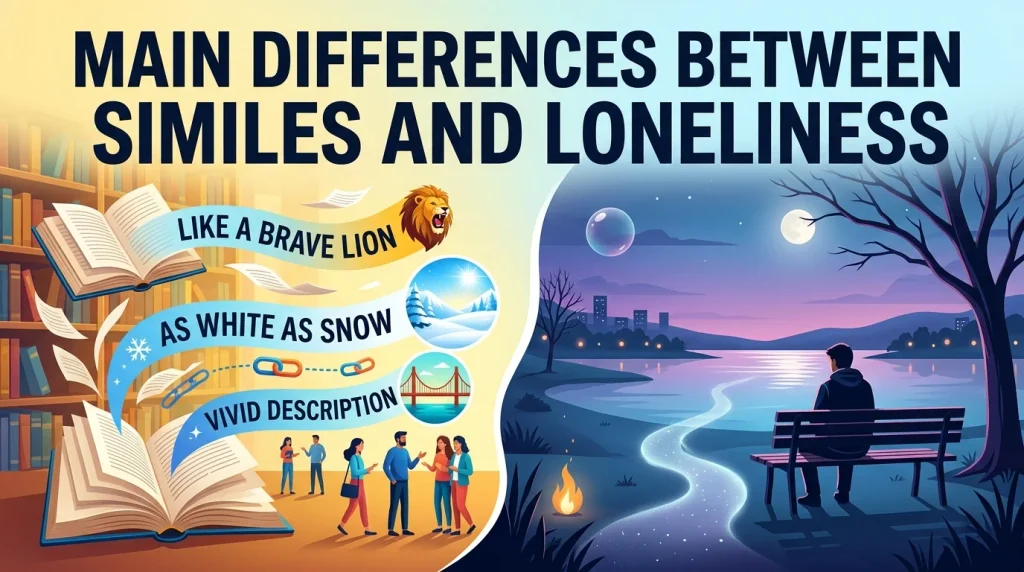
Although similes and loneliness appear together in the phrase “similes for loneliness,” they are not the same type of concept.
| Feature | Similes | Loneliness |
| Type | Figure of speech | Emotion or emotional experience |
| Purpose | Creates a comparison | Describes a feeling of isolation or disconnection |
| Grammar | Usually a noun | Usually a noun |
| Common markers | Like, as | No special grammatical marker |
| Example | “Like a forgotten shadow” | “She felt loneliness” |
| Role in writing | Describes something vividly | Provides the emotion being described |
| Relationship | Can describe loneliness | Can be expressed through similes |
The two concepts work together.
For example:
Loneliness: “He felt lonely.”
Simile for loneliness: “He felt as lonely as a lighthouse surrounded by an endless sea.”
The first sentence states the emotion. The second illustrates it.
Why Use Similes for Loneliness?
Loneliness is an abstract emotion. Readers cannot physically see loneliness, but they can understand images associated with it.
Compare these sentences:
“I felt lonely.”
and:
“I felt like a single candle burning in an empty house.”
The second sentence gives loneliness a physical image.
This makes similes especially useful when a writer wants to show an emotion rather than simply tell the reader about it.
Common Images Used for Loneliness
Writers frequently compare loneliness with:
- Empty rooms
- Deserted roads
- Islands
- Single stars
- Shadows
- Abandoned houses
- Lost birds
- Silent oceans
- Empty chairs
- Forgotten books
- Winter landscapes
- Fading lights
- Distant planets
- Trees standing alone
- Ships lost at sea
The best comparison depends on the specific kind of loneliness being described.
Types of Similes for Loneliness
Loneliness as Isolation
These similes emphasize separation from other people.
Examples:
- “As lonely as an island in a vast ocean.”
- “Like a single tree in an empty field.”
- “As isolated as a lighthouse in the middle of the sea.”
Loneliness as Emptiness
These comparisons focus on the absence of warmth, activity, or connection.
Examples:
- “Like an empty house after everyone has left.”
- “As empty as a room with no furniture.”
- “Like a silent theater after the audience has gone.”
Loneliness as Abandonment
These similes suggest that someone has been forgotten or left behind.
Examples:
- “Like a forgotten letter in an old drawer.”
- “As lonely as a toy left behind in an empty playground.”
- “Like a suitcase abandoned at a deserted station.”
Loneliness as Distance
These comparisons focus on emotional or physical separation.
Examples:
- “Like a voice lost across a mountain valley.”
- “As distant as a star at the edge of the universe.”
- “Like a ship disappearing beyond the horizon.”
Grammar Guide
The grammatical structure of a simile for loneliness is generally straightforward.
Loneliness is a noun.
Examples:
- “Loneliness can be difficult.”
- “His loneliness grew.”
- “She struggled with loneliness.”
Lonely is an adjective.
Examples:
- “He felt lonely.”
- “She was lonely.”
- “The child looked lonely.”
Simile is a noun.
Examples:
- “The writer used a simile.”
- “This is a powerful simile.”
- “The poem contains several similes.”
How Each Term Is Used in Sentences
A common pattern for expressing loneliness with a simile is:
Subject + linking verb + as + adjective + as + comparison
Example:
“He was as lonely as an abandoned house.”
Another common structure is:
Subject + verb + like + noun
Example:
“She felt like a forgotten shadow.”
You can also use a simile after describing an emotion:
“His loneliness was like an empty room that seemed to stretch forever.”
Common Mistakes Learners Make
Mistake 1: Using a metaphor instead of a simile
“He was an island.”
This is a metaphor, not a simile.
A simile would be:
“He was like an island.”
Mistake 2: Using “like” incorrectly
Not every sentence containing “like” is necessarily a strong simile.
“I like being alone.”
This is not a simile. Here, like is a verb meaning to enjoy something.
Mistake 3: Confusing “lonely” and “loneliness”
Incorrect:
“He felt loneliness.”
This can be grammatically possible, but in many ordinary contexts “He felt lonely” is more natural when describing someone’s immediate emotional state.
Compare:
“He felt lonely.”
“His loneliness lasted for months.”
Mistake 4: Making the comparison unclear
Weak:
“She was lonely like something.”
Better:
“She was as lonely as a single star in a moonless sky.”
Simple Rules to Remember
- Simile = comparison.
- Loneliness = the feeling being described.
- Use like or as when constructing a traditional simile.
- Use lonely to describe a person or thing experiencing the feeling.
- Use loneliness to name the emotional condition.
- Choose an image that naturally communicates isolation or separation.
- Avoid comparisons that are confusing or unrelated to loneliness.
Quick Tips for Writing and Speaking
When creating a simile for loneliness, ask:
What does loneliness feel like?
It might feel:
- Empty
- Cold
- Silent
- Distant
- Forgotten
- Lost
- Trapped
- Invisible
Then choose an image that represents that quality.
For example:
Feeling: emptiness
Image: an empty house
Simile:
“Her loneliness was like an empty house with every light turned off.”
When to Use Each One
Use Similes When You Want to Create an Image
Use a simile when simply saying “lonely” does not communicate enough.
Instead of:
“The character was lonely.”
Try:
“The character felt like a lone boat drifting across a silent sea.”
Use Loneliness When You Want to State the Emotion Directly
Sometimes direct language is better.
For example:
“After moving to a new city, he experienced intense loneliness.”
There is no need for a figurative comparison when clarity is the main goal.
Use Both Together for Stronger Writing
You can introduce the emotion directly and then illustrate it with a simile.
“Her loneliness felt like a long winter that refused to end.”
This technique works especially well in essays, stories, and poetry.
When NOT to Use Each One
Do Not Force a Simile Into Every Sentence
Too many comparisons can make writing feel unnatural.
Instead of:
“He was like a lonely bird, like an empty room, like a forgotten book, like a distant star.”
Choose one strong image:
“He felt like a forgotten bird separated from its flock.”
Do Not Use a Simile When Literal Language Is More Appropriate
In formal or technical writing, direct language may be clearer.
For example:
“The participant reported feelings of social isolation.”
is generally more suitable for a formal report than:
“The participant felt like a lonely bird.”
Do Not Confuse Loneliness With Physical Solitude
Being alone and feeling lonely are not always the same.
A person can enjoy spending time alone without experiencing loneliness.
Likewise, someone can feel lonely while surrounded by friends.
Which One to Use: Decision Guide
If you are deciding how to express loneliness, use this simple guide:
| What you want to do | Best approach |
| State the emotion directly | Use lonely/loneliness |
| Create a vivid comparison | Use a simile |
| Write a poem | Use a creative simile for loneliness |
| Write a formal report | Prefer direct terms such as loneliness or social isolation |
| Describe a fictional character | Use either direct language or a simile |
| Make an emotional caption | A short simile can work well |
| Explain loneliness to a child | Use a familiar simile |
| Add imagery to an essay | Use a carefully chosen simile.le |
| Make dialogue sound natural | Use direct language unless the character would naturally use figurative language |
A simple rule is:
Use “loneliness” to name the feeling and a “simile” to paint a picture of that feeling.
Real-World Practical Examples
Similes for Loneliness Examples
- Education:
“The new student felt as lonely as a single book on an empty library shelf.” - Daily life:
“After everyone went home, the house felt like a deserted station.” - Science-inspired writing:
“He felt as isolated as a distant planet drifting through the darkness of space.” - Business:
“Working remotely for months, she sometimes felt like a lone ship sailing without a crew.” - Creative writing:
“His loneliness was like a shadow that followed him everywhere.” - Technology:
“Scrolling through hundreds of posts, she felt like a disconnected device searching for a signal.” - Conversation:
“After moving away from his friends, he felt as lonely as a traveler in an unfamiliar city.” - Poetry:
“She stood like a single star beneath an endless sky.” - Relationships:
“He felt like an empty chair at a table meant for two.” - Travel:
“The traveler felt as lonely as a lighthouse surrounded by an endless ocean.”
Loneliness Examples
- Education:
“The student experienced loneliness after moving to a new school.” - Daily life:
“Loneliness became noticeable when her family moved away.” - Business:
“Working from home sometimes increased his sense of loneliness.” - Writing:
“The novel explores loneliness and the human need for connection.” - Conversation:
“She admitted that she had been feeling lonely.” - Technology:
“Social media can provide connection, but it does not automatically eliminate loneliness.” - Relationships:
“He experienced loneliness even though he was in a relationship.” - Travel:
“The traveler felt loneliness after arriving in an unfamiliar country.” - Literature:
“The character’s loneliness becomes one of the central themes of the story.” - Personal reflection:
“Writing in her journal helped her understand her feelings of loneliness.”
More Similes for Loneliness
Here are additional original examples that can be adapted for different types of writing:
- As lonely as a star in a black sky.
- Like a single leaf on a winter tree.
- As lonely as a lighthouse after sunset.
- Like an empty chair waiting for someone who never comes.
- As lonely as a bird separated from its flock.
- Like a forgotten photograph in an old album.
- As lonely as a road with no travelers.
- Like a candle burning in an abandoned house.
- As lonely as a ship without a harbor.
- Like a whisper disappearing into the wind.
- As lonely as a tree standing in a deserted field.
- Like a message that nobody ever reads.
- As lonely as a window overlooking an empty street.
- Like a distant voice beneath the ocean.
- As lonely as the last light in a deserted town.
- Like a forgotten song playing in an empty room.
- As lonely as a cloud drifting without direction.
- Like a book sitting unopened on a dusty shelf.
- As lonely as a moon hidden behind dark clouds.
- Like a traveler who has forgotten the way home.
How to Choose the Best Simile for Loneliness
Not every loneliness is the same. Choosing the right comparison makes the writing more precise.
For Sad Loneliness
Use soft or melancholy images:
“She felt like a fading star in an empty sky.”
For Deep Isolation
Use images of great distance:
“He felt like an island surrounded by an endless ocean.”
For Abandonment
Use forgotten or discarded objects:
“He felt like an old letter forgotten in a drawer.”
For Emotional Disconnection
Use images involving communication:
“She felt like a radio broadcasting into an empty room.”
For Temporary Loneliness
Use a temporary or passing image:
“His loneliness was like a cloud passing across the afternoon sun.”
Similes for Loneliness in Poetry
Poetry often benefits from concise, emotionally powerful comparisons.
Examples:
“Lonely as a star
In a sky with no moon.”
Or:
“I stood like a tree
In a field nobody crossed.”
Or:
“My heart was an empty room,
Waiting for a voice.”
The exact form can vary, but the comparison should reinforce the emotion rather than distract from it.
Similes for Loneliness in Creative Writing
In stories and novels, similes can reveal a character’s emotional state without directly explaining it.
For example:
“When the train disappeared beyond the station, Daniel felt as lonely as a child left standing on an empty platform.”
This gives readers an image of loneliness while keeping the story moving.
A good creative-writing simile should generally be:
- Relevant
- Understandable
- Specific
- Emotionally appropriate
- Original enough to feel meaningful
Similes for Loneliness in Essays
In an academic essay, figurative language should be used carefully.
For example:
“Moving to a new environment can create a sense of loneliness, similar to the feeling of being a stranger in a crowded room.”
This can make an explanation more accessible while still keeping the main idea clear.
However, if the essay is highly formal or scientific, direct terminology may be preferable.
Self-Assessment: Fill in the Blanks
Complete each sentence with the appropriate word or concept.
- I will use a ______ when I want to compare loneliness with another image using “like” or “as.”
The correct word is ______ because it creates a direct comparison. - I will use ______ when referring to the emotional condition of feeling disconnected or alone.
The correct word is ______ because it names the emotional experience. - I will use ______ to describe a person who is experiencing the feeling of being alone.
The correct word is ______ because it is an adjective. - “He felt as lonely as an island” is an example of a ______.
The correct word is ______ because two different things are being compared. - I will use ______ when I want to say that someone directly experiences the feeling of being alone.
The correct word is ______ because “lonely” functions as an adjective. - “Her loneliness was like an empty room” contains a ______.
The correct word is ______ because the emotion is compared with an image. - I will use ______ rather than a simile when writing a highly formal report that requires direct language.
The correct choice is ______ because literal wording is often clearer in formal contexts. - “Like a forgotten letter in a drawer” can be used as a simile for ______.
The correct word is ______ because the image suggests being forgotten and isolated. - I will use ______ when naming the emotional state itself.
The correct word is ______ because it is a noun. - “She was like a single star” is an example of a ______.
The correct word is ______ because the sentence makes a comparison using “like.” - “He felt lonely” uses ______ as an adjective.
The correct word is ______ because it describes the person’s emotional state. - “The character struggled with loneliness” uses ______ as a noun.
The correct word is ______ because it names an emotional condition. - I will use “as lonely as” when creating a ______.
The correct word is ______ because “as…as” is a common simile structure. - “She felt like a bird separated from its flock” expresses ______ through imagery.
The correct word is ______ because the comparison communicates isolation. - I will use a simile when I want to make an emotion more ______ and easier to imagine.
The correct word is ______ because figurative comparisons create mental pictures. - I will use “loneliness” rather than “lonely” when the word functions as a ______.
The correct word is ______ because “loneliness” is a noun. - A person can experience ______ even when surrounded by other people.
The correct word is ______ because emotional isolation does not always require physical isolation. - “He was as lonely as a lighthouse at midnight” uses ______ to communicate the emotion.
The correct word is ______ because the lighthouse creates an image of isolation. - I will use ______ when I want to describe someone rather than name the emotional condition.
The correct word is ______ because “lonely” is an adjective. - The phrase “similes for loneliness” refers to comparisons that help ______ the feeling of being alone.
The correct word is ______ because similes make abstract emotions easier to visualize.
Answers
- Simile: simile
- Loneliness: loneliness
- Lonely: lonely
- Simile: simile
- Lonely: lonely
- Simile: simile
- Direct/literal language: direct/literal language
- Loneliness: loneliness
- Loneliness: loneliness
- Simile: simile
- Lonely: lonely
- Loneliness: loneliness
- Simile: simile
- Loneliness: loneliness
- Vivid: vivid
- Noun: noun
- Loneliness: loneliness
- A simile: a simile
- Lonely: lonely
- Describe/express: describe/express
Final Verdict
“Similes for loneliness” refers to creative comparisons that help readers understand and visualize the feeling of loneliness. The key distinction is simple: loneliness is the emotion, while a simile is the literary device used to describe or illustrate that emotion.
Use lonely when describing a person or their emotional state:
“She felt lonely.”
Use loneliness when naming the emotional condition:
“Her loneliness lasted for several months.”
Use a simile when you want to create a vivid comparison:
“She felt as lonely as a single star in an empty sky.”
For beginners, the easiest rule to remember is:
Loneliness tells the reader what the emotion is; a simile helps the reader picture what the emotion feels like.
The most effective similes for loneliness are simple, relevant, and emotionally clear. Whether you are writing a poem, story, essay, caption, speech, or personal reflection, choosing the right comparison can turn the simple statement “I feel lonely” into an image that readers can immediately understand and remember.
Conclusion
Similes for loneliness offer a simple yet powerful way to turn an abstract emotion into a clear, memorable image. Instead of simply saying someone feels lonely, a well-chosen comparison can help readers understand the depth, emptiness, distance, or sadness behind that feeling. Expressions such as “as lonely as an island” or “like a forgotten letter” make emotional writing more vivid and relatable.
Whether you are writing a poem, story, essay, speech, journal entry, or social media caption, the best simile depends on the feeling you want to communicate. A gentle comparison can express quiet sadness, while a stronger image can convey deep isolation or abandonment. Remember that lonely describes a person or emotional state, loneliness names the feeling itself, and a simile creates the comparison. With the right imagery, similes for loneliness can make your writing more expressive, natural, and emotionally engaging.
FAQs
What is a simile for loneliness?
A simile for loneliness is a comparison that uses words such as “like” or “as” to describe the feeling of being alone or disconnected. For example, “She felt as lonely as an island in a vast ocean.” The comparison gives readers a visual image that makes the emotion easier to understand and feel.
What is a good simile for loneliness?
A good simile for loneliness is “as lonely as an island in a vast ocean.” It clearly communicates isolation and separation while creating an easy-to-understand mental picture. Other possibilities include “like a forgotten letter” or “like a single star in an empty sky,” depending on the mood and context.
What are some creative similes for loneliness?
Creative similes for loneliness include “like a candle burning in an empty house,” “as lonely as a bird without its flock,” and “like a forgotten photograph in an old album.” These comparisons use familiar images to communicate different forms of loneliness, including emptiness, separation, abandonment, and emotional distance.
How do you describe loneliness in a simile?
To describe loneliness in a simile, identify the quality of the feeling and compare it with something that represents that quality. For example, if loneliness feels empty, compare it with an empty room. You could write, “Her loneliness was like an empty room with no one coming through the door.”
What is the difference between lonely and loneliness?
Lonely is an adjective used to describe someone or something experiencing a lack of companionship or connection. Loneliness is a noun that names the emotional condition itself. For example, “He felt lonely” describes a person, while “His loneliness was overwhelming” names the feeling. Both words are closely related but serve different grammatical purposes.
Can loneliness be expressed without using the word lonely?
Yes. Loneliness can often be expressed more effectively through imagery and comparison without directly using the word “lonely.” For example, “She sat alone in a crowded room, watching everyone laugh together” communicates emotional isolation without explicitly naming it. This approach is especially useful in poetry, fiction, and descriptive writing.
What is a simile for feeling alone in a crowd?
A useful simile is, “I felt like a single island in a crowded sea.” Another option is, “She felt as lonely as a stranger at a celebration.” These comparisons communicate the difference between physical surroundings and emotional connection, showing that someone can feel isolated even when many people are nearby.
Are similes for loneliness useful in poetry?
Yes, similes are particularly useful in poetry because they create strong images with relatively few words. A comparison such as “lonely as a fading star” can communicate sadness, distance, and isolation at once. Poets can choose natural, emotional, or symbolic images to create a specific mood and help readers connect with the speaker.
How can I write my own simile for loneliness?
Start by asking what the loneliness feels like: empty, distant, forgotten, silent, cold, or isolated. Then choose an object, place, or situation that represents that feeling. For example, if loneliness feels empty, you might write, “Her heart felt like an abandoned house.” Keep the comparison clear and relevant to the emotion.
What is the best way to use similes for loneliness in writing?
Use a simile when you want readers to visualize or emotionally experience loneliness rather than simply receive a direct statement. Choose one strong comparison instead of filling every sentence with figurative language. A natural, relevant image such as an empty room, distant star, or abandoned road can make writing more vivid while keeping the meaning easy to understand.