
Finding the right simile for “dumb” depends on what you want to express: playful foolishness, poor judgment, confusion, or complete lack of understanding. A good simile makes writing more vivid without sounding unnecessarily insulting. This guide explains common similes for dumb, their meanings, grammatical use, tone, and the situations where each expression works best.
Comparison Overview
The phrase “similes for dumb” refers to creative comparisons that describe someone or something as foolish, unintelligent, confused, unaware, or lacking good judgment.
A simile normally uses words such as “like” or “as” to compare one thing with another. For example:
- “He was as confused as a lost tourist.”
- “She stared at the instructions like a deer in headlights.”
- “That idea was as foolish as building a snowman in summer.”
- “He acted like a computer with no operating system.”
There is no single “correct” simile for dumb. The best expression depends on the intended meaning and tone.
For example, “as confused as a lost tourist” focuses on confusion, while “as foolish as a fox walking into a trap” focuses more on poor judgment. A playful comparison such as “like a phone with no signal” can sound humorous and less harsh than directly calling someone dumb.
The most useful way to choose a simile is therefore to consider four things:
- Meaning — What kind of “dumb” do you mean?
- Tone — Should it be funny, gentle, sarcastic, or harsh?
- Context — Is it for conversation, fiction, school writing, or comedy?
- Grammar — Does the simile fit naturally into the sentence?
Definition of Similes for Dumb
A simile is a figure of speech that compares two different things, usually using “like” or “as.”
When someone searches for “similes for dumb,” they are usually looking for creative ways to describe foolishness, confusion, poor judgment, or lack of understanding without simply repeating words such as dumb, stupid, or unintelligent.
For example:
“He was as confused as a tourist reading a map upside down.”
The person is not literally a tourist. The comparison simply emphasizes how confused he appears.
Other examples include:
- “He was like a computer without an operating system.”
- “She looked as puzzled as a cat seeing a cucumber.”
- “The plan was as sensible as taking an umbrella underwater.”
- “He was like a calculator with dead batteries.”
These expressions can make writing more colorful and memorable.
Definition of “Dumb”
Dumb has several meanings depending on context.
Historically, dumb could mean unable to speak. In modern everyday English, however, it is often used informally to mean foolish, unintelligent, or lacking good judgment.
Examples include:
- “That was a dumb decision.”
- “I made a dumb mistake.”
- “It was dumb to ignore the warning.”
The word can be insulting when applied directly to a person, so writers often use humorous or indirect comparisons instead.
For example:
“He made a decision as wise as bringing a candle to a fireworks show.”
This communicates poor judgment without simply saying:
“He is dumb.”
It is also important to note that “dumb” can be context-sensitive and potentially insensitive when used to describe someone’s ability to speak. In modern writing, it is usually better to use precise terms such as speechless, unable to speak, confused, uninformed, or unwise when those are the meanings intended.
Main Differences Between Types of Similes for Dumb
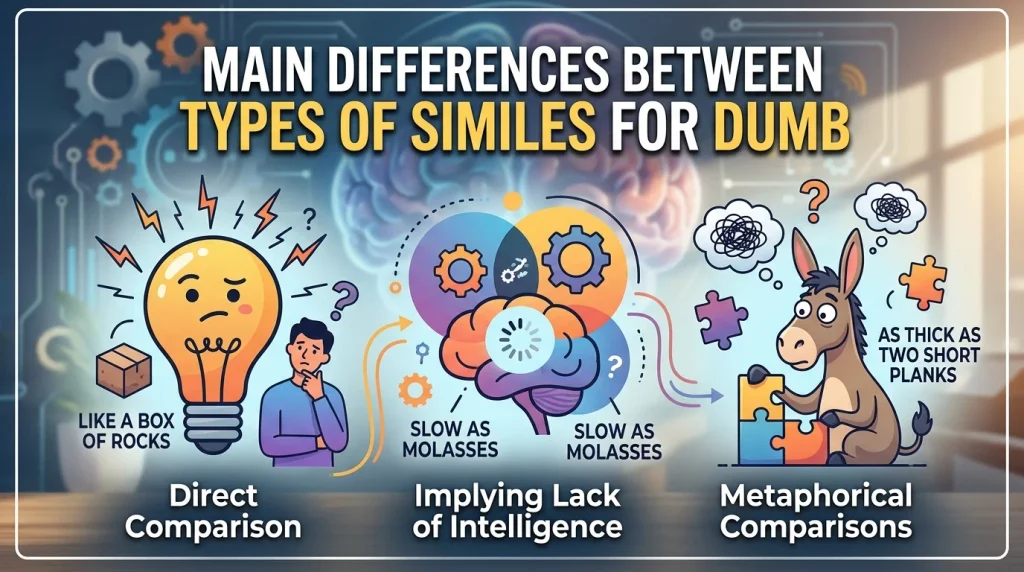
Because “similes for dumb” is a broad category, different expressions communicate different shades of meaning.
| Type of simile | What it suggests | Example | Typical tone |
| Confusion | Someone does not understand | “Like a tourist without a map” | Gentle |
| Poor judgment | Someone makes an unwise decision | “Like bringing a spoon to a sword fight” | Humorous |
| Lack of knowledge | Someone does not know something | “Like a student who skipped every lesson” | Mild |
| Absurdity | An idea makes little sense | “As sensible as wearing a raincoat underwater” | Funny |
| Slow understanding | Someone takes a long time to understand | “Like a computer running on one percent battery” | Playful |
| Carelessness | Someone ignores obvious information | “Like driving with your eyes closed” | Strong |
| Complete foolishness | Extremely poor reasoning | “Like a compass pointing everywhere at once” | Sarcastic |
This distinction matters because dumb, confused, ignorant, careless, and foolish are not exact synonyms.
Someone can be intelligent but temporarily confused. Someone can lack information without being unintelligent. Someone can also make one foolish decision without generally being foolish.
Funny Similes for Dumb
Humorous similes are often useful in casual writing, jokes, stories, and friendly conversation.
Examples include:
- As confused as a cat at a dog show.
- Like a computer with no operating system.
- As lost as a tourist without a map.
- Like a phone with no signal.
- As useful as a chocolate teapot.
- Like bringing a spoon to a sword fight.
- As organized as a sock drawer in a hurricane.
- Like a GPS that forgot where north is.
- As prepared as a penguin in the desert.
- Like trying to charge a phone with a piece of string.
These comparisons are usually less direct than calling someone “dumb.”
Mild Similes for Dumb
If you want to communicate the idea without sounding excessively insulting, choose a comparison focused on confusion or poor judgment.
Examples:
- Like someone reading a map upside down.
- As puzzled as a student seeing a question from an unfamiliar chapter.
- Like a computer waiting for an instruction.
- As confused as someone entering the wrong classroom.
- Like a person looking for glasses while wearing them.
- As uncertain as a compass near a powerful magnet.
These work especially well when the goal is humorous rather than aggressive.
Sarcastic Similes for Dumb
Sarcastic similes exaggerate foolishness for comic effect.
Examples:
- As logical as a square wheel.
- Like using a parachute to go swimming.
- As practical as a refrigerator in Antarctica.
- Like bringing a ladder to dig a hole.
- As clever as locking yourself out and throwing away the key.
- Like searching for your phone while talking on it.
Sarcasm depends heavily on context. A phrase that sounds funny between friends can sound rude in a professional setting.
Creative Similes for Dumb in Writing
Creative writing often benefits from unusual comparisons.
Consider:
“His plan was as sensible as planting an umbrella and expecting rain.”
Or:
“She stared at the equation like a sailor staring at a desert.”
Or:
“His reasoning wandered like a GPS with no satellites.”
These expressions create imagery rather than merely labeling a character as dumb.
Grammar Guide
Similes for dumb are usually built with either “like” or “as…as.”
How Each Term Is Used in Sentences
The most common pattern is:
Subject + be + like + noun phrase
Example:
“He was like a computer with no operating system.”
Another common pattern is:
Subject + be + as + adjective + as + comparison
Example:
“He was as confused as a tourist without a map.”
You can also use similes after verbs:
“She stared at the screen like a confused robot.”
Or use them as part of a longer description:
“The plan sounded as sensible as taking a boat onto a highway.”
Using “Like”
Use like when directly comparing one thing to another.
Pattern:
noun/pronoun + verb + like + noun
Examples:
- “He talks like a broken radio.”
- “She stared like a confused owl.”
- “The computer behaved like a machine with a loose wire.”
Using “As…As”
Use as…as when making a comparison involving an adjective.
Pattern:
subject + be + as + adjective + as + noun
Examples:
- “He was as confused as a lost traveler.”
- “The plan was as foolish as bringing ice to a snowstorm.”
- “She was as puzzled as a student seeing an impossible question.”
Common Mistakes Learners Make
Mistake 1: Treating Every Simile as a Direct Synonym
A simile does not necessarily mean the same thing as dumb.
For example:
“He was like a lost tourist.”
This usually means confused or directionless, not necessarily unintelligent.
Mistake 2: Using “Like” and “As” Incorrectly
Incorrect:
“He was as a computer.”
Better:
“He was like a computer.”
Or:
“He was as confused as a computer with no instructions.”
Mistake 3: Making the Comparison Too Literal
A simile should create a recognizable comparison.
Weak:
“He was like a person.”
This does not communicate much because almost everyone is a person.
Stronger:
“He was like a GPS with no satellite signal.”
Mistake 4: Using Insults in Formal Writing
Calling someone “dumb” or comparing them harshly to something foolish may be inappropriate in academic or professional writing.
Instead, describe the specific issue:
- “The reasoning was unclear.”
- “The decision was poorly considered.”
- “The explanation showed a misunderstanding of the topic.”
Simple Rules to Remember
- Use “like” for direct comparisons.
- Use “as…as” with adjectives.
- Choose the simile according to the exact meaning.
- Use gentle comparisons in sensitive situations.
- Avoid confusing lack of knowledge with lack of intelligence.
- Make sure the comparison is understandable.
- Match the tone to your audience.
Quick Tips for Writing and Speaking
For casual conversation, humorous expressions often sound natural:
“He was like a phone with no signal.”
For creative writing, use vivid imagery:
“His thoughts moved like a car stuck in mud.”
For academic writing, avoid insulting comparisons and explain the actual problem:
“The argument was poorly supported.”
For comedy, exaggeration can work:
“That plan was as practical as using a toaster as a swimming pool.”
When to Use Each One
Use Confusion-Based Similes
Use these when someone does not understand what is happening.
Example:
“He looked as confused as a tourist reading a map upside down.”
This is appropriate when the person is temporarily confused rather than generally unintelligent.
Use Poor-Judgment Similes
Use these when someone has made an obviously unwise decision.
Example:
“That was like bringing a spoon to a sword fight.”
The focus is on the decision, not necessarily the person’s intelligence.
Use Knowledge-Based Similes
Use these when someone does not know the information.
Example:
“He approached the subject like a student who had missed every class.”
This can be more precise than simply calling someone dumb.
Use Absurd Similes
Use these for humor and exaggeration.
Example:
“The plan was as sensible as wearing a raincoat underwater.”
These are particularly useful in creative writing and informal conversation.
When NOT to Use Each One
Avoid harsh similes when discussing someone’s genuine difficulty with learning, disability, or lack of access to information.
For example, saying:
“He is as dumb as a rock.”
may be unnecessarily insulting.
A more precise statement could be:
“He did not understand the instructions.”
Similarly, do not use a confusion-based simile when the actual issue is poor judgment.
Instead of:
“He was like a lost tourist.”
When someone deliberately ignored clear instructions, you might say:
“His decision was as sensible as ignoring a stop sign.”
The more accurately you identify the problem, the better your simile will be.
Similes for Dumb in Different Tones
Friendly
- “Like a phone with no signal.”
- “Like a GPS without satellites.”
- “As confused as a tourist without a map.”
Funny
- “As useful as a chocolate teapot.”
- “Like bringing a spoon to a sword fight.”
- “As sensible as wearing a raincoat underwater.”
Sarcastic
- “As logical as a square wheel.”
- “Like using a ladder to dig a hole.”
- “As organized as a tornado’s desk.”
Gentle
- “As puzzled as a student seeing a new problem.”
- “Like someone reading a map upside down.”
- “As uncertain as a compass near a magnet.”
Strong
- “As sensible as driving with your eyes closed.”
- “Like ignoring a warning sign and walking straight into trouble.”
- “As practical as using a paper umbrella in a storm.”
Which One to Use (Decision Guide)
Use this simple decision process.
If you mean confused:
Choose a simile such as:
“as confused as a lost tourist.”
If you mean uninformed:
Use:
“like a student who missed the lesson.”
If you mean poor judgment:
Use:
“like bringing a spoon to a sword fight.”
If you mean an absurd idea:
Use:
“as sensible as wearing a raincoat underwater.”
If you want a playful insult:
Use:
“like a computer with no operating system.”
If you are writing formally:
Avoid a personal insult and describe the specific problem instead.
For example:
“The decision was poorly considered.”
This is clearer and more professional than:
“The decision was dumb.”
Real-World Practical Examples
Similes for Confusion Examples
- Education: “The student looked as confused as a tourist reading a map upside down when the teacher introduced the new formula.”
- Daily life: “I was like a person searching for their glasses while wearing them.”
- Technology: “The old computer behaved like a machine that had forgotten its instructions.”
- Conversation: “He looked as puzzled as someone who had walked into the wrong meeting.”
- Writing: “The character wandered through the unfamiliar city like a tourist without a map.”
Funny Simile Examples
- Business: “The marketing plan was as organized as a sock drawer in a hurricane.”
- Daily life: “Trying to assemble the furniture without instructions was like bringing a spoon to a sword fight.”
- Technology: “My internet connection is like a phone with no signal.”
- Education: “The question looked as mysterious as a secret code to someone who had skipped the lesson.”
- Conversation: “His explanation was like a GPS that kept sending us in circles.”
Poor-Judgment Simile Examples
- Business: “Investing without reading the contract would be like signing a document with your eyes closed.”
- Education: “Submitting the assignment without checking it was like taking an exam without reading the questions.”
- Daily life: “Leaving the door unlocked all night was like inviting trouble inside.”
- Technology: “Deleting the backup before saving the original file was like throwing away the parachute before jumping.”
- Conversation: “Arguing without knowing the facts is like navigating without a map.”
Absurdity-Based Simile Examples
- Science: “The proposed experiment was as sensible as trying to measure temperature with a ruler.”
- Business: “The strategy was as practical as opening an umbrella underwater.”
- Technology: “Trying to fix the software by turning off the monitor was like repairing a car by washing the windshield.”
- Writing: “His plan was as logical as expecting a shadow to answer a question.”
- Daily life: “Wearing winter clothes on a beach in midsummer was as sensible as carrying a snow shovel to a desert.”
Creative Simile Examples
- Fiction: “His thoughts moved like a computer searching for a file that did not exist.”
- Storytelling: “She stared at the puzzle as if the pieces were speaking another language.”
- Education: “The equation looked like an ancient map with no legend.”
- Technology: “His reasoning was like a GPS without satellites—full of directions but going nowhere.”
- Conversation: “The explanation wandered like a train that had forgotten its destination.”
Self-Assessment (Fill in the Blanks)
Complete each sentence with a suitable simile or expression.
- I will use ________ when referring to someone who is temporarily confused, rather than generally unintelligent.
- I will use ________ when describing a foolish decision humorously.
- I will use ________ when I want a comparison involving the adjective “confused.”
- I will use ________ when describing an idea that makes very little practical sense.
- I will use ________ when I want a playful comparison involving technology.
- I will use ________ when someone does not understand directions.
- I will use ________ when describing poor judgment rather than a lack of knowledge.
- I will use ________ when writing a formal business report about a poorly considered decision.
- I will use ________ when I want to make a humorous comparison with a person who cannot find their way.
- I will use ________ when comparing someone’s reasoning to a device that cannot receive instructions.
- I will use ________ when I want to describe an absurd plan without directly insulting a person.
- I will use ________ when describing a student who does not understand a difficult question.
- I will use ________ when the intended meaning is “unprepared” rather than “unintelligent.”
- I will use ________ when I want a sarcastic comparison involving something impractical.
- I will use ________ when describing someone who ignores obvious information.
- I will use ________ when I want a gentle alternative to directly calling someone dumb.
- I will use ________ when describing an explanation that goes nowhere.
- I will use ________ when the comparison should sound humorous and informal.
- I will use ________ when writing about someone who lacks information about a particular topic.
- I will use ________ when I need to choose between several similes and want the one that best matches the exact meaning.
Answers
- As confused as a lost tourist: because it describes confusion rather than general intelligence.
- Like bringing a spoon to a sword fight: because it humorously represents poor preparation or judgment.
- As confused as a tourist without a map: because “as…as” naturally forms an adjective-based comparison.
- As sensible as wearing a raincoat underwater: because the comparison emphasizes absurdity.
- Like a phone with no signal: because it creates a simple technology-based comparison.
- Like someone reading a map upside down: because the comparison suggests difficulty understanding directions.
- Like bringing a spoon to a sword fight: because the focus is on an inappropriate decision.
- The decision was poorly considered: because professional writing should generally describe the specific problem instead of using an insulting simile.
- As lost as a tourist without a map: because it emphasizes being unable to find the correct direction.
- Like a computer with no operating system: because the computer comparison suggests an inability to function properly.
- As sensible as taking an umbrella underwater: because it criticizes the idea rather than directly labeling the person.
- As puzzled as a student seeing an unfamiliar question: because it focuses on confusion.
- Like a student who skipped every lesson: because it suggests a lack of preparation.
- As practical as a chocolate teapot: because the comparison is intentionally absurd and impractical.
- Like driving with your eyes closed: because it suggests ignoring obvious risks or information.
- Like a phone with no signal: because it is playful and less direct than a personal insult.
- Like a GPS with no destination: because the comparison suggests that the explanation lacks direction.
- Like a computer waiting for an instruction: because it creates a light, informal image.
- Like a student who missed the lesson: because it suggests missing information rather than low intelligence.
- Choose the simile based on meaning, tone, and context: because there is no single correct simile for every situation.
Final Verdict
There is no single “correct” simile for “dumb.” The best choice depends on exactly what you want to communicate.
If the meaning is confusion, use a comparison such as “as confused as a lost tourist.” If the meaning is poor judgment, a phrase such as “like bringing a spoon to a sword fight” works better. If you want to describe an absurd idea, use a comparison such as “as sensible as wearing a raincoat underwater.”
For casual or creative writing, humorous similes can make your language more vivid. For professional, academic, or sensitive situations, it is usually better to describe the specific problem instead of directly calling someone “dumb.”
The key rule is simple: choose the simile that matches the exact meaning you want, and always consider your audience and tone.
Conclusion
Finding the right similes for dumb is really about choosing a comparison that matches the meaning, tone, and situation. Whether you want to describe confusion, poor judgment, lack of knowledge, or an obviously foolish idea, a well-chosen simile can make your writing more colorful and memorable. Expressions such as “as confused as a lost tourist” or “like a computer with no operating system” can communicate an idea without repeatedly using the word “dumb.”
In friendly, creative writing, humorous comparisons often work especially well, while formal or sensitive situations call for more precise, respectful language. Remember that being confused or uninformed does not necessarily mean someone lacks intelligence. The strongest similes focus on the specific behavior or situation you want to describe. By considering meaning, grammar, audience, and tone, you can choose natural, effective similes for conversations, stories, essays, social content, and everyday writing.
FAQs
What is a simile for dumb?
A simile for “dumb” is a creative comparison that describes foolishness, confusion, poor judgment, or lack of understanding. Similes commonly use “like” or “as…as” to create the comparison. For example, “as confused as a lost tourist” describes someone who does not understand what is happening without directly calling that person dumb.
What is a funny simile for dumb?
A funny simile for dumb can be “like a computer with no operating system.” Other playful examples include “as sensible as wearing a raincoat underwater” and “like bringing a spoon to a sword fight.” These expressions use humor and exaggeration to describe confusion or poor judgment without relying on a direct insult.
What is a good simile for someone who is confused?
A useful simile for confusion is “as confused as a lost tourist.” You could also say “like someone reading a map upside down” or “like a GPS without a signal.” These comparisons emphasize uncertainty or confusion rather than suggesting that someone is generally unintelligent.
What is a simile for poor judgment?
A simile for poor judgment could be “like bringing a spoon to a sword fight.” It suggests that someone has chosen an unsuitable approach to a situation. Another example is “like driving with your eyes closed,” which emphasizes ignoring obvious risks or consequences rather than describing someone’s overall intelligence.
Can similes for dumb be used in formal writing?
Some can, but caution is important. Humorous or insulting similes are generally better suited to casual and creative writing. In academic or professional writing, it is usually clearer to describe the specific issue, such as “poorly considered,” “incorrect,” or “based on a misunderstanding,” rather than directly describing someone as dumb.
What is the difference between a simile for dumb and a simile for confused?
A simile for dumb generally suggests foolishness, poor reasoning, or bad judgment, while a simile for confused focuses on difficulty understanding something. For example, “like bringing a spoon to a sword fight” suggests poor judgment, whereas “as confused as a lost tourist” suggests uncertainty or lack of direction.
What are some gentle alternatives to saying someone is dumb?
Gentler alternatives include “confused,” “uninformed,” “mistaken,” “misguided,” “unprepared,” or “unclear.” You can also use a light simile such as “like a phone with no signal.” These choices are often more respectful because they describe a particular situation rather than making a broad judgment about someone’s intelligence.
How do you make a good simile for dumb?
Start by identifying what you actually mean: confusion, poor judgment, lack of knowledge, or an absurd idea. Then choose a familiar image that clearly represents that quality. For example, “as sensible as wearing a raincoat underwater” works for an impractical idea because the comparison is immediately understandable and humorous.
Should I use “like” or “as” in a simile?
Both are correct, but they create different grammatical structures. Use “like” for a direct comparison, such as “He looked like a confused tourist.” Use “as…as” with an adjective, such as “He was as confused as a lost tourist.” The important point is to keep the sentence grammatically natural.
What is the best simile for dumb?
There is no single best simile because the appropriate choice depends on your intended meaning and audience. A confusion-based comparison works when someone does not understand something, while a poor-judgment comparison works for an unwise decision. For formal contexts, precise descriptive language is usually more suitable than an insulting simile.