
Finding the right simile for silence can make writing more vivid, emotional, and memorable. “Similes for silent” are comparisons that describe a person, place, sound, or situation as extremely quiet. This guide explains common silent similes, their meanings, differences, grammar, usage, examples, mistakes, and how to choose the best expression for your writing.
Comparison Overview

The phrase “similes for silent” refers to expressions that compare silence or quietness to something familiar, usually by using “like” or “as.”
For example:
- As silent as the night
- As quiet as a mouse
- As still as a statue
- Silent like a shadow
- Quiet as a whisper
- As silent as the grave
- As quiet as snowfall
- Silent like a sleeping child
Although these expressions all convey quietness, they create different images and emotional effects.
Some suggest complete silence, while others suggest gentle quietness, secrecy, stillness, peacefulness, or tension.
| Simile | Main Meaning | Typical Feeling | Best Context |
| As quiet as a mouse | Very quiet | Gentle, familiar | Everyday writing |
| As silent as the night | Extremely quiet | Peaceful, atmospheric | Descriptive writing |
| As silent as the grave | Completely silent | Dark, serious | Dramatic writing |
| Silent like a shadow | Quiet and unnoticed | Mysterious | Creative writing |
| Quiet as a whisper | Very soft | Gentle, delicate | Conversation and description |
| As still as a statue | Completely motionless | Calm or tense | People and objects |
| Quiet as snowfall | Soft and peaceful | Serene | Poetry and nature writing |
The important point is that silent, quiet, and still are related but not identical.
Definition of “Similes for Silent”
A simile for silent is a figurative comparison used to describe something as very quiet or completely without sound.
A simile commonly uses words such as “like” or “as” to make the comparison.
For example:
The classroom was as silent as the night.
The classroom is not literally the night. Instead, the writer compares its silence to the quietness associated with nighttime.
Another example is:
He moved like a shadow, silent and unnoticed.
This comparison suggests not only quietness but also secrecy and a lack of attention.
What Does “Silent” Mean?
Silent is an adjective meaning without sound or without speaking.
Examples:
- The room was silent.
- She remained silent.
- The audience became silent.
- The machine suddenly went silent.
When writers need to make the idea of silence more vivid, they can replace a simple statement such as “The room was very quiet” with a simile such as:
The room was as silent as a deserted church.
Definition of “Quiet Similes”
Quiet similes are comparisons that describe something as having little or no noise.
The word quiet is broader than silent.
Something can be quiet without being completely silent.
For example:
The library was as quiet as a mouse.
There might still be tiny sounds—pages turning, footsteps, or whispers—but the overall environment is quiet.
By contrast:
The forest was as silent as the grave.
This suggests a much stronger absence of sound.
Definition of “Stillness Similes”
A stillness simile compares something to an object or situation that is motionless.
For example:
He stood as still as a statue.
This sentence primarily describes a lack of movement, not a lack of sound.
A person can be still without being silent, and something can be silent without being still.
For example:
The machine was silent, but its warning light was flashing.
The machine makes no sound, but it is not visually still.
This distinction is important when selecting a simile.
Main Differences Between Silent, Quiet, and Still Similes
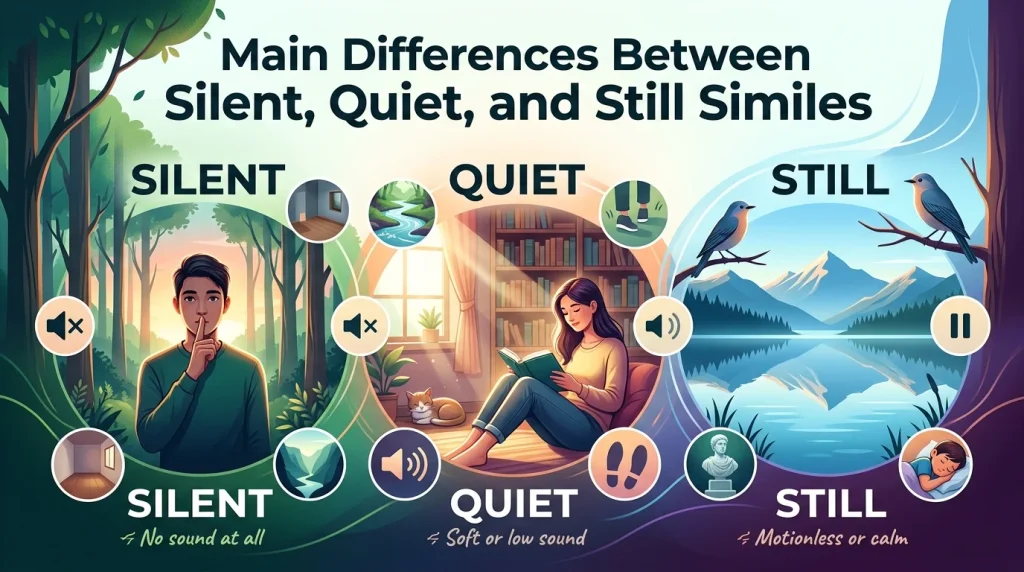
The biggest difference is the exact quality being described.
Silent
Silent focuses on the absence of sound or speech.
The audience was as silent as the grave.
The emphasis is on no sound.
Quiet
Quiet focuses on a low level of sound.
The library was as quiet as a mouse.
There may be some sound, but it is minimal.
Still
Still focuses on a lack of movement.
The soldier stood as still as a statue.
The person may even be breathing or making a tiny sound, but the important detail is that they are not moving.
Shadow-Like Silence
A phrase such as:
She moved like a shadow.
adds another meaning: quietness combined with invisibility or unobtrusiveness.
This can work particularly well in stories and descriptive writing.
Quick Comparison
| Expression | Primary Idea | Sound | Movement | Tone |
| As silent as the night | Silence | None/very little | Not important | Peaceful |
| As quiet as a mouse | Quietness | Very little | Not important | Casual |
| As silent as the grave | Complete silence | None | Not important | Dark/serious |
| Silent like a shadow | Quiet + unnoticed | Very little | Often movement | Mysterious |
| As still as a statue | Stillness | Not important | None | Calm/tense |
| Quiet as a whisper | Very soft sound | Extremely low | Not important | Gentle |
Why Use Similes for Silence?
A plain sentence can communicate information, but a simile can create an image.
Compare:
The room was silent.
with:
The room was as silent as the night.
The second sentence gives the reader a stronger sensory impression.
Similes for silence are particularly useful in:
- Creative writing
- Poetry
- Novels
- Short stories
- Essays
- Speeches
- Descriptive paragraphs
- Songwriting
- Social media captions
- Classroom assignments
- Fictional dialogue
- Mystery and suspense writing
A good simile does more than say something is quiet. It can communicate mood.
For example:
The hallway was as silent as the grave.
This creates a darker atmosphere than:
The hallway was as quiet as a mouse.
Popular Similes for Silence
Here are some commonly useful expressions for describing silence.
As Silent as the Night
This suggests peaceful, deep, or atmospheric silence.
The village was as silent as the night.
As Quiet as a Mouse
This is a familiar expression for someone or something being very quiet.
The children became as quiet as mice when the teacher entered.
As Silent as the Grave
This suggests complete and often serious or unsettling silence.
The abandoned house was as silent as the grave.
Silent Like a Shadow
This suggests someone or something moves without being noticed.
He slipped through the doorway, silent like a shadow.
Quiet as a Whisper
This suggests an extremely soft sound.
Her voice was quiet as a whisper.
As Still as a Statue
This is primarily a simile for stillness, but it can support descriptions of silent situations.
He stood as still as a statue, saying nothing.
Quiet as Snowfall
This creates an image of soft, peaceful quietness.
The garden was quiet as snowfall before sunrise.
Silent as a Sleeping Child
This suggests peaceful and gentle silence.
The house was silent as a sleeping child.
Grammar Guide
Understanding the grammar behind these expressions helps you use them naturally.
The most common patterns are:
as + adjective + as + noun
Examples:
- as silent as the night
- as quiet as a mouse
- as still as a statue
Another common structure is:
verb + like + noun
Examples:
- moved like a shadow
- disappeared like a ghost
- entered like a whisper
How Each Term Is Used in Sentences
Pattern 1: “As silent as…”
Use this structure when describing something with little or no sound.
The classroom was as silent as the night.
Pattern:
Subject + linking verb + as + adjective + as + comparison.
Example:
The street was as silent as the grave.
Pattern 2: “As quiet as…”
Use this when describing something that produces very little noise.
The baby was as quiet as a mouse.
Pattern 3: “As still as…”
Use this when the main idea is lack of movement.
The lake was as still as a mirror.
Pattern 4: “Like a shadow”
Use like to compare an action or manner to another thing.
She walked like a shadow.
This often works especially well with verbs such as:
- move
- walk
- slip
- creep
- disappear
- enter
- leave
Common Mistakes Learners Make
Mistake 1: Confusing “silent” with “still”
Incorrect reasoning:
He was still, so he must have been silent.
Being still means not moving. It does not necessarily mean making no sound.
Better:
He stood as still as a statue.
If you specifically mean no sound:
He remained as silent as the night.
Mistake 2: Using “silent” for a soft sound
If something is making a sound, it is technically not completely silent.
For example, a very soft voice is better described as:
Her voice was quiet as a whisper.
rather than:
Her voice was completely silent.
Mistake 3: Overusing “as silent as the grave”
This phrase is effective but has a serious or dark tone.
For a cheerful scene, something like:
The garden was quiet as snowfall.
may create a more suitable mood.
Mistake 4: Forgetting the comparison
A simile needs a comparison.
Plain:
The room was silent.
Simile:
The room was as silent as the night.
Both are grammatically correct, but only the second uses a simile.
Mistake 5: Using “like” and “as” randomly
Both can introduce comparisons, but sentence structure matters.
He moved like a shadow.
is natural.
He was as silent as the night.
is natural.
Simple Rules to Remember
- Use silent when the focus is on the absence of sound or speech.
- Use quiet when something makes little noise.
- Use still when the focus is on the absence of movement.
- Use as + adjective + as for many traditional similes.
- Use like + noun to describe a similar manner or quality.
- Consider the emotional tone before choosing a simile.
- Do not assume every “quiet” comparison means complete silence.
Quick Tips for Writing and Speaking
For everyday writing, choose familiar expressions:
as quiet as a mouse
For poetry or descriptive writing, choose atmospheric expressions:
as silent as the night
For suspense:
as silent as the grave
For mystery:
silent like a shadow
For peaceful scenes:
quiet as snowfall
For movement:
as still as a statue
The best simile is not necessarily the most dramatic one. It is the one that matches the meaning and mood of the sentence.
When to Use Each One
Use “As Silent as the Night” When…
Use it for:
- Nighttime settings
- Empty streets
- Peaceful landscapes
- Quiet rooms
- Atmospheric descriptions
- Reflective writing
Example:
The city became as silent as the night after the storm passed.
Use “As Quiet as a Mouse” When…
Use it for:
- Children
- Students
- People trying not to make noise
- Libraries
- Casual conversation
- Everyday situations
Example:
The students became as quiet as mice when the principal entered.
Use “As Silent as the Grave” When…
Use it for:
- Suspense
- Horror
- Mystery
- Serious situations
- Abandoned locations
- Dramatic descriptions
Example:
The old building was as silent as the grave.
Use “Silent Like a Shadow” When…
Use it when you want to emphasize:
- Secrecy
- Unnoticed movement
- Mystery
- Stealth
- Quiet actions
Example:
The cat moved silently like a shadow through the hallway.
For formal grammar, “silently like a shadow” or “like a silent shadow” may be more natural depending on the sentence.
Use “As Still as a Statue” When…
Use it when the key idea is:
- No movement
- Frozen attention
- Shock
- Concentration
- Waiting
Example:
He stood as still as a statue during the ceremony.
When NOT to Use Each One
Do Not Use “Silent” When You Mean “Motionless”
If something is not moving but is making noise, silent is inaccurate.
Better:
The machine remained still.
rather than:
The machine remained silent.
If the intended meaning is lack of movement.
Do Not Use “Still” When You Mean “No Sound”
A person can stand still while talking.
Therefore:
She stood as still as a statue.
does not necessarily mean she was silent.
Do Not Use Dark Similes in Cheerful Contexts Without a Reason
“As silent as the grave” can suggest death, fear, or seriousness.
For a peaceful garden, a softer comparison may work better:
The garden was quiet as snowfall.
Do Not Force a Simile Into Every Sentence
Similes are most effective when they add imagery.
Instead of writing:
The silent room was as silent as the night, and the silent chairs were silent too.
Use one strong comparison:
The room was as silent as the night.
Which One to Use: Decision Guide
Choose the expression based on what you want the reader to imagine.
| If You Mean… | Consider Using… |
| Complete absence of sound | As silent as the night |
| Everyday quietness | As quiet as a mouse |
| Dark or dramatic silence | As silent as the grave |
| Quiet and unnoticed movement | Silent like a shadow |
| A very soft sound | Quiet as a whisper |
| No movement | As still as a statue |
| Peaceful natural quiet | Quiet as snowfall |
| Gentle household silence | Silent as a sleeping child |
A simple decision process is:
Step 1: Are you describing sound?
- Yes → consider silent or quiet.
Step 2: Is there absolutely no sound?
- Yes → silent may be the better choice.
Step 3: Is there only a small amount of sound?
- Yes → quiet may be more appropriate.
Step 4: Are you describing movement instead?
- Yes → use still.
Step 5: Do you want a mysterious or secretive feeling?
- Consider silent like a shadow.
Step 6: Do you want a dark or dramatic feeling?
- Consider it as silent as the grave.
Real-World Practical Examples
As Silent as the Night Examples
Education:
The examination hall became as silent as the night when the test began.
Daily life:
The house was as silent as the night after everyone went to bed.
Nature:
The forest was as silent as the night before sunrise.
Writing:
The battlefield became as silent as the night after the soldiers left.
Technology:
The computer suddenly became as silent as the night when the fan stopped.
Business:
The office was as silent as the night during the unexpected holiday.
As Quiet as a Mouse Examples
Education:
The students sat as quiet as mice while the teacher explained the lesson.
Daily life:
The baby became as quiet as a mouse after drinking milk.
Conversation:
He became as quiet as a mouse when everyone looked at him.
Workplace:
The new employee was as quiet as a mouse during the first meeting.
Writing:
The little fox was as quiet as a mouse while hiding in the bushes.
Family life:
The children tried to be as quiet as mice while their parents slept.
As Silent as the Grave Examples
Mystery:
The abandoned mansion was as silent as the grave.
Horror writing:
The hallway was as silent as the grave after the lights went out.
History:
The ancient ruins were as silent as the grave at midnight.
Daily description:
The usually busy street was as silent as the grave during the blackout.
Fiction:
Everyone became as silent as the grave when the mysterious letter was opened.
Dramatic writing:
The audience was as silent as the grave before the announcement.
Silent Like a Shadow Examples
Creative writing:
The stranger moved silently like a shadow through the alley.
Nature:
The owl flew like a shadow across the moonlit sky.
Mystery:
The detective entered like a shadow and watched from the doorway.
Daily life:
She slipped out of the room like a shadow so nobody would notice.
Fiction:
The thief moved like a shadow across the darkened floor.
Conversation:
He came into the room like a shadow and quietly took his seat.
As Still as a Statue Examples
Education:
The students stood as still as statues during the school ceremony.
Art:
The model remained as still as a statue for the painting.
Nature:
The deer stood as still as a statue in the forest.
Daily life:
He stood as still as a statue when he heard the strange noise.
Sports:
The goalkeeper remained as still as a statue before the penalty kick.
Fiction:
The guard stood as still as a statue beside the ancient door.
Self-Assessment: Fill in the Blanks
Choose the expression that best completes each sentence.
- The examination room was __________ when the test began.
- The little boy became __________ when his mother asked him who broke the vase.
- The abandoned house was __________ at midnight.
- The cat moved __________ across the dark room.
- The soldier stood __________ while waiting for orders.
- The village was __________ before sunrise.
- The students were __________ while the baby was sleeping nearby.
- Her voice was __________ because she did not want anyone else to hear.
- The lake was __________, with no visible movement on its surface.
- The theater became __________ before the final announcement.
- If the main idea is “no sound,” I should use a simile for __________.
- If the main idea is “no movement,” I should use a simile for __________.
- “As quiet as a mouse” usually describes __________.
- “As silent as the grave” usually creates a __________ tone.
- “Silent like a shadow” can suggest quietness and being __________.
- “As still as a statue” focuses mainly on __________.
- A person who is speaking very softly can be described as __________ as a whisper.
- A peaceful snowy landscape can be described as __________ as snowfall.
- “The classroom was as silent as the night” uses the adjective __________.
- “He stood as still as a statue” uses the adjective __________.
Answers
- As silent as the night: The sentence describes a place with almost no sound.
- As quiet as a mouse: The comparison describes someone becoming very quiet.
- As silent as the grave: This expression emphasizes deep, often dramatic silence.
- Like a shadow: The comparison emphasizes quiet, unnoticed movement.
- As still as a statue: The key idea is that the soldier is not moving.
- As silent as the night: The comparison fits the deep quietness before sunrise.
- As quiet as mice: The students need to make very little noise.
- Quiet as a whisper: A whisper is extremely soft rather than completely silent.
- As still as a statue: The sentence focuses on the lack of movement.
- As silent as the grave: The expression creates a serious and dramatic feeling.
- Silent: “Silent” focuses on the absence of sound or speech.
- Still: “Still” focuses on the absence of movement.
- Everyday quietness: The expression commonly describes someone or something being very quiet.
- Dark or serious: “As silent as the grave” often has a dramatic or unsettling tone.
- Unnoticed: A shadow can move without attracting attention.
- Lack of movement: “Still” means motionless in this context.
- Quiet: A whisper is very soft.
- Quiet: Snowfall is commonly associated with peaceful, gentle quietness.
- Silent: The sentence describes the absence of sound.
- Still: The sentence describes the person’s lack of movement.
Final Verdict
The best simile for silent depends on the exact meaning and mood you want to communicate.
Use “as silent as the night” for peaceful or atmospheric silence, “as quiet as a mouse” for familiar everyday quietness, and “as silent as the grave” for serious or dramatic silence. Use “silent like a shadow” when quietness is combined with secrecy or unnoticed movement.
Remember that silent means without sound, quiet means having little sound, and still means without movement. Choosing the right simile makes your writing more precise while giving readers a stronger mental picture.
For most beginner-friendly writing, start with “as quiet as a mouse” or “as silent as the night.” For creative writing, select the comparison that best matches the atmosphere rather than simply choosing the most dramatic expression.
Conclusion
Finding the right similes for silent can make simple descriptions much more vivid, expressive, and memorable. Instead of simply saying that something is quiet, a well-chosen simile helps readers picture the scene and understand its mood. Expressions such as “as silent as the night,” “as quiet as a mouse,” “as silent as the grave,” and “silent like a shadow” each create a slightly different feeling.
Some suggest peacefulness, while others communicate mystery, seriousness, secrecy, or complete silence. Remember that silent focuses on the absence of sound, quiet suggests very little sound, and still mainly describes a lack of movement. Choosing the right comparison depends on your sentence, audience, and intended atmosphere.
Whether you are writing an essay, story, poem, conversation, or description, the right simile can make your language more natural and engaging while helping readers clearly understand the feeling you want to express.
FAQs
What is a simile for silent?
A simile for silent is a figurative comparison that describes something as very quiet or completely without sound. Common examples include “as silent as the night,” “as quiet as a mouse,” and “as silent as the grave.” These expressions make descriptions more vivid by comparing silence with something familiar to the reader.
What is the best simile for silent?
There is no single best simile because the ideal choice depends on the context. “As silent as the night” works well for peaceful or atmospheric scenes, while “as silent as the grave” creates a darker, more dramatic feeling. For everyday situations, “as quiet as a mouse” is simple and familiar.
What is a simile for someone who is very quiet?
A common simile for someone who is very quiet is “as quiet as a mouse.” It suggests that the person is making very little noise. For a more creative description, you could say someone is “silent like a shadow,” especially when you want to suggest that the person is quiet and unnoticed.
What does “as silent as the night” mean?
“As silent as the night” means extremely quiet, with little or no noticeable sound. It often creates a peaceful, calm, or atmospheric image. Writers commonly use this expression when describing empty streets, sleeping houses, quiet landscapes, or other settings where nighttime silence creates a strong sense of stillness.
What does “as silent as the grave” mean?
“As silent as the grave” describes extremely deep silence. It often has a serious, mysterious, dramatic, or slightly unsettling tone because a grave is associated with complete quietness. The expression is particularly useful in stories, suspenseful descriptions, mysteries, and situations where the surrounding silence feels unusually intense.
What is the difference between silent and quiet?
Silent generally means that there is no sound or speech, while quiet means that there is very little sound. A library can be quiet even when people are turning pages or whispering. Something described as silent suggests a stronger absence of sound. The appropriate word depends on how much sound is actually present.
What is a simile for moving silently?
A useful simile for moving silently is “silent like a shadow” or “moving like a shadow.” These comparisons suggest that someone or something moves quietly without attracting attention. They are especially effective in creative writing, mystery stories, descriptions of animals, and scenes involving secrecy or unnoticed movement.
Is “as still as a statue” a simile for silent?
“As still as a statue” is a simile, but it primarily describes a lack of movement rather than a lack of sound. Someone can stand as still as a statue while still speaking or making noise. Use this expression when the important idea is that a person or object remains completely motionless.
What is a peaceful simile for silent?
For a peaceful atmosphere, expressions such as “quiet as snowfall” or “as silent as the night” work well. These comparisons create gentle, calm images rather than dramatic ones. They are suitable for nature writing, poetry, descriptive essays, stories, and scenes involving peaceful mornings, quiet gardens, or sleeping surroundings.
How can I use similes for silence in writing?
Use a simile when you want to make silence more vivid or communicate a particular mood. First decide whether the scene is peaceful, mysterious, dramatic, or casual. Then choose a comparison that matches that feeling. For example, use “as quiet as a mouse” for everyday writing and “silent like a shadow” for a mysterious scene.