
Learning similes can make writing more colorful, descriptive, and interesting. A simile compares two different things using words such as “like” or “as.” For students, understanding similes is useful for English assignments, creative writing, reading comprehension, speeches, and everyday communication. This guide explains what similes are, how to use them correctly, common mistakes to avoid, and plenty of easy examples.
Comparison Overview
A simile is a figure of speech that compares two different things to show that they have a similar quality. Similes usually use like or as to make the comparison clear.
For example:
The baby is as quiet as a mouse.
The baby and the mouse are not literally the same. The sentence compares their quietness.
Another example is:
The runner moved like the wind.
The runner does not actually become the wind. The comparison shows that the runner moved very quickly.
Similes are especially useful for students because they help make ordinary sentences more descriptive. Instead of writing:
The water was cold.
A student could write:
The water was as cold as ice.
The second sentence creates a stronger mental picture.
Definition of a Simile
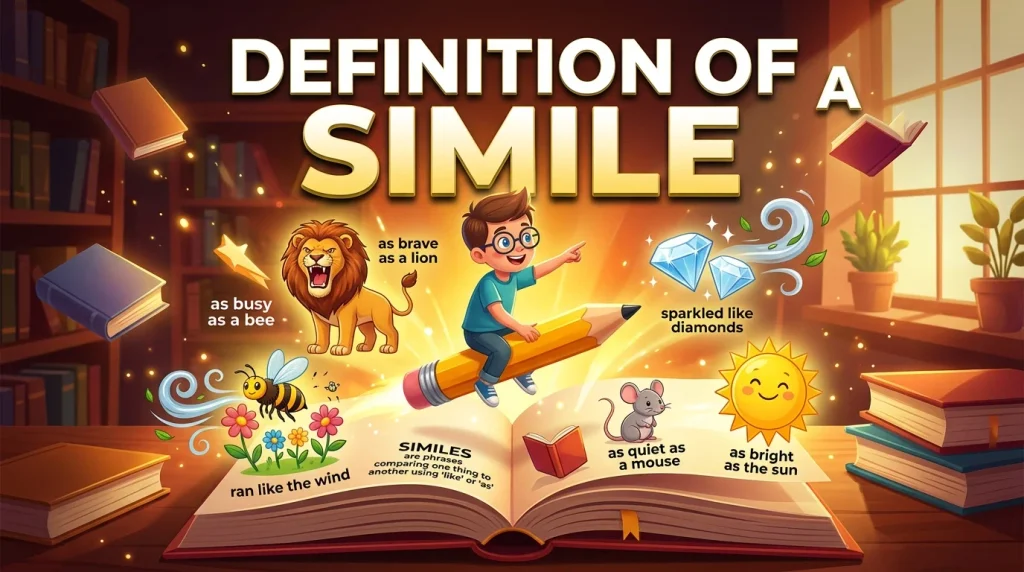
A simile is a figure of speech used to compare two unlike things, people, animals, places, or ideas. The comparison normally includes like or as.
The purpose of a simile is to help readers understand or imagine something more clearly.
Basic Simile Formula
Common patterns include:
Subject + verb + like + noun
Example:
The car moved like a rocket.
Another common pattern is:
Subject + is/was + as + adjective + as + noun
Example:
The classroom was as quiet as a library.
Similes can describe many qualities, including:
- Speed
- Size
- Color
- Strength
- Beauty
- Sound
- Temperature
- Personality
- Movement
- Emotion
Main Differences Between Similes and Ordinary Descriptions
A normal description gives information directly, while a simile explains an idea through comparison.
| Feature | Ordinary Description | Simile |
| Purpose | Gives direct information | Creates a comparison |
| Language | Usually straightforward | Often more imaginative |
| Comparison | Not required | Usually compares two different things |
| Common words | Varies | Often uses “like” or “as” |
| Example | The boy is fast. | The boy is as fast as a cheetah. |
| Effect | Clear and simple | More vivid and memorable |
For example:
Ordinary:
The snow was white.
Simile:
The snow was as white as cotton.
The simile gives the reader a stronger visual image.
Simile vs. Metaphor
Students often confuse similes with metaphors because both compare different things.
A simile usually uses like or as:
Her smile was like sunshine.
A metaphor makes a direct comparison without using like or as:
Her smile was sunshine.
Both can make writing more descriptive, but their grammatical structures are different.
| Simile | Metaphor |
| Uses a direct comparison with like or as | Makes a direct comparison |
| “He is as brave as a lion.” | “He is a lion.” |
| “The clouds looked like cotton.” | “The clouds were cotton.” |
| Often easier for beginners | Can be more imaginative or indirect |
Grammar Guide
A simile is not a particular type of noun or verb. It is a figure of speech or literary device.
A simile can appear inside many different grammatical structures.
For example:
The girl runs like a deer.
Here, runs is the verb, while the simile is like a deer.
Another example:
The cake is as sweet as honey.
Here, sweet is an adjective, and as sweet as honey creates the comparison.
How Each Term Is Used in Sentences
There are several common structures students can use.
Pattern 1: Like + Noun
The baby slept like a log.
The leaves danced like butterflies.
The athlete ran like the wind.
Pattern 2: As + Adjective + As
She is as gentle as a lamb.
The room was as dark as night.
The ice was as cold as snow.
Pattern 3: Verb + Like
He eats like a horse.
The children shouted like excited fans.
The machine worked like a clock.
Pattern 4: Adjective + Like
Her eyes were bright like stars.
The surface felt smooth like glass.
Some writers may prefer “as bright as stars” or “as smooth as glass” depending on the sentence.
Common Mistakes Learners Make
Mistake 1: Forgetting the comparison
Incorrect:
The boy is like very fast.
Better:
The boy is very fast.
Or:
The boy is as fast as a cheetah.
Mistake 2: Using an incomplete “as” structure
Incorrect:
She is as beautiful a flower.
Better:
She is as beautiful as a flower.
Mistake 3: Making the comparison unclear
Weak:
The car was like something.
Better:
The car was like a roaring lion.
A good simile should give the reader a clear idea of what quality is being compared.
Mistake 4: Taking the comparison literally
When someone says:
He runs like the wind.
It does not mean that the person physically becomes wind. It means he runs very quickly.
Mistake 5: Confusing similes with metaphors
She is a star.
This is a metaphor.
She shines like a star.
This is a simile.
Simple Rules to Remember
Students can remember these simple rules:
- A simile compares two different things.
- Like and as are common simile markers.
- The comparison should make sense.
- A simile should help describe an idea, quality, or feeling.
- Do not interpret a figurative comparison literally.
- Avoid comparisons that are so complicated that readers cannot understand them.
- Use similes naturally rather than adding them to every sentence.
Quick Tips for Writing and Speaking
When creating a simile, ask:
What am I describing?
Then ask:
What is similar to it?
For example:
The boy was very nervous.
Think about something that represents nervousness.
The boy was as nervous as a cat in a room full of dogs.
You can also think about the quality you want to emphasize:
- Fast → cheetah
- Bright → sun
- Quiet → mouse
- Strong → ox
- Cold → ice
- Sweet → honey
- Busy → bee
- Light → feather
However, students should choose comparisons that fit the context.
When to Use Similes
Similes are useful in many situations.
In School Assignments
Students can use similes in:
- Essays
- Creative writing
- Stories
- Poems
- Descriptive paragraphs
- Book reports
- Speeches
Example:
The old house stood like a lonely guard at the edge of the village.
In Creative Writing
Similes help readers visualize characters, settings, and actions.
The moon hung in the sky like a silver coin.
In Poetry
Poets often use similes to communicate emotions and images.
Her voice was as soft as falling snow.
In Everyday Conversation
Similes are not limited to literature.
I’m as hungry as a bear.
He sleeps like a baby.
In Descriptive Writing
A simile can make a simple description more vivid.
Instead of:
The ocean was blue.
You could write:
The ocean was as blue as a sapphire.
When NOT to Use Similes
Similes are useful, but they should not appear in every sentence.
Avoid Unnecessary Comparisons
Simple:
The teacher entered the classroom.
There may be no need to add a simile.
Avoid Confusing Comparisons
A comparison should be understandable.
Weak:
The pencil was like an idea in the middle of Tuesday.
The relationship is unclear.
Avoid Too Many Similes
Using several similes in every sentence can make writing feel unnatural.
Instead, choose one strong comparison when it adds meaning.
Avoid Mixed or Contradictory Comparisons
Try not to combine unrelated comparisons confusingly.
For example:
He ran like lightning as slow as a turtle.
The ideas conflict.
Types of Similes Students Should Know
Similes can describe many different qualities.
Similes About Speed
He ran like the wind.
The car moved as fast as a rocket.
Similes About Strength
She was as strong as an ox.
His grip was like a steel clamp.
Similes About Quietness
The classroom was as quiet as a library.
The baby was quiet like a sleeping kitten.
Similes About Brightness
The stars shone like diamonds.
Her eyes were as bright as the morning sun.
Similes About Coldness
The water was as cold as ice.
His hands felt cold like snow.
Similes About Happiness
She was as happy as a child on a holiday.
His face lit up like a sunrise.
Similes About Fear
He was as frightened as a rabbit.
Her heart beat like a drum.
Similes About Beauty
The garden looked like a colorful painting.
The sunset was as beautiful as a work of art.
When to Use “Like” and “As” in Similes
One of the most useful grammar points for students is understanding the difference between common like and as … as structures.
Using “Like”
Use like to compare something with a noun or noun phrase.
Examples:
She sings like a bird.
The clouds look like cotton.
He fights like a warrior.
Using “As … As”
Use as + adjective + as to compare a quality.
Examples:
She is as quiet as a mouse.
The water is as clear as glass.
The box is as heavy as a rock.
A useful pattern is:
like + noun
and
as + adjective + as + noun
Real-World Practical Examples
Simile Examples for Education
- The teacher explained the difficult topic like a guide leading travelers through a forest.
- The classroom was as quiet as a library during the examination.
- The student was as busy as a bee before the final exam.
- Her handwriting was as neat as printed text.
- The textbook was like a map that helped students understand the subject.
Simile Examples for Daily Life
- My little brother sleeps like a log.
- The soup was as hot as fire.
- She smiled like the morning sun.
- The baby was as quiet as a mouse.
- The old man walked as slowly as a turtle.
Simile Examples for Science
- The cell membrane acts like a protective gate.
- Electrons move through some materials like water flowing through a pipe.
- The Earth looks like a blue marble from space.
- A volcano can release material like a giant pressure valve.
- The human brain is sometimes compared to a highly complex computer.
Simile Examples for Business
- The new manager worked like a well-organized machine.
- The company’s sales increased like a rapidly rising wave.
- The meeting was as busy as a marketplace.
- The new employee learned the software like a professional.
- The team worked together like pieces of a puzzle.
Simile Examples for Technology
- The new processor works like a powerful engine.
- A password acts like a key to a digital door.
- The application interface is as simple as a paper form.
- The computer’s cooling system works like a fan in a hot room.
- The internet can spread information like a wave across a huge ocean.
Simile Examples for Writing and Literature
- The moon appeared like a silver coin in the dark sky.
- The old house stood like a forgotten castle.
- Her voice was as soft as a whisper.
- The storm roared like an angry beast.
- His words cut like a sharp knife.
Simile Examples for Conversation
- “I’m as hungry as a bear.”
- “You look as busy as a bee today.”
- “That test was like climbing a mountain.”
- “He runs like the wind.”
- “The room is as cold as ice.”
Simile Examples for Students: Easy Sentences
Here are additional short simile examples that beginners can easily understand:
- The baby is as cute as a button.
- The water is as clear as glass.
- He is as brave as a lion.
- She is as busy as a bee.
- The boy runs like a deer.
- The girl sings like a bird.
- The pillow is as soft as a cloud.
- The road was as straight as an arrow.
- The stars twinkled like diamonds.
- The child slept like a log.
- The cake was as sweet as honey.
- His hands were as cold as ice.
- The soldier stood like a statue.
- The wind howled like a wolf.
- The water flowed like a silver ribbon.
How to Create Your Own Similes
Students can create original similes by following a simple process.
Step 1: Choose Something to Describe
For example:
The student was nervous.
Step 2: Identify the Main Quality
The important quality is nervousness.
Step 3: Think of Something That Represents That Quality
A frightened animal might represent nervousness.
Step 4: Create the Comparison
The student was as nervous as a frightened rabbit.
Step 5: Check the Meaning
Ask whether the comparison makes sense and whether it helps the reader understand the original idea.
Self-Assessment (Fill in the Blanks)
Complete each sentence with a suitable simile or comparison.
- The classroom was as quiet as ______.
- The athlete ran like ______.
- The ice was as cold as ______.
- The stars shone like ______.
- The cake was as sweet as ______.
- The baby slept like ______.
- The soldier stood like ______.
- Her voice was as soft as ______.
- The boy was as busy as ______.
- The water was as clear as ______.
- The old building looked like ______.
- The car moved like ______.
- His hands were as cold as ______.
- The girl’s smile was like ______.
- The storm sounded like ______.
- The pillow was as soft as ______.
- The student was as nervous as ______.
- The computer worked like ______.
- The moon looked like ______.
- The children were as excited as ______.
Answers
There can be more than one correct answer for many similes because students can create original comparisons. The following are sample answers.
- a library: both can be very quiet.
- the wind: the comparison emphasizes speed.
- ice: ice represents extreme coldness.
- diamonds: diamonds suggest brightness and sparkle.
- honey: honey represents sweetness.
- a log: this suggests deep, peaceful sleep.
- a statue: this suggests standing very still.
- a whisper: a whisper is very soft.
- a bee: bees are commonly associated with being busy.
- glass: clear glass allows light to pass through.
- a castle: this can emphasize an old or impressive appearance.
- a rocket: this emphasizes great speed.
- ice: ice represents coldness.
- sunshine: sunshine can suggest warmth and happiness.
- a roaring animal: this emphasizes the loudness of the storm.
- a cloud: clouds can suggest softness.
- a frightened rabbit: this emphasizes fear or nervousness.
- a well-oiled machine: this suggests efficient operation.
- a silver coin: this describes its round, bright appearance.
- children at a birthday party: this emphasizes excitement.
Quick Comparison: Simile and Other Figurative Language
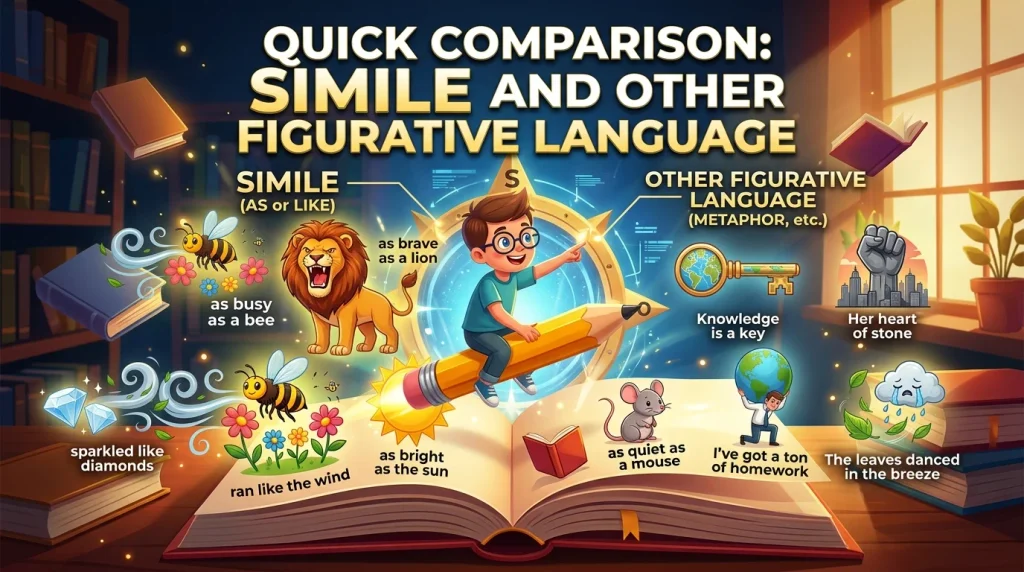
Students may encounter several types of figurative language in English.
| Literary Device | Main Feature | Example |
| Simile | Compares using like/as | She is as busy as a bee. |
| Metaphor | Direct comparison | She is a busy bee. |
| Personification | Gives human qualities to nonhuman things | The wind whispered. |
| Hyperbole | Deliberate exaggeration | I have told you a million times. |
| Alliteration | Repetition of initial sounds | Peter picked purple petals. |
Understanding these differences can help students identify literary devices in reading exercises and use them correctly in their own writing.
Which One to Use (Decision Guide)
Because simile is a specific literary device rather than one of several competing vocabulary terms, the main decision is whether a simile is appropriate for the sentence.
Use a simile when:
- You want to compare two different things.
- You want to make an idea easier to visualize.
- You want writing to sound more descriptive.
- You want to emphasize a particular quality.
- You are writing creatively or descriptively.
- The comparison adds useful meaning.
Use a plain description when:
- The information needs to be precise.
- The comparison would distract from the main point.
- You are writing instructions where clarity is more important than imagery.
- The reader needs a literal fact rather than a figurative expression.
Use a metaphor when you want a more direct comparison without explicitly using “like” or “as.”
Simple Decision Rule
Ask yourself:
Am I comparing two different things to describe a quality?
If yes, a simile may be appropriate.
Then ask:
Can I naturally use “like” or “as” to make the comparison?
If yes, you probably have a simile.
Benefits of Using Similes in Student Writing
Similes can improve writing in several ways.
They Make Writing More Vivid
Compare:
The river was wide.
with:
The river was as wide as a giant road.
The second sentence gives the reader a stronger image.
They Help Explain Difficult Ideas
A complicated idea can sometimes be easier to understand through a familiar comparison.
For example:
The heart works like a pump.
This comparison helps students connect an unfamiliar scientific function with something familiar.
They Make Stories More Interesting
Compare:
The storm was loud.
with:
The storm roared like an angry giant.
The second sentence creates a stronger atmosphere.
They Help Express Emotion
Instead of simply saying:
She was nervous.
A writer might say:
She was as nervous as a rabbit hiding from a fox.
The comparison gives the reader a clearer sense of the emotion.
Common Simile Words and Expressions
Students will frequently encounter these patterns:
- like a lion
- like the wind
- like a bird
- like a rocket
- like a statue
- like a dream
- like a star
- as busy as a bee
- as brave as a lion
- as quiet as a mouse
- as cold as ice
- as sweet as honey
- as white as snow
- as soft as a cloud
- as clear as glass
- as fast as lightning
These familiar comparisons are useful for learning the structure of similes, but students can also create their own original comparisons.
Final Verdict
A simile is a figure of speech that compares two different things, usually with “like” or an “as … as” structure. For students, similes are especially useful for descriptive writing, stories, poems, speeches, classroom assignments, and everyday conversation.
The easiest way to recognize a simile is to look for a comparison between unlike things. For example, “The boy ran like the wind” compares the boy’s speed with the movement of the wind.
When writing your own similes, focus on one clear quality, choose a familiar comparison, and make sure the comparison helps the reader understand your idea. A strong simile should make writing clearer, more vivid, and more memorable—not simply add extra words.
Conclusion
Learning simile examples for students is a simple and effective way to make English writing more descriptive, creative, and engaging. A simile compares two different things, usually with words such as “like” or “as,” to help readers understand an idea more clearly. From “as busy as a bee” to “runs like the wind,” similes can make ordinary sentences more vivid and memorable.
For students, practicing similes can improve creative writing, poetry, storytelling, classroom assignments, speeches, and everyday communication. The key is to choose comparisons that are clear, meaningful, and suitable for the context. Remember that a simile is a comparison, not a literal statement. With regular practice, students can easily recognize similes and create their own original examples. Whether you are learning basic grammar or developing stronger writing skills, understanding similes is a valuable step toward becoming a more confident and expressive writer.
FAQs
What is a simile?
A simile is a figure of speech that compares two different things to highlight a shared quality or characteristic. It commonly uses words such as “like” or “as.” For example, “The baby is as quiet as a mouse” compares the baby’s quietness with that of a mouse. Similes make descriptions clearer, more colorful, and easier to imagine.
What are some easy simile examples for students?
Easy simile examples include “as busy as a bee,” “as cold as ice,” “runs like the wind,” “as white as snow,” and “sings like a bird.” These examples are useful for beginners because their comparisons are familiar and easy to understand. Students can use similar patterns to create original similes in stories, essays, and poems.
What words are commonly used in similes?
The words “like” and “as” are commonly used in similes. A typical pattern with “like” is “He runs like the wind.” A common “as” pattern is “She is as quiet as a mouse.” However, simply using “like” or “as” does not automatically make a sentence a simile; the words must create a meaningful comparison.
What is the difference between a simile and a metaphor?
A simile makes a comparison using words such as “like” or “as,” while a metaphor makes a direct comparison. For example, “She shines like a star” is a simile. “She is a star” is a metaphor. Both forms can make writing expressive, but they use different structures to communicate comparisons.
Why are similes important for students?
Similes help students make their writing more vivid, descriptive, and memorable. They can explain unfamiliar ideas by connecting them to familiar things and can also help express emotions, appearances, sounds, and actions. Using appropriate similes can strengthen creative writing, poetry, descriptive paragraphs, stories, presentations, and other forms of school writing.
How do I create my own simile?
Start by choosing something you want to describe and identify its most important quality. Then think of something familiar that has a similar quality. Finally, connect the two with “like” or an “as … as” structure. For example, if someone is very fast, you might write, “He runs like the wind.”
Can a simile be used in everyday conversation?
Yes, similes are common in everyday speech as well as formal and creative writing. People regularly say things such as “I’m as hungry as a bear” or “He sleeps like a log.” These expressions help listeners quickly understand feelings, actions, or characteristics by connecting them with familiar images.
What is a good simile for describing something beautiful?
A good simile for beauty should create a clear and pleasant image. For example, “The garden was like a colorful painting” compares the garden with artwork. Another example is “Her eyes were as bright as stars.” The best choice depends on what aspect of beauty you want to emphasize, such as color, brightness, shape, or overall appearance.
Can similes be used in academic writing?
Similes can be useful in academic writing when they make a difficult concept easier to understand, particularly in educational or explanatory contexts. For example, a teacher might explain that “a password works like a key.” However, formal academic writing should prioritize accuracy and clarity, so figurative comparisons should be used only when they genuinely support the explanation.
How can students practice using similes?
Students can practice by describing familiar objects, people, places, emotions, and actions with comparisons. Start with simple patterns such as “as ___ as ” and “ like ___.” Reading stories and poems can also help students recognize effective similes. Writing several original comparisons and checking whether each one clearly communicates a quality is excellent practice.