
Similes for friendship use words such as “like” or “as” to compare friendship with something familiar, beautiful, or meaningful. They help writers and speakers explain feelings in a vivid way. This guide explores friendship similes, how they differ from metaphors and literal descriptions, and how to use them naturally in everyday writing and conversation.
Comparison Overview
A simile for friendship is a comparison that usually uses “like” or “as” to describe what a friendship feels like.
For example:
“Our friendship is like a warm blanket on a cold night.”
The friendship is not literally a blanket. The comparison explains that the friendship provides comfort, warmth, and security.
Three common ways to describe friendship are:
| Expression type | How it works | Example |
| Simile | Compares two things using “like” or “as” | “Our friendship is like a lighthouse in the dark.” |
| Metaphor | Directly says one thing is another | “Our friendship is a lighthouse.” |
| Literal description | Describes friendship directly without figurative comparison | “Our friendship gives me support.” |
The primary focus of this article is similes for friendship, including creative examples suitable for essays, poems, cards, social media posts, speeches, and everyday conversations.
Definition of Similes for Friendship
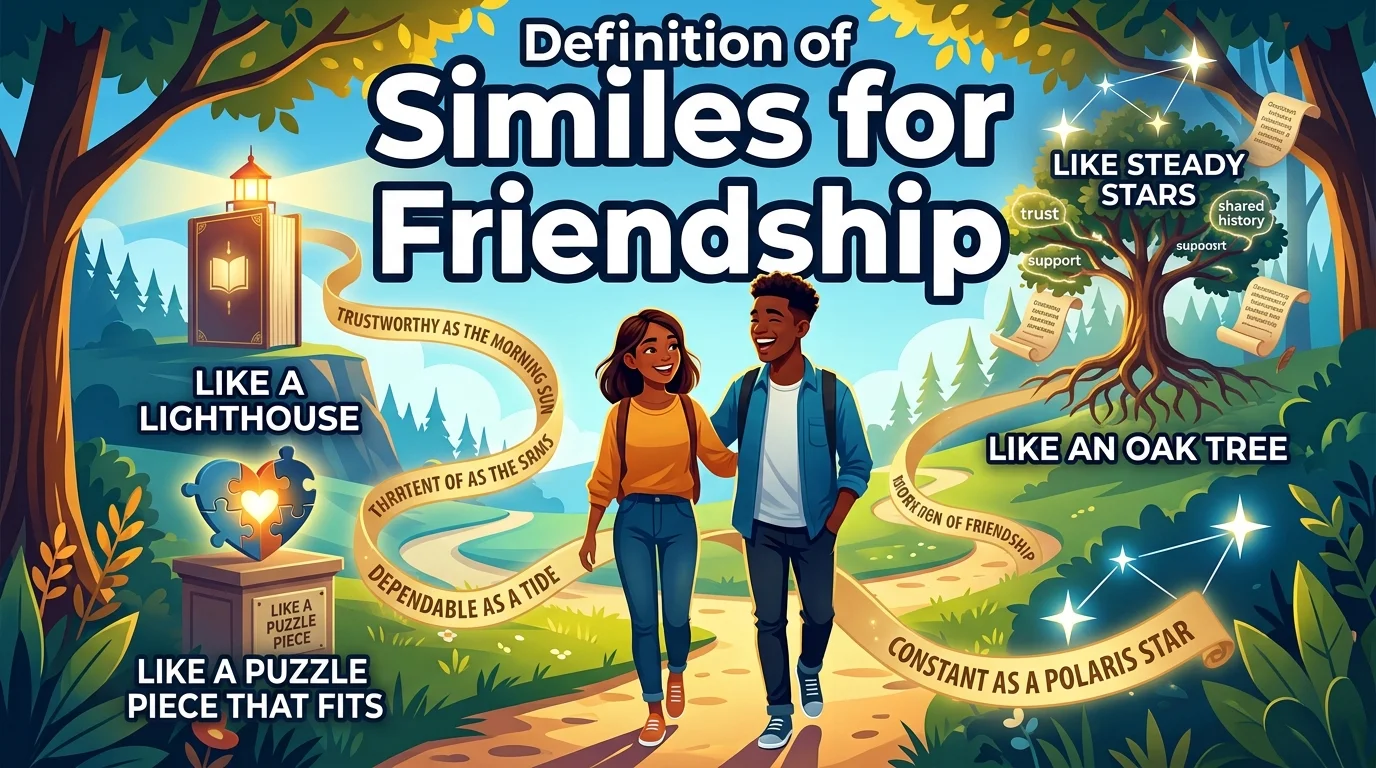
A simile for friendship is a figurative expression that compares friendship to another person, object, place, experience, or natural phenomenon.
The comparison helps communicate an emotion or quality that may be difficult to explain directly.
For example:
“A true friendship is like a tree with deep roots.”
This simile suggests that strong friendships can be stable, dependable, and able to survive difficult conditions.
Common qualities expressed through friendship similes include:
- Loyalty
- Trust
- Support
- Comfort
- Happiness
- Strength
- Understanding
- Growth
- Reliability
- Closeness
- Lasting connection
Basic Simile Pattern
Many friendship similes follow these patterns:
Friendship + is like + comparison
“Friendship is like sunshine.”
Or:
Friendship + is as + adjective + as + comparison
“A loyal friendship is as strong as an oak tree.”
Similes do not have to use only the exact phrase “friendship is like.” They can describe friends and relationships in many different ways.
“She is like a sister to me.”
“My best friend is as dependable as a lighthouse.”
Definition of Metaphors for Friendship
A metaphor for friendship makes a direct comparison without normally using “like” or “as.”
For example:
“Our friendship is a bridge.”
This does not mean the friendship is literally a physical bridge. The bridge represents connection, communication, or bringing people together.
Compare the two:
Simile:
“Our friendship is like a bridge.”
Metaphor:
“Our friendship is a bridge.”
Both communicate a similar idea, but the grammatical structure is different.
Similes generally make the comparison explicit, while metaphors present the comparison more directly.
Definition of Literal Descriptions of Friendship
A literal description explains friendship directly rather than using a figurative comparison.
For example:
“My friend always supports me when I have problems.”
This sentence communicates a clear fact or personal observation. It does not compare friendship to another thing.
A literal description can be useful when clarity is more important than creativity.
For example:
“My best friend listens to me when I am upset.”
A simile could express the same general idea more creatively:
“My best friend is like a safe harbor when life becomes difficult.”
Main Differences Between Similes, Metaphors, and Literal Descriptions
The main difference is how the idea is communicated.
| Feature | Simile | Metaphor | Literal description |
| Main purpose | Creates a comparison | Creates a direct symbolic comparison | Gives direct information |
| Common words | Like, as | Often no comparison word | No figurative comparison required |
| Style | Descriptive and imaginative | Strong and expressive | Clear and straightforward |
| Example | “Friendship is like sunshine.” | “Friendship is sunshine.” | “Friendship makes me happy.” |
| Best for | Creative writing and emotional descriptions | Poetry and expressive writing | Formal or factual communication |
| Meaning | Suggests a similarity | Treats one thing symbolically as another | States the idea directly |
Simile vs. Metaphor
The easiest distinction is:
Simile = comparison with “like” or “as.”
Metaphor = direct comparison.
Examples:
“Their friendship is like a sturdy bridge.” — Simile
“Their friendship is a sturdy bridge.” — Metaphor
Simile vs. Literal Description
A simile adds imagery.
“My friend is like a lighthouse when I feel lost.”
A literal description simply states the idea:
“My friend helps me when I feel lost.”
Both can be correct. The best choice depends on the purpose of the writing.
Types of Similes for Friendship
There are many ways to create a friendship simile. Choosing the right image can make the comparison more meaningful.
Friendship Similes About Strength
These describe friendships that survive challenges.
- Friendship is like an oak tree with deep roots.
- A strong friendship is like a sturdy bridge.
- True friendship is like a mountain that stands through every season.
- A loyal friend is like an anchor in rough water.
- Friendship is like a strong rope that does not easily break.
Friendship Similes About Support
These focus on emotional help and reliability.
- A good friend is like a lighthouse in a storm.
- Friendship is like a hand reaching out when you fall.
- A true friend is like a shelter during heavy rain.
- Friendship is like a safety net beneath a difficult journey.
- A loyal friend is like a steady guide on an unfamiliar road.
Friendship Similes About Happiness
These focus on joy and positive emotions.
- Friendship is like sunshine after rain.
- A best friend is like a favorite song.
- Good friendship is like laughter that never feels forced.
- Friendship is like a bright morning after a long night.
- A true friend is like a spark that makes ordinary days brighter.
Friendship Similes About Trust
- Trust in friendship is like a bridge built one piece at a time.
- A trustworthy friend is like a locked diary.
- Friendship is like a strong foundation beneath a house.
- Trust is like clear water: once polluted, it can be difficult to restore.
- A loyal friendship is like a promise written in permanent ink.
Friendship Similes About Time
- Friendship is like an old photograph that becomes more valuable with time.
- A lasting friendship is like a well-aged book.
- True friendship is like a tree that grows stronger year after year.
- Old friends are like familiar songs from childhood.
- A long friendship is like a road that continues through changing seasons.
Grammar Guide
A simile is primarily a figurative language device, not a particular noun, verb, or adjective.
The words surrounding the simile determine the grammatical structure.
How Each Term Is Used in Sentences
A common structure is:
Subject + linking verb + like + noun phrase
“Our friendship is like a strong bridge.”
Another structure uses as…as:
Subject + be + as + adjective + as + noun
“Our friendship is as strong as an oak tree.”
A simile can also appear after an action:
“We laughed like children.”
Or it can describe a person:
“My best friend is like a sister to me.”
Simile as a Noun Concept
The word simile itself is a noun.
“The writer used a simile to describe friendship.”
Plural:
“The poem contains several similes for friendship.”
The phrase “simile” refers to the literary device, while “similes” refers to more than one.
Common Mistakes Learners Make
Mistake 1: Confusing a simile with a metaphor
Incorrect classification:
“Friendship is a garden” is a simile.
It is normally a metaphor, because it makes a direct comparison.
A simile would be:
“Friendship is like a garden.”
Mistake 2: Forgetting “like” or “as”
When you intend to create a conventional simile, make the comparison clear.
“Friendship is like sunshine.”
rather than:
“Friendship is sunshine.”
The second sentence can still be figurative, but it is a metaphor rather than a simile.
Mistake 3: Creating an unclear comparison
A simile should communicate a recognizable quality.
Weak:
“Friendship is like a chair.”
This could have meaning, but the reader may not understand what quality of a chair is being compared.
Clearer:
“Friendship is like a comfortable chair because it gives you a place to rest when life becomes difficult.”
Mistake 4: Mixing “like” and “as” incorrectly
Not every sentence containing “like” is a simile.
“I like my friend.”
Here, like is a verb meaning to enjoy or appreciate something.
In:
“My friend is like sunshine.”
like introduces a comparison.
Simple Rules to Remember
- A simile makes a comparison.
- Similes commonly use like or as.
- A metaphor usually makes the comparison directly.
- A literal statement gives information without figurative comparison.
- Choose an image that represents the quality you want to express.
- Make sure the comparison is understandable in context.
- Avoid forcing “like” or “as” into a sentence simply to create a simile.
Quick Tips for Writing and Speaking
When writing a friendship simile, first identify the quality you want to describe.
For support, think about:
- Lighthouse
- Shelter
- Anchor
- Safety net
For happiness, think about:
- Sunshine
- Music
- Laughter
- Spring
For strength, think about:
- Oak tree
- Mountain
- Bridge
- Rock
For growth, think about:
- Garden
- Tree
- River
- Journey
This makes it easier to create original and meaningful similes.
When to Use Each One
Use Similes for Friendship When You Want to:
- Make writing more descriptive
- Add emotion to a poem
- Explain an abstract feeling
- Make an essay more engaging
- Write a friendship card
- Create a memorable social media caption
- Describe a character
- Add imagery to a story
- Make a speech more expressive
- Help children understand an abstract idea
For example:
“Friendship is like a garden; it needs care to continue growing.”
This works well because the garden provides a clear image of growth and care.
Use Metaphors When You Want To:
- Make a stronger direct comparison
- Create poetic language
- Develop symbolism
- Make a sentence more dramatic or concise
Example:
“My best friend is my anchor.”
Use Literal Descriptions When You Want To:
- Communicate information clearly
- Avoid ambiguity
- Write formal instructions
- Explain a relationship directly
- Describe an actual event or behavior
Example:
“My friend helped me prepare for the examination.”
When NOT to Use Each One
Do Not Use a Simile When:
- The comparison makes the sentence confusing.
- The context requires strict literal language.
- The comparison distracts from the main point.
- The audience may not understand the reference.
- A simple factual statement would communicate the idea better.
For example, in a formal business report:
“Our friendship is like sunshine.”
may sound inappropriate if the report is supposed to describe a professional relationship objectively.
Do Not Use a Metaphor When:
- The reader needs exact, literal information.
- The metaphor could create ambiguity.
- The writing requires technical precision.
- The audience may misunderstand the symbolic meaning.
Do Not Use a Literal Description When:
A literal statement is not wrong, but it may be less effective when the purpose is creative expression.
For example:
“My friend makes me feel safe.”
is clear.
But:
“My friend is like a safe harbor.”
creates stronger imagery and may be more appropriate for poetry or creative writing.
Which One to Use (Decision Guide)
Use this simple process.
Step 1: Ask What You Want to Do
If you want to compare friendship to something else, use a simile or metaphor.
If you simply want to state information, use a literal description.
Step 2: Decide Whether You Want an Explicit Comparison
Use a simile when you want to say:
“Friendship is like…”
Use a metaphor when you want to say:
“Friendship is…”
Step 3: Choose the Right Image
Think about the quality you want to communicate.
| Quality | Possible friendship simile |
| Strength | “like an oak tree” |
| Support | “like a lighthouse” |
| Comfort | “like a warm blanket” |
| Happiness | “like sunshine” |
| Trust | “like a strong foundation” |
| Growth | “like a garden” |
| Loyalty | “like an anchor” |
| Connection | “like a bridge” |
| Guidance | “like a compass” |
| Stability | “like a mountain” |
Quick Decision Formula
Want a comparison? → Use figurative language.
Want “like” or “as”? → Use a simile.
Want a direct comparison? → Use a metaphor.
Want maximum clarity? → Use a literal description.
Real-World Practical Examples
Similes for Friendship Examples
- Education:
“A good study partner is like a compass because they help you stay focused on your goals.” - Daily life:
“My best friend is like a warm cup of tea after a stressful day.” - Science-inspired writing:
“A strong friendship is like gravity because it keeps people connected.” - Business:
“A successful professional friendship is like a bridge between different areas of expertise.” - Creative writing:
“Their friendship was like a small flame that survived even the strongest winds.” - Technology:
“Our friendship is like a reliable internet connection—it keeps us connected even when we are far apart.” - Conversation:
“You are like family to me.” - Poetry:
“Friendship is like moonlight, quietly brightening the darkest nights.” - Social media:
“Friends are like stars; even when you cannot see them, they can still be there.” - Speech:
“A true friend is like a lighthouse, offering direction when the path ahead becomes difficult.”
Metaphor Examples for Friendship
- Education:
“My study partner is my compass.” - Daily life:
“My best friend is my safe harbor.” - Creative writing:
“Their friendship was an unbreakable bridge.” - Business:
“Trust is the foundation of their professional relationship.” - Poetry:
“Friendship is a garden that grows through care.” - Technology:
“Our friendship is a connection that never goes offline.” - Conversation:
“You are my rock.” - Speech:
“A good friend is a guiding light.” - Storytelling:
“Their friendship became an anchor during difficult years.” - Social media:
“Friends are the colors that brighten the canvas of life.”
Literal Friendship Examples
- Education:
“My friend helps me understand difficult lessons.” - Daily life:
“We talk every evening.” - Business:
“Our professional relationship is based on mutual trust.” - Conversation:
“She always listens when I need advice.” - Writing:
“They have been friends since childhood.” - Technology:
“We stay in contact through video calls.” - Family and relationships:
“He supports his friend during difficult situations.” - School:
“The two students work together on their projects.” - Community:
“The friends regularly volunteer together.” - Personal reflection:
“My friendship with her has become stronger over the years.”
20 Self-Assessment Fill-in-the-Blanks
Complete each sentence with the most appropriate term or expression.
- I will use ______ when comparing friendship to something else with “like” or “as.”
- The sentence “Friendship is like a garden” contains a ______.
- I will use a ______ when I want to make a direct comparison without normally using “like” or “as.”
- “My friend is my anchor” is an example of a ______.
- “My friend is like an anchor” is an example of a ______.
- I will use a literal description when I want to communicate information ______.
- “A true friend is like a lighthouse” compares friendship with a source of ______.
- The word “simile” is a ______.
- The plural form of “simile” is ______.
- “Friendship is like sunshine” uses the word ______ to introduce the comparison.
- “Our friendship is as strong as an oak tree” uses the ______ structure.
- If I write “My friend helps me when I am sad,” I am using a ______ description rather than a figurative comparison.
- “Friendship is a bridge” is generally a ______ because the comparison is direct.
- If I want to describe emotional support creatively, I could say “A good friend is like a ______ in a storm.”
- If I want to describe friendship that grows over time, I could compare it to a ______.
- “I like my friend” uses “like” as a ______.
- “My friend is like sunshine” uses “like” to make a ______.
- For a formal report requiring precise factual information, a ______ description may be more appropriate.
- A good friendship simile should make the intended ______ clear.
- If I want an imaginative comparison using “like,” I should choose a ______.
Answers
- Simile: because a simile compares two things, commonly using “like” or “as.”
- Simile: “like a garden” creates an explicit comparison.
- Metaphor: a metaphor normally presents a direct comparison.
- Metaphor: “my friend is my anchor” directly compares the friend to an anchor.
- Simile: “like an anchor” explicitly signals the comparison.
- Directly / clearly: literal descriptions communicate information without relying on figurative imagery.
- Guidance or support: a lighthouse can symbolize direction and safety.
- Noun: “simile” names a type of figurative-language device.
- Similes: this is the plural form.
- Like: “like sunshine” introduces the comparison.
- As…as: “as strong as an oak tree” follows this common simile structure.
- Literal: the sentence directly describes what the friend does.
- Metaphor: “is a bridge” makes a direct comparison.
- Lighthouse: a lighthouse can symbolize guidance and support.
- Tree or garden: either can represent growth over time.
- Verb: in “I like my friend,” “like” means to enjoy or appreciate.
- Comparison: “like sunshine” compares the friend with sunshine.
- Literal: direct language is often clearer when precision is required.
- Meaning or comparison: readers should be able to understand the quality being compared.
- Simile: a simile commonly uses “like” or “as” to make an explicit comparison.
Final Verdict
Similes for friendship are useful when you want to make the idea of friendship vivid, emotional, and memorable. A simile normally uses “like” or “as”, such as “Friendship is like a garden” or “A true friend is as reliable as an anchor.”
A metaphor makes the comparison more directly, such as “Friendship is a garden.” A literal description simply states the idea, such as “Friendship requires care and trust.”
The easiest rule is:
Simile = comparison using “like” or “as.”
Metaphor = direct comparison.
Literal description = straightforward information.
When writing about friendship, choose the form that matches your purpose. Use similes for friendship when you want imagery and emotion, metaphors when you want a stronger symbolic comparison, and literal descriptions when clarity and precision matter most.
Conclusion
Similes for friendship are a simple yet powerful way to turn ordinary descriptions into warm, memorable expressions. By comparing friendship to familiar things such as sunshine, a lighthouse, a tree, a bridge, or an anchor, you can communicate feelings of trust, loyalty, comfort, strength, and happiness more vividly.
Whether you are writing a school essay, poem, greeting card, speech, social media caption, or personal message, the right friendship simile can make your words feel more meaningful. Remember that a simile commonly uses “like” or “as” to create a clear comparison, while a metaphor makes the comparison directly. The best similes are natural, easy to understand, and connected to the feeling you want to express. With a little creativity, you can use similes for friendship to describe the special relationships that make life brighter, stronger, and more enjoyable.
FAQs
What is a simile for friendship?
A simile for friendship is a figurative comparison that describes friendship by comparing it with something familiar. It commonly uses “like” or “as.” For example, “Friendship is like a garden” suggests that friendship needs attention and care to grow. Similes make descriptions of friendship more vivid, emotional, and memorable in both creative and everyday writing.
What is a good simile for friendship?
A good simile for friendship depends on the quality you want to express. “Friendship is like sunshine” can represent happiness, while “friendship is like an anchor” can represent stability and support. “Friendship is like a garden” can suggest growth and care. The strongest simile is one whose comparison clearly matches the intended feeling or idea.
What are some short similes for friendship?
Short friendship similes include “like sunshine,” “like a warm blanket,” “like a lighthouse,” “like an anchor,” “like a sturdy bridge,” and “like a growing tree.” These expressions are easy to use in captions, cards, poems, speeches, and conversations. Each comparison can represent a different quality, such as happiness, comfort, guidance, loyalty, connection, or growth.
How do you write a simile about friendship?
Start by deciding what quality of friendship you want to describe, such as trust, happiness, support, or loyalty. Then choose something that represents that quality and connect the two with “like” or “as.” For example, if you want to express support, you could write, “A true friend is like a lighthouse during a storm.”
Is “friendship is like a garden” a simile?
Yes, “friendship is like a garden” is a simile because it explicitly compares friendship with a garden using the word “like.” The comparison suggests that friendships require care, patience, attention, and time to flourish. Without “like,” the sentence “friendship is a garden” would generally be classified as a metaphor instead.
What is the difference between a simile and a metaphor about friendship?
A simile usually makes an explicit comparison using “like” or “as,” while a metaphor makes a direct comparison. For example, “Friendship is like a bridge” is a simile, whereas “Friendship is a bridge” is a metaphor. Both can communicate connection, but they use different grammatical structures and create slightly different styles.
Can similes for friendship be used in essays?
Yes, similes for friendship can be effective in essays, especially when the writing includes personal reflection, creative description, or literary analysis. They can make an idea easier to visualize and add emotional depth. However, in highly formal or technical writing, use them carefully so they support the main point without making the explanation unnecessarily vague.
What is a simile for a best friend?
A best friend can be compared to something that represents trust, comfort, or support. For example, “My best friend is like a safe harbor” suggests that the friend provides comfort during difficult times. Other possibilities include “like a lighthouse,” “like sunshine,” or “like an anchor,” depending on the particular quality you want to emphasize.
Why are similes useful when describing friendship?
Similes make abstract emotions easier to understand by connecting them to familiar images. Instead of simply saying that a friendship is supportive, you might say, “A true friend is like a lighthouse in a storm.” This gives readers a visual image while communicating the emotional meaning of friendship naturally and memorably.
Can I create my own similes for friendship?
Absolutely. Creating original similes can make your writing more personal and distinctive. Think about what your friendship feels like and choose an image that captures that feeling. For example, if your friend makes difficult days easier, you might write, “Your friendship is like a window letting sunlight into a dark room.” The comparison should feel natural and meaningful.