
“Annual,” “yearly,” and “every year” all relate to something happening once a year, so they often seem interchangeable. However, they differ in grammar, style, and the situations where they sound most natural. Understanding these small differences can help you write clearer emails, reports, academic work, business documents, and everyday English with greater confidence.
Comparison Overview
Annual, yearly, and every year all refer to one year or something that happens once a year. The main difference is how they function grammatically and how formal or natural they sound in a sentence.
| Term | Main function | Basic meaning | Typical style |
| Annual | Adjective; sometimes noun | Happening once a year; relating to a year | Formal, professional |
| Yearly | Adjective or adverb | Happening once a year; relating to a year | Neutral, general |
| Every year | Adverbial phrase | Once in each year | Natural, conversational |
For example:
- Annual meeting = a meeting held once a year.
- Yearly meeting = a meeting held once a year.
- We meet every year. = the meeting happens once each year.
The meaning can overlap, but the grammatical position is often what determines which expression you should use.
Definition of Annual

Annual is primarily an adjective meaning “happening once every year” or “relating to a year.”
It is particularly common in formal, professional, academic, financial, and organizational English.
Examples of annual
- annual report
- annual meeting
- annual salary
- annual budget
- annual examination
- annual rainfall
- annual subscription
For example:
The company published its annual report in March.
Here, annual describes the noun “report.”
The word can also refer to something measured over a period of one year:
The annual growth rate was 5%.
Annual as a noun
Annual can also function as a noun, although this use is less common in everyday English.
For example, an annual can refer to a publication produced once a year, such as a yearbook or special yearly publication.
The school published its annual.
In ordinary modern English, however, you will much more often see annual used as an adjective.
Definition of Yearly
Yearly means happening once a year or occurring each year.
Unlike annual, it can work as both an adjective and an adverb.
Yearly as an adjective
When used as an adjective, yearly describes a noun.
We conduct a yearly review of our policies.
The company gives employees a yearly bonus.
She receives a yearly allowance.
Yearly as an adverb
Yearly can also describe how frequently an action happens.
The conference is held yearly.
The machine is inspected yearly.
This makes yearly more grammatically flexible than annual in many everyday situations.
However, “every year” is often more natural in conversational English.
Definition of Every Year
Every year is a two-word adverbial phrase meaning once in each year or each year.
It describes the frequency of an action or event.
We visit our grandparents every year.
The festival takes place every year.
Prices increase every year.
Unlike annual, “every year” does not normally function as an adjective directly before a noun.
You would say:
We have an annual meeting.
Not:
We have an every year meeting.
Instead, you could say:
We have a meeting every year.
This grammatical distinction is one of the easiest ways to decide between the expressions.
Main Differences Between Annual, Yearly, and Every Year
Although all three can describe yearly frequency, their grammatical roles and typical contexts differ.
1. Difference in grammar
Annual is normally an adjective.
annual event
Yearly can be an adjective or an adverb.
yearly event
The event happens yearly.
Every year functions as an adverbial phrase.
The event happens every year.
2. Difference in formality
Annual generally sounds more formal.
The organization publishes an annual report.
Yearly is more neutral.
The organization publishes a yearly report.
Every year is especially natural in ordinary speech.
The organization publishes a report every year.
All three sentences can communicate essentially the same idea.
3. Difference in sentence structure
The position of the expression often determines your choice.
Before a noun:
annual conference
yearly conference
After a verb:
The conference happens every year.
The conference happens yearly.
But:
The conference happens annually.
4. Difference in naturalness
In many conversational contexts, every year sounds more natural than yearly.
For example:
I go there every year.
I go there yearly, but it sounds somewhat less conversational
In formal writing, however, annual is often preferred:
The company conducts an annual audit.
Annual vs Yearly: Are They Synonyms?
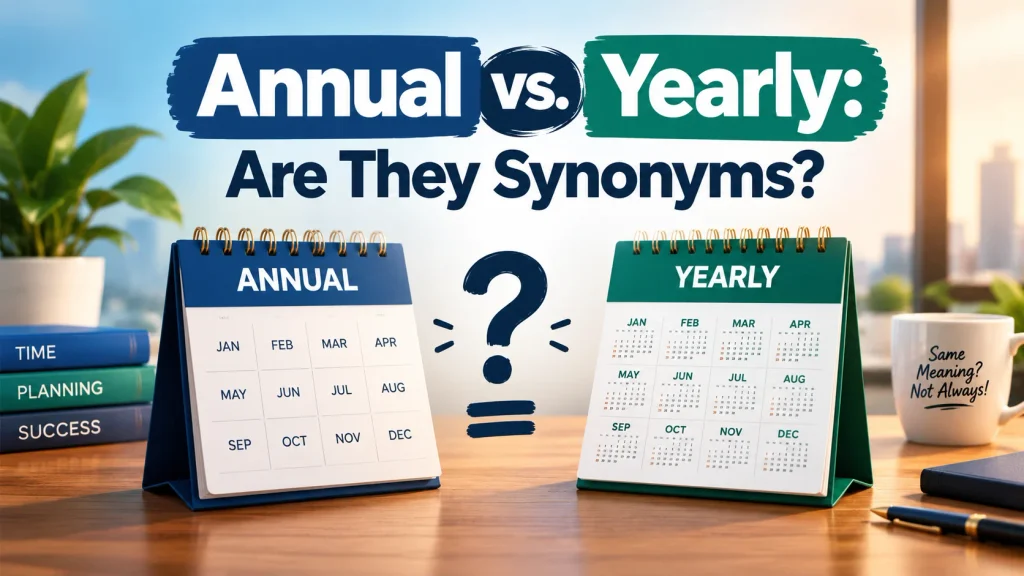
In many contexts, yes.
Both can mean something that happens once a year.
Compare:
The company holds an annual conference.
The company holds a yearly conference.
The basic meaning is the same.
However, annual is often preferred in established expressions and formal terminology.
For example:
- annual report
- annual income
- annual leave
- annual meeting
- annual examination
- annual budget
- annual percentage rate
“Yearly” is grammatically possible in some of these contexts, but it may sound less conventional or less formal.
Yearly vs Every Year: Are They the Same?
They can be very close in meaning, especially when describing frequency.
The event occurs yearly.
The event occurs every year.
Both mean that the event occurs once each year.
The major difference is grammatical structure and style.
Yearly can directly modify a noun:
yearly payment
Every year cannot normally modify a noun directly:
every year payment
Instead:
payment every year
For everyday conversation, every year is frequently the simplest choice.
Annual vs Every Year
These expressions often communicate the same idea but use different sentence structures.
Compare:
The company conducts an annual review.
The company conducts a review every year.
The first uses annual as an adjective before “review.” The second uses every year as an adverbial phrase describing when the review occurs.
A useful transformation is:
annual examination → examination every year
festival → festival every year
payment → payment every year
Grammar Guide
Understanding the grammatical role of each expression makes the difference much easier.
How each term is used in sentences
Annual
Pattern:
annual + noun
Examples:
annual meeting
annual income
annual report
annual inspection
You can also use forms such as:
The annual meeting is scheduled for June.
Here, “annual” modifies “meeting.”
Do not normally use annual as an adverb:
The company reviews its policies annual.
Use:
The company reviews its policies annually.
or:
The company reviews its policies every year.
Yearly
As an adjective:
yearly + noun
Example:
We receive a yearly statement.
As an adverb:
verb + yearly
Example:
We receive a statement yearly.
Although the adverbial use is grammatically correct, “every year” may sound more natural in ordinary conversation.
Every year
Pattern:
subject + verb + every year
Examples:
We travel every year.
She renews her membership every year.
The school holds a competition every year.
It can also appear at the beginning:
Every year, thousands of visitors attend the festival.
Common mistakes learners make
Mistake 1: Using “annual” as an adverb
The company meets annual.
Better:
The company meets annually.
Or:
The company meets every year.
Mistake 2: Using “every year” directly before a noun
We attended an every year conference.
Better:
We attended an annual conference.
Or:
We attended a conference every year.
Mistake 3: Confusing “annual” with “annually”
Annual is generally an adjective.
an annual event
Annually is an adverb.
The event occurs annually.
Mistake 4: Assuming “yearly” is always better than “annual”
“Yearly” is correct in many cases, but established formal expressions often use annual.
annual report
is generally more conventional than:
yearly report
Mistake 5: Thinking “every year” is one word
The expression is:
every year
Not:
everyyear
Simple rules to remember
Use these four rules:
- Annual + noun
- annual report
- annual meeting
- Yearly + noun OR after a verb
- yearly report
- happens yearly
- Every year = frequency phrase
- happens every year
- I visit every year
- Annually = adverb
- happens annually
A simple memory trick is:
Annual describes; every year tells when.
Quick tips for writing and speaking
For formal documents, annual is often a good choice.
The annual financial report is available online.
For everyday conversation, every year is usually straightforward and natural.
We go there every year.
For a neutral alternative, yearly can work well.
We conduct a yearly review.
When describing something directly before a noun, choose annual or yearly, not “every year.”
describing how often an action occurs, use every year, yearly, or annually.
When to Use Each One
Use annual when:
- you are writing formally;
- you are describing a recurring event;
- you are discussing business or finance;
- you are writing an academic or professional document;
- the word comes directly before a noun.
Examples:
annual report
conference
examination
revenue
maintenance
When to use Yearly
Use yearly when:
- you want an adjective meaning “once a year”;
- you want a neutral alternative to “annual”;
- you need an adverb meaning “once a year”;
- the context is not particularly formal.
Examples:
yearly payment
yearly review
The equipment is checked yearly.
When to use Every Year
Use every year when:
- you are talking about frequency;
- you are speaking conversationally;
- you want especially clear, simple English;
- the phrase follows an action or event.
Examples:
We celebrate it every year.
She visits her family every year.
The company updates the software every year.
When NOT to Use Each One
When not to use Annual
Don’t use annual by itself as an adverb.
The festival occurs annual.
Use:
The festival occurs annually.
or:
The festival occurs every year.
When not to use Yearly
Avoid yearly when a standard formal term is clearly more conventional.
For example:
annual report
is generally preferable in formal corporate writing to:
yearly report
This does not mean “yearly report” is necessarily grammatically wrong; it is mainly a matter of conventional usage and register.
When not to use Every Year
Don’t put every year directly before a noun as though it were an adjective.
every year conference
Use:
annual conference
or:
yearly conference
Alternatively:
conference every year
Which One to Use (Decision Guide)
Use this quick decision process:
Are you describing a noun?
- Yes → annual or yearly
- Example: annual meeting
Are you saying how often something happens?
- Yes → every year, yearly, or annually
- Example: The meeting happens every year.
Is the writing formal or professional?
- Annual is often the conventional choice.
- Example: annual financial statement
Are you having an ordinary conversation?
- Every year is usually a simple, natural choice.
- Example: I visit my family every year.
Do you want an adjective but don’t need a particularly formal tone?
- Yearly works.
- Example: yearly subscription
Quick decision table
| What you mean | Recommended expression | Example |
| Describe a formal yearly event | Annual | annual conference |
| Describe a yearly amount | Annual | annual income |
| Describe a recurring noun informally | Yearly | yearly payment |
| Say something happens once each year | Every year | We meet every year. |
| Say something happens once each year formally | Annually | We meet annually. |
Real-World Practical Examples
Annual Examples
- Business:
The company released its annual report last month. - Education:
Students must complete the annual examination before the end of the academic year. - Finance:
The bank charges an annual fee for the account. - Science:
Researchers calculated the area’s annual rainfall. - Technology:
The software receives an annual security review. - Professional writing:
Employees attend an annual training session. - Events:
The city hosts an annual cultural festival. - Employment:
Her annual salary increased after the promotion.
Yearly Examples
- Daily life:
We have a yearly family gathering. - Business:
The company performs a yearly review of its policies. - Education:
The school publishes a yearly calendar. - Technology:
The application receives a yearly update. - Finance:
Customers receive a yearly statement. - Science:
The researchers record the species’ yearly population changes. - Frequency:
The equipment is inspected yearly. - Conversation:
We usually travel abroad yearly.
Every Year Examples
- Daily life:
We visit our relatives every year. - Education:
The school organizes a science fair every year. - Business:
The company reviews its expenses every year. - Science:
Scientists measure the glacier’s movement every year. - Technology:
I replace my phone’s battery every year. - Travel:
Thousands of tourists visit the region every year. - Conversation:
“Do you come here often?”
“Yes, I come here every year.” - Writing:
The organization publishes a new report every year.
Self-Assessment (Fill in the Blanks)
Complete each sentence with annual, yearly, or every year.
- The company publishes an ______ report for its shareholders.
- We visit our hometown ______.
- The school conducts a ______ examination in December.
- She receives a ______ bonus from her employer.
- The festival takes place ______ in the spring.
- The bank charges an ______ maintenance fee.
- I renew my membership ______.
- The organization conducts a ______ review of its policies.
- The machine is inspected ______.
- Thousands of people attend the event ______.
- The company announced its ______ revenue figures.
- We have a ______ family reunion.
- The museum holds an exhibition ______.
- Employees receive an ______ performance review.
- The software is updated ______.
- The university publishes an ______ report.
- The farmers measure rainfall ______.
- The club organizes a ______ sports competition.
- She travels to that city ______.
- The government releases an ______ economic report.
Answers
- annual: It directly describes the noun “report.”
- every year: It describes how often the action “visit” occurs.
- annual: It directly modifies “examination.”
- yearly: It functions as an adjective describing “bonus.”
- every year: It expresses the frequency of the festival.
- annual: “Annual fee” is a standard formal expression.
- every year: It describes the frequency of “renew.”
- annual: It directly describes the noun “review.”
- yearly: It is functioning as an adverb describing when the inspection occurs.
- every year: It expresses frequency.
- annual: “Annual revenue” is a conventional business expression.
- yearly: It functions as an adjective before “family reunion.”
- every year: It describes how frequently the museum holds the exhibition.
- annual: “Annual performance review” is a conventional professional expression.
- yearly: It functions as an adverb modifying “updated.”
- annual: “Annual report” is the conventional formal expression.
- every year: It clearly expresses the frequency of measurement.
- yearly: It modifies the noun “sports competition.”
- every year: It describes the frequency of traveling.
- annual: “Annual economic report” uses the adjective before the noun.
Final Verdict
Annual, yearly, and every year can all express the idea of something happening once each year, but they are not always interchangeable in a sentence.
The simplest rules are:
- Annual → usually an adjective, especially common in formal and professional English: annual report.
- Yearly → adjective or adverb: yearly payment, reviewed yearly.
- Every year → adverbial phrase expressing frequency: We review it every year.
If you are describing a noun, choose annual or yearly. If you are saying how often an action happens, every year is a clear and natural choice.
One final distinction is especially important: annual ≠ annually. “Annual” is generally an adjective, while “annually” is an adverb. Thus, write “an annual meeting” but “the meeting occurs annually.”
In short, there is usually no major difference in the basic time meaning. The key difference is grammar, formality, and sentence structure.
Conclusion
Understanding annual vs. yearly vs. every year becomes much easier when you consider both meaning and grammar. All three expressions are connected with something happening once a year, but they fit into sentences differently. Annual is mainly an adjective and is especially common in formal, professional, academic, and business expressions such as “annual report” or “annual meeting.” Yearly can work as both an adjective and an adverb, making it a flexible alternative in many situations.
Every year is an adverbial phrase and is particularly natural when talking about how frequently an action happens, such as “We travel every year.” Choosing the right expression is therefore less about changing the meaning and more about matching the word to the sentence structure and tone. Once you remember these simple patterns, you can use annual, yearly, and every year confidently in everyday conversations and formal writing.
FAQs
Is annual the same as yearly?
In many contexts, annual and yearly have essentially the same meaning: something that happens once a year or relates to a year. The main difference is style and usage. “Annual” is more common in formal or professional expressions, such as “annual report,” while “yearly” is more neutral and conversational. Both can be grammatically correct depending on the sentence.
Is every year the same as annual?
Every year and annual can express the same basic idea, but they have different grammatical functions. “Annual” is generally an adjective used before a noun, as in “annual meeting.” “Every year” is an adverbial phrase describing frequency, as in “The meeting happens every year.” The meaning overlaps, but the sentence structure determines which expression fits naturally.
Should I use annual or yearly in formal writing?
Annual is generally the more conventional choice in formal, business, academic, and professional writing. Expressions such as “annual report,” “annual budget,” and “annual review” are widely established. “Yearly” is not necessarily incorrect, but it can sound more informal or less conventional in certain professional contexts. Consider the tone and the established terminology of your field.
Can yearly be used as an adverb?
Yes, yearly can function as an adverb meaning once a year or each year. For example, “The equipment is inspected yearly” is grammatically correct. However, in everyday conversation, “every year” may sound more natural: “The equipment is inspected every year.” In formal writing, “annually” is another useful adverbial option.
Can annual be used as an adverb?
No, annual is normally an adjective, so it should not be used directly to describe how an action happens. For example, “The company reviews its policies annual” is incorrect. You could instead write “The company conducts an annual review,” “The company reviews its policies annually,” or “The company reviews its policies every year.”
What is the difference between annual and annually?
Annual is generally an adjective, while annually is an adverb. Use “annual” to describe a noun, such as “annual conference” or “annual income.” Use “annually” to describe an action or occurrence, such as “The conference is held annually.” Remembering this adjective-versus-adverb distinction helps prevent one of the most common grammar mistakes.
Is every year grammatically correct?
Yes, every year is a standard and grammatically correct adverbial phrase. It tells the reader or listener how frequently something happens. For example, “We visit our relatives every year” clearly means that the visit occurs once each year. It can appear in different positions, including at the beginning or end of a sentence.
Which sounds more natural, yearly or every year?
Both are correct, but every year often sounds more natural in everyday conversation because it clearly expresses frequency. For example, “I visit my hometown every year” is very common. “I visit my hometown yearly” is also understandable and grammatically acceptable, but it may sound slightly more formal or less conversational depending on the context.
Can I say every year meeting?
No. Every year is an adverbial phrase and normally does not work directly as an adjective before a noun in this structure. Instead of “every year meeting,” say “annual meeting” or “yearly meeting.” You can also restructure the sentence: “We have a meeting every year.” This distinction is important for natural English sentence construction.
Which should I use: annual, yearly, or every year?
Choose based on grammar and context. Use annual when describing a noun, especially in formal writing: “annual report.” Use yearly as an adjective or adverb when a neutral alternative is suitable: “yearly payment.” Use every year when expressing frequency clearly: “We review the policy every year.” All three can refer to yearly occurrence.