
“Neither” and “either” are commonly confused because both refer to two choices or people. However, they express opposite ideas: either generally refers to one of two possibilities, while neither means not one and not the other. Understanding this difference helps you write accurate sentences and avoid common grammar mistakes in everyday English.
Comparison Overview
Either and neither are both used when talking about two people, things, choices, or possibilities.
The key difference is positive versus negative meaning:
| Word | Basic meaning | Typical use | Example |
| Either | One or the other of two | Choices, alternatives, agreement with a negative statement | You can choose either option. |
| Neither | Not one and not the other | Rejecting both of two options | Neither option is available. |
A simple way to remember them is:
- Either = one of two
- Neither = not one and not the other
- Either…or = one choice or another
- Neither…nor = not this choice and not that choice
For example:
You can have either tea or coffee.
This means tea is possible, and coffee is possible, but the person will choose one.
You can have neither tea nor coffee.
This means both choices are rejected.
Definition of Either

Either is used when referring to one of two people or things, or when presenting two alternatives.
It can function as a determiner, pronoun, adverb, or conjunction depending on how it is used.
Either as a determiner
When used before a singular noun, either means one or the other of two.
Pattern:
either + singular noun
Examples:
- You can take either road.
- Either answer could be correct.
- Sit in either chair.
- We can meet on either day.
Either as a pronoun
Either can stand alone when the noun is understood.
- Which shirt should I buy?
Either is fine. - There are two buses. Either will take you downtown.
Either…or
The structure either…or presents two alternatives.
Examples:
- You can either call me or send me an email.
- Either Sara or Ahmed will attend the meeting.
- We can either leave now or wait.
Either in negative sentences
Either can also appear at the end of a negative sentence to mean “also.”
- I don’t like coffee either.
- She isn’t coming either.
- We didn’t understand the question either.
Here, either does not mean “one of two.” It has a different grammatical function.
Definition of Neither
Neither means not one and not the other of two.
It expresses a negative idea about both members of a pair.
Like either, neither can function as a determiner, pronoun, adverb in certain constructions, or conjunction.
Neither as a determiner
Neither comes before a singular noun.
Pattern:
neither + singular noun
Examples:
- Neither answer is correct.
- Neither student was late.
- Neither option is suitable.
- Neither car belongs to me.
Neither as a pronoun
Neither can stand alone when the two choices are already understood.
- Which dress do you prefer?
Neither. - Do you want tea or coffee?
Neither, thank you.
Neither…nor
The structure neither…nor rejects both alternatives.
Examples:
- Neither John nor Maria attended.
- I want neither tea nor coffee.
- Neither answer nor explanation was convincing.
Neither in responses
Neither can also be used to agree with a negative statement.
- “I don’t like spicy food.”
- “Neither do I.”
Another comm.on form is:
- “I can’t swim.”
- “Neither can I.”
Main Differences Between Either and Neither
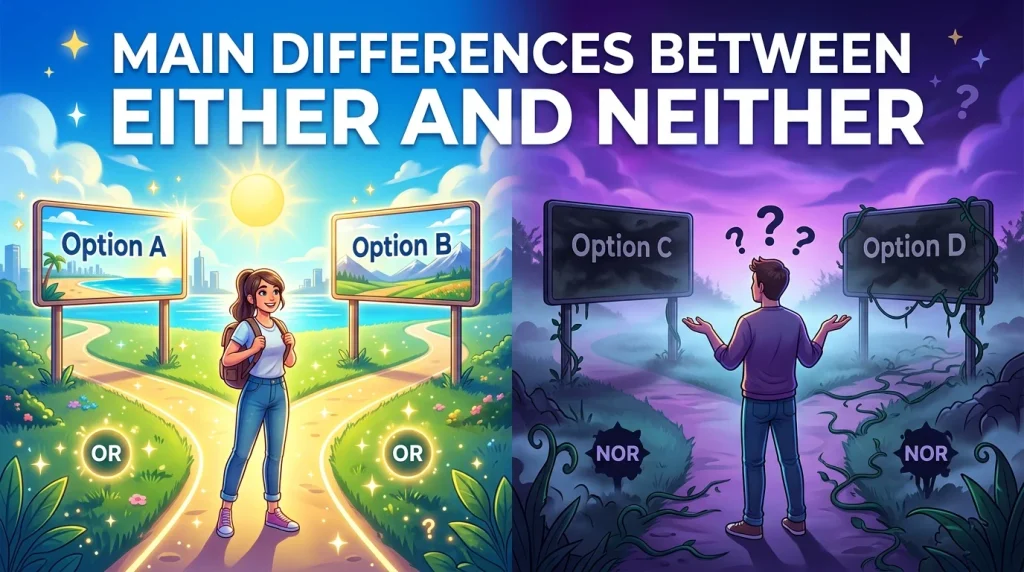
The most important distinction is their meaning.
Meaning
Either normally indicates that one of two possibilities is available or possible.
Neither indicates that both possibilities are rejected or untrue.
Compare:
Either answer is acceptable.
At least one of the two answers can be accepted; in some contexts, both may be acceptable.
Neither answer is acceptable.
Both answers are unacceptable.
Positive versus negative meaning
| Either | Neither |
| One or the other | Not one or the other |
| Usually affirmative | Negative |
| Offers alternatives | Rejects alternatives |
| either…or | neither…nor |
Example comparison
You can choose either blue or green.
The speaker allows a choice.
You can choose neither blue nor green.
The speaker does not allow either option.
Either vs. Neither With “Or” and “Nor”
One of the easiest ways to distinguish the two words is to remember their paired conjunctions.
Either…or
Use:
either + option A + or + option B
Examples:
- Either take the train or take the bus.
- We can either study at home or go to the library.
- Either Ali or Hassan will answer.
Neither…nor
Use:
neither + option A + nor + option B
Examples:
- Neither Ali nor Hassan answered.
- I want neither cake nor ice cream.
- Neither plan nor proposal was approved.
The easy memory trick
Think:
Either → or
Neither → nor
Can Either Mean Both?
This is an important point because either can sometimes be ambiguous.
Consider:
You can use either hand.
This normally means one hand or the other. It does not necessarily mean you should use both hands.
However, in certain contexts, “either” can have a broader meaning, especially when discussing two possibilities where each independently satisfies a condition.
For beginners, the safest rule is:
Either usually means one of two alternatives.
If you specifically mean both, use both.
- Both students passed.
- Either student can answer.
- Neither student failed.
Either vs Neither vs Both
Although the comparison is specifically between either and neither, both is useful because learners often confuse all three.
| Word | Meaning | Example |
| Either | One of two | Either answer is possible. |
| Neither | Not one or the other | Neither answer is possible. |
| Both | The two together | Both answers are possible. |
Think of the three this way:
- Either = A or B
- Neither = not A and not B
- Both = A and B
Grammar Guide
Either and neither are primarily used with two alternatives.
They are not normally used to refer to three or more choices.
For three or more options, use expressions such as:
- any
- none
- one of
- all
- any of the options
For example:
You can choose either of these two books.
But:
You can choose any of these five books.
Not:
You can choose either of these five books.
Singular nouns after either and neither
When either or neither directly determines a noun, that noun is normally singular.
Correct:
Either student can participate.
Correct:
Neither student was available.
Usually incorrect in standard formal English:
Either students can participate.
Neither students were available.
How each term is used in sentences
Either + singular noun
Either option is acceptable.
Either of + plural noun/pronoun
Either of the options is acceptable.
Either of them can help you.
Either…or
Either call me or text me.
Neither + singular noun
Neither option is acceptable.
Neither of + plural noun/pronoun
Neither of the options is acceptable.
Neither of them knows the answer.
Neither…nor
Neither John nor David attended.
Negative statement + either
I don’t understand it either.
Negative agreement with neither
“I don’t understand it.”
“Neither do I.”
Common mistakes learners make
Mistake 1: Using “neither” with “or”
Incorrect:
Neither Ali nor Ahmed came.
Correct:
Neither Ali nor Ahmed came.
Remember:
Neither…nor
Mistake 2: Using “either” with “nor”
Incorrect: Neither tea nor coffee is available.
Correct:
Either tea or coffee is available.
Remember:
Either…or
Mistake 3: Double negatives
Because neither already has a negative meaning, avoid adding another negative unnecessarily.
Incorrect:
I don’t like neither option.
Better:
I like neither option.
Or:
I don’t like either option.
Both convey the intended negative meaning.
Mistake 4: Using “either” when you mean “both”
Either student passed.
If you mean the two students passed, say:
Both students passed.
Mistake 5: Using “neither” for three or more choices
Neither normally refers to two things.
For more than two:
None of the three answers is correct.
Mistake 6: Confusing “either” with “too”
In a negative sentence, either can mean “also.”
I don’t like it either.
This does not mean “one of two.”
Simple rules to remember
- Either = one of two.
- Neither = not one and not the other.
- Either goes with or.
- Neither goes with nor.
- Use both when the two are included together.
- Use none when more than two choices are being rejected.
- After either/neither + noun, use a singular noun.
- Avoid unnecessary double negatives with neither.
Quick tips for writing and speaking
When choosing between the two, ask:
Am I allowing one of two choices?
Use either.
Either route will work.
Am I rejecting both choices?
Use neither.
Neither route will work.
Am I talking about both together?
Use both.
Both routes are open.
Am I talking about more than two choices?
Consider any, none, or all, depending on the meaning.
When to Use Each One
When to use Either
Use either when:
- There are two choices.
- One of two alternatives is acceptable.
- You are offering alternatives.
- You are saying that either member of a pair can do something.
- You are agreeing with a negative statement using “either.”
Examples:
You can choose either color.
Either candidate can answer the question.
We can either walk or take a taxi.
I don’t want dessert either.
When to use Neither
Use neither when:
- There are two choices.
- Both choices are rejected.
- Both people or things fail to meet a condition.
- You want to express “not this one and not that one.”
- You want to agree with a negative statement using “neither.”
Examples:
Neither color looks good.
Neither answer is correct.
Neither employee was available.
Neither did I.
When NOT to Use Each One
When not to use Either
Do not normally use either when:
- You are referring to more than two choices.
- You mean both choices together.
- You mean all members of a larger group.
- You are rejecting both options and need a negative expression.
For example, if there are five choices:
Any of these five options will work.
If both options work together:
Both options work.
When not to use Neither
Do not normally use neither when:
- There are more than two choices.
- You mean both choices are included.
- You mean at least one of the choices is acceptable.
- You are using a positive alternative structure.
For example:
Both students passed.
Not:
Neither student passed.
And for three choices:
None of the three students passed.
Either vs. Neither in Questions
Questions often use either when discussing two alternatives.
Do you want either tea or coffee?
However, natural English often uses either…or to present choices:
Would you like either tea or coffee?
Neither can appear in answers:
“Do you want tea or coffee?”
“Neither, thank you.”
You can also ask:
Do you like neither option?
This is grammatically possible, but depending on the intended meaning, a more natural question may be:
Do you dislike both options?
Either v. Neither With “Of”
Both words can be followed by of.
Either of
Either of these books is useful.
Either of them can help.
Neither of
Neither of these books is useful.
Neither of them can help.
The difference remains the same:
- Either of = one or the other
- Neither of = not one and not the other
Either and Neither Subject-Verb Agreement
A common grammar question concerns whether the verb should be singular or plural.
When either or neither is the subject by itself, standard formal English generally uses a singular verb:
Either is acceptable.
Neither is available.
When using either of or neither of with a plural noun/pronoun, singular agreement is traditionally preferred in formal English:
Neither of the answers is correct.
Either of the options is suitable.
In everyday English, plural verbs can sometimes occur, particularly with neither of or either of, but singular agreement is a safe choice for formal writing.
With either…or and neither…nor, verb agreement can depend on the subjects:
Either the manager or the employees are responsible.
Either the employees or the manager is responsible.
When the two subjects differ in number, the verb generally agrees with the subject closest to it in standard constructions.
When “Either” Means “Also”
This is one of the most important meanings to learn.
In negative sentences, either commonly means also.
Compare:
I like coffee too.
Positive sentence: use too.
I don’t like coffee either.
Negative sentence: use either.
Examples:
- I can’t swim either.
- She doesn’t know the answer either.
- We didn’t see him either.
Here, either is not expressing a choice between two things.
When “Neither” Means “Also Not”
Neither can be used to agree with a negative statement.
“I don’t like the movie.”
“Neither do I.”
This means:
I don’t like the movie either.
The grammatical structure changes depending on the verb:
Neither do I.
Neither can I.
Neither am I.
Neither will I.
For example:
“I can’t drive.”
“Neither can I.”
Either vs. Neither: A Simple Formula
You can reduce the entire comparison to four formulas:
Either
Either = one of two
Either A or B.
Neither
Neither = not A and not B
Neither A nor B.
Both
Both = A and B
Both A and B.
More than two
None = not any
None of A, B, and C.
This formula is especially useful for beginners.
When to Use “Either…Or”
Use either…or when presenting two alternatives.
Examples:
- You can either stay here or come with us.
- Either the blue shirt or the black shirt will work.
- We will either call you or email you.
- Either option is acceptable.
The alternatives should generally be grammatically parallel.
Less balanced:
She will either study or a movie.
Better:
She will either study or watch a movie.
The two alternatives—study and watch a movie—are both verb phrases.
When to Use “Neither…Nor”
Use neither…nor when rejecting two alternatives.
Examples:
- Neither John nor Sarah attended.
- Neither the printer nor the scanner is working.
- I want neither tea nor coffee.
- Neither explanation nor evidence was provided.
Like either…or, the construction works best when the two alternatives are grammatically parallel.
When to Choose Either. Neither
Use this quick decision process:
| Question | Use |
| Are there two alternatives? | Either or neither may work |
| Do you mean one of the two? | Either |
| Do you mean not one and not the other? | Neither |
| Are you offering two alternatives? | Either…or |
| Are you rejecting two alternatives? | Neither…nor |
| Do you mean the two together? | Both |
| Are there more than two and none are acceptable? | None |
| Are you adding agreement to a negative statement? | Either or neither, depending on sentence structure |
Real-World Practical Examples
Either Examples
1. Education
Either student can present the project.
Meaning: one or the other student can present it.
2. Daily life
You can take either bus to the city center.
Meaning: one bus or the other will work.
3. Business
We can either schedule the meeting today or move it to tomorrow.
Meaning: there are two alternatives.
4. Technology
You can connect the device using either port.
Meaning: one of the two ports can be used.
5. Conversation
“Which movie should we watch?”
“Either one is fine.”
Meaning: the speaker has no preference between the two.
6. Science
The experiment can be performed using either method.
Meaning: one of the two methods can be selected.
7. Writing
The author could use either example to explain the concept.
Meaning: either of the two examples would work.
8. Negative agreement
I don’t understand this question either.
Meaning: the speaker also does not understand it.
Neither Examples
1. Education
Neither student completed the assignment.
Meaning: student A did not complete it, and student B did not complete it.
2. Daily life
Neither restaurant is open today.
Meaning: both restaurants are closed.
3. Business
Neither proposal meets the company’s requirements.
Meaning: both proposals fail to meet the requirements.
4. Technology
Neither device is connected to the network.
Meaning: both devices are disconnected.
5. Conversation
“Do you want tea or coffee?”
“Neither, thanks.”
Meaning: the speaker wants neither of the two choices.
6. Science
Neither sample showed signs of contamination.
Meaning: both samples did not show contamination.
7. Writing
Neither explanation adequately supports the conclusion.
Meaning: both explanations are inadequate.
8. Negative agreement
“I don’t like crowded places.”
“Neither do I.”
Meaning: the second speaker also does not like crowded places.
Self-Assessment (Fill in the Blanks)
Complete each sentence with either, neither, both, none, or nor, as appropriate.
- You can choose ______ of the two available seats.
- ______ answer is correct; both contain errors.
- We can ______ take the train ______ drive there.
- ______ Ali ______ Hamza attended the meeting.
- I don’t like this restaurant ______.
- ______ of the two computers is working.
- ______ student can answer the question.
- I want ______ tea ______ coffee.
- There are two possible routes, and ______ route will get us there.
- ______ of the two explanations makes sense.
- She doesn’t understand the instructions, and I don’t ______.
- ______ the manager or the assistant will contact you.
- ______ the manager nor the assistant was available.
- Which of these two jackets do you want? — ______ is fine.
- Which of these two desserts do you want? — ______, thank you.
- ______ students passed the exam because the question was removed for everyone.
- You can use ______ hand to operate the machine.
- ______ of the two experiments produced the expected result.
- I can neither confirm ______ deny the report.
- ______ option is acceptable, so we need a different solution.
Answers
- either: One of the two seats can be chosen.
- neither: Both answers are being rejected.
- either, or: This presents two alternatives.
- neither, nor: Both Ali and Hamza are excluded.
- either: In a negative sentence, “either” can mean “also.”
- neither: Neither computer is working.
- either: One or the other student can answer.
- neither, nor: Both drinks are rejected.
- either: One of the two routes can be used.
- neither: Both explanations fail to make sense.
- either: It follows a negative statement and means “also.”
- either, or: Two alternatives are presented.
- neither, nor: Both people are excluded.
- either: The speaker has no preference between the two.
- neither: The speaker wants neither choice.
- both: The statement refers to the two students together.
- either: One of two hands can be used.
- neither: Both experiments failed to produce the expected result.
- nor: The fixed structure is “neither…nor.”
- neither: Both options are unacceptable.
Final Verdict
Either and neither are both correct words, but they have opposite meanings when discussing two alternatives.
- Either = one of two possibilities.
- Neither = not one and not the other.
- Either…or = presents two alternatives.
- Neither…nor = rejects both alternatives.
- Both = refers to the two together.
- None = normally refers to three or more possibilities being rejected.
The simplest rule is to ask what you mean: If one of two choices is possible, use “either.” If both choices are rejected, use “neither.” Once you understand this basic distinction, most either vs neither grammar questions become straightforward.
Conclusion
Understanding Neither Vs Either becomes much easier once you focus on the meaning behind each word. Either is generally used for one of two choices or possibilities, while neither means not one and not the other. The pair also follows a useful pattern: either…or presents alternatives, whereas neither…nor rejects both alternatives. These words may seem confusing at first, especially when they appear in questions, negative sentences, or phrases with “of,” but the core distinction remains simple.
When you mean one of two, think either; when you mean neither choice applies, think neither. With regular practice and attention to sentence context, choosing between them becomes natural. Whether you are writing an email, completing an English exercise, speaking in conversation, or improving your grammar for professional writing, knowing the difference between either and neither will help you communicate more clearly and confidently.
FAQs
What is the main difference between either and neither?
Either generally refers to one of two choices, people, or possibilities, while neither means not one and not the other. For example, “Either answer is acceptable” allows a choice between two answers. “Neither answer is acceptable” rejects both. The easiest memory rule is either = one of two, while neither = not either one.
Is either positive and neither negative?
Generally, yes. Either is commonly used to present or allow one of two alternatives, while neither expresses a negative meaning by rejecting both alternatives. For example, “You can choose either option” permits a choice. “You can choose neither option” means both choices are unacceptable. Context can create other uses, especially when “either” appears in negative sentences.
Should I use either or neither with two choices?
Use either when you mean one of the two choices is possible or acceptable. Use neither when you mean both choices are rejected or do not apply. For example, “Either restaurant is suitable” means you can choose one. “Neither restaurant is suitable” means both restaurants are unsuitable for the situation.
What is the difference between either or and neither nor?
Either…or introduces two alternatives, while neither…nor excludes both alternatives. For example, “We can either walk or take a bus” gives two possible choices. “We can neither walk nor take a bus” means both options are unavailable or unacceptable. Remember the useful pairing: either goes with or, and neither goes with nor.
Can either and neither be used with “of”?
Yes. Both can be followed by of when referring to two people or things within a larger group or clearly identified pair. For example, “Either of the books is useful” means one of the two books can be chosen. “Neither of the books is useful” means both books are unsuitable.
Can either mean also?
Yes. In negative sentences, either can mean “also.” For example, “I don’t like coffee either” means the speaker also does not like coffee. This is different from the choice-related meaning of “either.” In this construction, either commonly appears at the end of a negative sentence and functions similarly to “too” in positive sentences.
Can neither be used by itself?
Yes. Neither can stand alone when two choices have already been mentioned or are understood. For example, if someone asks, “Do you want tea or coffee?” you can answer, “Neither, thank you.” This means you do not want tea and you do not want coffee. The word therefore clearly communicates rejection of both choices.
Is it correct to say neither or?
In standard English, the usual paired construction is neither…nor, not “neither…or.” For example, say, “Neither John nor Mary attended the meeting.” Similarly, use either…or when presenting alternatives. Keeping these pairs together is a simple and reliable way to avoid a common grammar mistake.
Do either and neither take singular nouns?
Yes. When either or neither directly modifies a noun, the noun is normally singular. Examples include “either option,” “either student,” “neither answer,” and “neither choice.” You can also use either of or neither of with plural nouns, such as “either of the options” and “neither of the answers.”
How can I easily remember either vs neither?
Use a simple meaning test. Either means one of two, while neither means not one and not the other. Then remember their common pairs: either…or and neither…nor. If both choices are included, use both; if more than two choices are all rejected, none is generally more appropriate.