
Angry similes compare anger to familiar people, animals, objects, or natural forces. They help readers understand how intense someone’s anger feels and make writing more vivid and engaging. Learning different similes for anger can improve creative writing, storytelling, everyday conversations, and English vocabulary, and help you choose the most suitable comparison for each situation.
Comparison Overview
An angry simile is a figure of speech that compares an angry person, emotion, or reaction to something recognizable. It usually uses the words “like” or “as” to make the comparison clear.
For example:
- As angry as a bull: Suggests powerful, aggressive anger.
- Like a volcano about to erupt: Describes anger that is building and may soon explode.
- Like a storm: Represents intense anger that is noisy, powerful, or difficult to control.
- As red as a beetroot: Emphasizes the physical appearance of someone angry.
- Like a boiling kettle: Suggests growing frustration that is close to bursting out.
These expressions are related because they describe anger, but they do not communicate the same feeling. Some emphasize intensity, others suggest loss of control, and some describe visible signs of anger.
It is important to understand that “angry similes” is a category of expressions, not a single simile competing against another grammatical term. The expressions below are different ways to communicate anger, and the best choice depends on your intended meaning.
Definition of Angry Similes
Angry similes are comparisons that describe anger by connecting it to another person, animal, object, or experience.
A simile makes an emotion easier to imagine. Instead of writing, “She was very angry,” you might write, “She was as angry as a bull.”
The second sentence gives readers a stronger impression of the character’s emotional intensity.
Purpose of angry similes
Angry similes serve several purposes:
- Express intensity: They show whether anger is mild, strong, or overwhelming.
- Create imagery: They help readers visualize an emotional reaction.
- Reveal personality: A character’s reaction can suggest whether they are aggressive, restrained, or easily frustrated.
- Improve storytelling: They make descriptions more memorable.
- Communicate emotion: They help speakers explain feelings in an expressive way.
Common examples of angry similes
| Angry simile | Meaning |
| As angry as a bull | Extremely angry and potentially aggressive |
| Like a volcano about to erupt | Anger that has been building up |
| Like a raging storm | Powerful, chaotic anger |
| Like a boiling kettle | Growing frustration close to bursting |
| As red as a beetroot | A flushed face caused by anger or embarrassment |
| Like a bear with a sore head | Irritable and unpleasant |
| Like a fire out of control | Anger that is difficult to manage |
| Like thunder in the sky | A loud, forceful expression of anger |
| Like a pressure cooker ready to explode | Suppressed anger reaching its limit |
| As fierce as a lion | Intense, forceful anger or aggression |
Not every expression is equally suitable for every situation. For instance, “like a pressure cooker ready to explode” works particularly well when describing someone who has hidden their frustration for a long time.
Definition of “As Angry as a Bull”

“As angry as a bull” is a simile that compares an angry person to a bull, an animal often associated in popular imagery with strength, force, and aggression.
The expression suggests that someone is extremely angry and may react forcefully. Depending on the context, it can describe an aggressive mood, an intimidating reaction, or a character who seems ready to confront someone.
Meaning and purpose
This simile emphasizes the strength and intensity of anger.
For example:
“Dad was as angry as a bull when he discovered that someone had scratched his car.”
The sentence suggests that Dad was furious. The comparison makes his reaction seem powerful and intimidating.
When this simile works best
Use “as angry as a bull” when describing:
- A character who is visibly furious.
- A heated argument or confrontation.
- Someone reacting strongly to an insult.
- A dramatic scene in a story.
- An exaggerated or humorous description of anger.
Is it literal or figurative?
The expression is figurative. It does not mean that a person has become a bull. It compares the person’s emotional intensity to the animal’s stereotypical strength and aggression.
For a more formal description, you could write, “He was extremely angry.” However, the simile creates a more vivid image and can make creative writing more engaging.
Definition of “Like a Volcano About to Erupt”
“Like a volcano about to erupt” is a simile that compares a person’s growing anger to a volcano building pressure before releasing lava, ash, and gases.
It suggests that the person is becoming increasingly angry and may soon lose control of their emotions or express their frustration.
Meaning and purpose
This expression emphasizes anger that is building up and is close to being expressed.
For example:
“She sat silently through the meeting, like a volcano about to erupt.”
The sentence suggests that the woman is holding back her anger. Although she may appear quiet, her frustration is becoming increasingly intense.
When this simile works best
Use this expression when describing:
- Someone suppressing anger.
- A person becoming increasingly frustrated.
- Tension building during a disagreement.
- A character who is close to shouting.
- A situation in which a small additional problem might trigger a strong reaction.
Why the volcano comparison is effective
A volcano can remain quiet while pressure builds beneath its surface. Similarly, a person may hide anger until it becomes difficult to contain.
This makes the expression particularly effective for suspenseful stories, emotional scenes, and descriptions of workplace or family tension.
It is not necessary for someone to shout or become aggressive for the simile to work. The important feature is the sense of growing pressure.
Main Differences Between Angry Similes
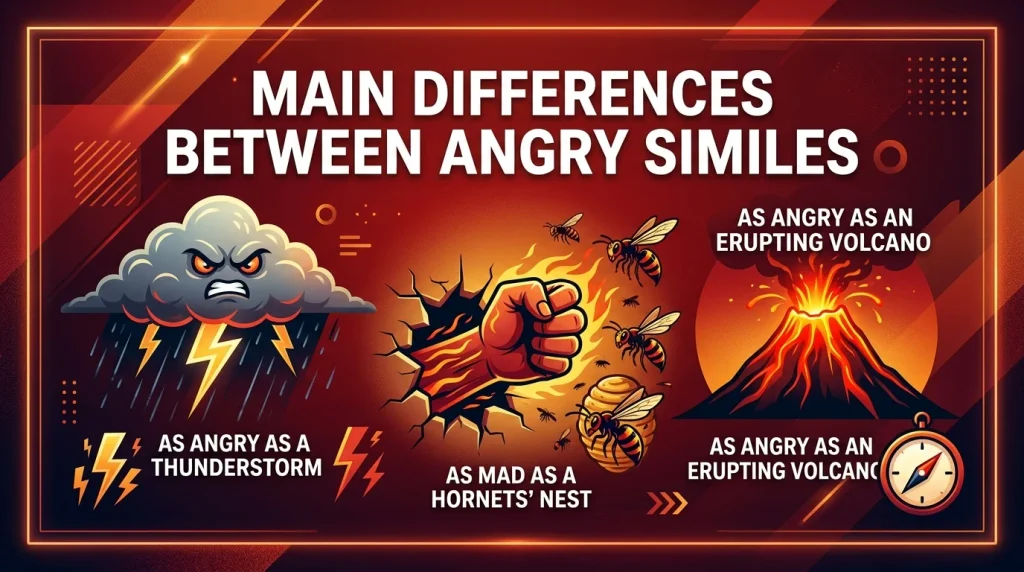
Angry similes differ in the kind of anger they communicate. Some suggest physical aggression, some describe hidden frustration, and others create an image of uncontrolled emotional force.
Comparison table
| Simile | Main emphasis | Typical situation | Example |
| As angry as a bull | Strength and aggression | Confrontation | He was as angry as a bull. |
| Like a volcano about to erupt | Growing pressure | Suppressed frustration | She looked like a volcano about to erupt. |
| Like a raging storm | Powerful, disruptive emotion | An intense argument | He shouted like a raging storm. |
| Like a boiling kettle | Increasing frustration | Everyday irritation | I was like a boiling kettle after waiting an hour. |
| Like a pressure cooker ready to explode | Long-suppressed anger | Workplace or family tension | She was like a pressure cooker ready to explode. |
| As red as a beetroot | Visible physical appearance | Embarrassment or anger | His face was as red as a beetroot. |
| Like a bear with a sore head | Irritability | Everyday interactions | He was like a bear with a sore head before breakfast. |
| Like a fire out of control | Unrestrained anger | Dramatic conflict | Her anger spread like a fire out of control. |
Types of Angry Similes
Understanding different categories of angry similes makes it easier to choose the right phrase for your writing.
1. Animal-based angry similes
Animal comparisons are useful for expressing strong emotions and recognizable behavior.
Examples:
- As angry as a bull.
- Like a bear with a sore head.
- As fierce as a lion.
- Like a snarling dog.
- Like a cornered animal.
These expressions often suggest aggression, irritability, defensiveness, or an intimidating attitude.
However, they can sound exaggerated if used to describe a minor disagreement.
2. Nature-based angry similes
Natural forces provide powerful imagery for intense emotions.
Examples:
- Like a volcano about to erupt.
- Like a raging storm.
- Like thunder rolling across the sky.
- Like a wildfire spreading through dry grass.
- Like waves crashing against rocks.
Nature-based similes work especially well in fiction, poetry, speeches, and descriptive writing.
3. Household-object angry similes
Everyday objects can help explain frustration in a simple and relatable way.
Examples:
- Like a boiling kettle.
- Like a pressure cooker ready to explode.
- Like a pot about to boil over.
- Like a tightly wound spring.
- Like a bottle shaken under pressure.
These expressions are especially useful when the anger has been building gradually.
4. Appearance-based angry similes
Some similes focus on the physical signs of anger rather than the emotion itself.
Examples:
- As red as a beetroot.
- As tense as a drawn bowstring.
- Like a person about to burst a blood vessel.
- Like a thundercloud gathering overhead.
Be careful with expressions that imply a specific physical condition. In ordinary creative writing, these are often figurative, but they should not be treated as medical descriptions.
Grammar Guide
Angry similes are grammatical comparisons. They usually appear within complete sentences and may describe a person, an expression, a voice, a reaction, or an emotional state.
The most common structures use “as … as” or “like.”
How each term is used in sentences
The “as … as” pattern
This structure commonly compares an adjective describing a person with a quality associated with something else.
Pattern: Subject + be + as + adjective + as + comparison.
Examples:
- He was as angry as a bull.
- She was as furious as a lion.
- The manager looked as irritated as a bear with a sore head.
- The child became as red as a beetroot.
The first adjective describes the subject. The second “as” introduces the comparison.
The “like” pattern
“Like” introduces a noun or noun phrase that serves as the comparison.
Pattern: Subject + verb + like + noun phrase.
Examples:
- He roared like a raging storm.
- She looked like a volcano about to erupt.
- My brother was acting like a bear with a sore head.
- The crowd reacted like a wildfire spreading through dry grass.
“Like” can follow different verbs, including “look,” “sound,” “act,” “move,” and “feel,” depending on the sentence’s intended meaning.
Using similes after linking verbs
Linking verbs such as “be,” “seem,” and “appear” can connect a subject to a simile.
Examples:
- He seemed like a volcano about to erupt.
- She was like a boiling kettle.
- They appeared as angry as a group of people facing an unfair decision.
The last example is a comparison, although it is less conventional than the more familiar expressions.
Are angry similes nouns, verbs, or adjectives?
An angry simile is a figure of speech, not a single part of speech.
Within a simile:
- Angry is an adjective.
- Anger is a noun.
- Angrily is an adverb.
- Explode is a verb.
- Like a raging storm is a comparison phrase.
- As angry as a bull is an adjective-based comparison.
For example:
“She angrily slammed the door like a raging storm.”
Here, “angrily” modifies the verb “slammed,” while “like a raging storm” provides a figurative comparison.
Real-World Practical Examples
The following examples demonstrate how angry similes can be used in education, daily life, science-related descriptions, business, literature, technology, and conversation.
“As Angry as a Bull” Examples
- Education: The teacher was as angry as a bull when the students deliberately damaged the classroom equipment.
- Daily life: My brother was as angry as a bull when he discovered that someone had borrowed his bicycle without asking.
- Business: The client was as angry as a bull after receiving an invoice containing several unexpected charges.
- Sports: The coach looked as angry as a bull when the players ignored the game plan.
- Creative writing: The king entered the hall as angry as a bull, demanding to know who had betrayed him.
- Technology: Liam was as angry as a bull when his computer crashed just before he saved his project.
- Conversation: “Dad was as angry as a bull when he found out that I had broken his favorite mug,” Sam explained.
- Travel: The passenger was as angry as a bull after learning that the airline had canceled the flight without providing clear information.
“Like a Volcano About to Erupt” Examples
- Education: The student sat like a volcano about to erupt after being blamed for a mistake he had not made.
- Daily life: My sister looked like a volcano about to erupt when I accidentally deleted her favorite photographs.
- Business: The project manager was like a volcano about to erupt after the team missed another important deadline.
- Science: The volcano imagery in the story helped students understand how pressure can build before an eruption, although human anger and volcanic processes are different phenomena.
- Creative writing: Behind her polite smile, Elena was like a volcano about to erupt.
- Technology: After the application crashed for the fifth time, the developer felt like a volcano about to erupt.
- Conversation: “I was like a volcano about to erupt when the bus drove past my stop,” Amir said.
- Family life: Dad became like a volcano about to erupt when he discovered that nobody had completed the chores.
“Raging Storm” Examples
- Education: The debate became like a raging storm when both students began arguing over the final result.
- Daily life: His anger moved through the kitchen like a raging storm after he discovered the broken window.
- Business: The boardroom discussion turned like a raging storm when the directors disagreed over the company’s future.
- Creative writing: Her accusations poured out like a raging storm, leaving everyone in the room speechless.
- Technology: Online complaints spread like a raging storm after users experienced a major service outage.
- Sports: The supporters’ anger rose like a raging storm when the referee disallowed the goal.
- Conversation: “When she heard the unfair decision, her response was like a raging storm,” he said.
- Public life: Public anger swept through the community like a raging storm after residents learned about the proposed closure of their local library.
“Boiling Kettle” Examples
- Education: I felt like a boiling kettle when my group members repeatedly ignored my suggestions.
- Daily life: She was like a boiling kettle after waiting in a long queue for an hour.
- Business: The employee felt like a boiling kettle when the meeting was delayed for the third time.
- Technology: I was like a boiling kettle when my internet connection failed during an important video call.
- Conversation: “I’m like a boiling kettle every time this printer jams,” my colleague joked.
- Travel: The driver was like a boiling kettle after sitting in traffic for two hours.
- Family life: My mother was like a boiling kettle when everyone left their dirty dishes in the sink.
- Creative writing: Each careless remark made the detective feel more like a boiling kettle.
Self-Assessment (Fill in the Blanks)
Complete the 20 sentences by choosing the most suitable expression from the following list. You may use an expression more than once.
Word bank: as angry as a bull; like a volcano about to erupt; like a raging storm; like a boiling kettle; like a pressure cooker ready to explode; like a bear with a sore head; as red as a beetroot; like a fire out of control.
- After discovering that someone had deliberately damaged his car, Mark was ______.
- Sara remained silent during the unfair meeting, but she looked ______.
- The argument became loud and chaotic, with accusations flying everywhere, like ______.
- After waiting for two hours in a crowded queue, I felt ______.
- Following weeks of stress and unreasonable deadlines, the department felt ______.
- My brother was irritable and unpleasant before breakfast, behaving ______.
- His face became ______ when he realized how angry he was.
- The character’s anger spread rapidly and became increasingly difficult to control, like ______.
- The coach was furious when the players ignored every instruction, looking ______.
- She had been hiding her frustration for so long that she seemed ______.
- The meeting was becoming increasingly tense, and the manager looked ______.
- I was frustrated by the printer repeatedly jamming, so I felt ______.
- After several unresolved conflicts, the team felt ______.
- The character shouted forcefully and disrupted the room, expressing anger like ______.
- He was grumpy and easily annoyed all morning, acting ______.
- After the embarrassing argument, her cheeks were ______.
- The angry customer confronted the manager with an aggressive expression, looking ______.
- The employee had endured weeks of pressure and seemed ______.
- Each new complaint intensified his anger until it spread like ______.
- Choose the correct grammatical structure to complete this sentence: “She was as ______ as a bull.”
Answers
- As angry as a bull: The deliberate damage causes strong, aggressive anger.
- Like a volcano about to erupt: Sara is holding back anger that may soon be expressed.
- A raging storm: The comparison conveys a loud, chaotic argument.
- Like a boiling kettle: The long wait has caused increasing frustration.
- Like a pressure cooker ready to explode: The department has been under prolonged pressure.
- Like a bear with a sore head: This expression describes irritability and a bad mood.
- As red as a beetroot: The phrase describes the visible redness of his face.
- Like a fire out of control: The comparison emphasizes anger spreading and becoming difficult to manage.
- As angry as a bull: The coach’s reaction is intense and forceful.
- Like a volcano about to erupt: Her suppressed frustration suggests an approaching outburst.
- Like a volcano about to erupt: The manager’s anger is building as tension increases.
- Like a boiling kettle: Repeated technical problems create mounting frustration.
- Like a pressure cooker ready to explode: The team’s stress has accumulated over time.
- A raging storm: The expression emphasizes powerful, disruptive anger.
- Like a bear with a sore head: The phrase describes someone grumpy and irritable.
- As red as a beetroot: The simile emphasizes her flushed cheeks.
- As angry as a bull: The expression suggests an aggressive or confrontational reaction.
- Like a pressure cooker ready to explode: The employee has experienced prolonged stress.
- Like a fire out of control: The simile emphasizes the rapid spread of anger.
- Angry: The correct phrase is “She was as angry as a bull.” The “as … as” structure compares the degree of anger with the bull imagery.
Final Verdict
Angry similes make descriptions of anger more vivid, expressive, and memorable. Although they all communicate anger, each expression emphasizes a different aspect of the emotion.
- “As angry as a bull” is best for intense, aggressive anger.
- “Like a volcano about to erupt” is best for anger that is building beneath the surface.
- “Like a raging storm” is best for powerful, chaotic, or disruptive anger.
- “Like a boiling kettle” is best for growing frustration.
- “Like a pressure cooker ready to explode” is best for anger that has accumulated under prolonged stress.
- “Like a bear with a sore head” is best for irritability or a bad mood.
- “As red as a beetroot” is best for describing a flushed appearance rather than anger itself.
There is no single correct angry simile for every situation. The best expression depends on the character’s emotional state, the intensity of the anger, and the effect you want to create.
For everyday English, start with familiar comparisons such as “as angry as a bull” and “like a boiling kettle.” For creative writing, experiment with more detailed images that show whether anger is building, exploding, or spreading. Above all, choose a simile that communicates your intended meaning clearly and naturally.
Conclusion
Angry similes are a wonderful way to make writing more expressive, colorful, and engaging. By comparing anger to familiar animals, natural forces, or everyday objects, you can help readers understand not only how angry someone feels but also how that emotion develops and affects their behavior. Expressions such as “as angry as a bull,” “like a volcano about to erupt,” and “like a raging storm” each create a different image and emotional effect.
The key to using angry similes effectively is choosing a comparison that matches the situation. Use powerful imagery to describe intense anger, a boiling kettle to express growing frustration, or a pressure cooker ready to explode to show emotions building under stress. Remember that similes commonly use “like” or “as” to make comparisons, making them easy to recognize and use in everyday English.
Whether you are a student, teacher, storyteller, or English learner, practicing angry similes can strengthen your vocabulary and descriptive writing skills. Choose your words thoughtfully, avoid unnecessary repetition, and let your comparisons bring emotions to life naturally.
FAQs
What is an angry simile?
An angry simile is a figure of speech that compares anger to something familiar using words such as “like” or “as.” For example, “He was as angry as a bull” compares a person’s anger to the strength and aggression commonly associated with a bull. Angry similes make descriptions more vivid and help readers imagine the intensity of an emotion.
What are some common examples of angry similes?
Common angry similes include “as angry as a bull,” “like a volcano about to erupt,” “like a raging storm,” and “like a boiling kettle.” Each expression communicates a different aspect of anger. A bull suggests aggression, a volcano suggests building pressure, a storm suggests powerful emotions, and a boiling kettle represents growing frustration.
What is the best simile for extreme anger?
“As angry as a bull” is a familiar simile for extreme, aggressive anger. Another effective option is “like a raging storm,” especially when describing a loud or disruptive outburst. The best choice depends on the context. If the character is holding back intense emotions, “like a volcano about to erupt” may communicate the situation more accurately.
What is a simile for anger building up?
“Like a volcano about to erupt” is an effective simile for anger that is gradually building. It compares a person’s growing frustration to pressure accumulating inside a volcano before an eruption. For example, “She remained silent, looking like a volcano about to erupt.” This comparison creates suspense and suggests that an emotional outburst may happen soon.
What is the difference between an angry simile and an angry metaphor?
An angry simile makes an explicit comparison using words such as “like” or “as.” For example, “He was as angry as a bull.” An angry metaphor describes the emotion by directly identifying it with something else, such as “His anger was a raging storm.” Both techniques create imagery, but they express comparisons differently.
How do you write a good simile for anger?
To write a good angry simile, identify the type of anger you want to describe and compare it to a familiar image. Use a bull for aggression, a storm for overwhelming emotion, or a boiling kettle for increasing frustration. Keep the comparison clear, natural, and appropriate for your audience. Avoid exaggerated imagery when a simple description works better.
Can angry similes be used in everyday conversation?
Yes, angry similes can make everyday conversations more expressive and relatable. For example, you might say, “I felt like a boiling kettle after waiting in traffic.” This memorably communicates frustration. However, choose expressions that suit the situation. A dramatic comparison may sound humorous among friends but inappropriate in a formal business conversation.
What is a funny simile for anger?
A funny simile for anger might be “like a boiling kettle with nowhere to whistle” or “like a bear who missed breakfast.” These playful comparisons describe irritation without making the situation sound too serious. Humorous similes work particularly well in casual conversations, lighthearted stories, and creative writing where exaggeration adds personality and entertainment.
Why are angry similes important in creative writing?
Angry similes help writers show emotions rather than simply naming them. Instead of saying that a character is furious, a writer can describe the character as “like a volcano about to erupt.” This creates a stronger mental image, builds tension, and helps readers connect with the character. Varied similes also make stories more engaging and memorable.
What is the easiest way to remember angry similes?
The easiest way to remember angry similes is to connect each comparison with its main meaning. Think of a bull for aggressive anger, a volcano for building frustration, a storm for powerful emotional outbursts, and a boiling kettle for everyday irritation. Practicing these expressions in short sentences will help you remember their meanings and use them naturally.