
Similes for music compare a song, sound, voice, rhythm, or melody to something familiar using words such as “like” or “as.” They make descriptions more vivid, emotional, and memorable. Whether you are writing creatively, analyzing a song, teaching English, or simply describing what music sounds like, the right simile can make your meaning much clearer.
Comparison Overview
Unlike a typical “A vs. B” comparison, “Similes for Music” is a topic focused on using similes to describe musical experiences. A simile creates a comparison between music and another person, object, place, feeling, action, or natural phenomenon.
For example:
- The melody was like a gentle river.
- Her voice was as smooth as silk.
- The drums sounded like thunder.
- The guitar riff moved like a racing car.
- The song was as bright as sunshine.
The purpose is not to say that music literally is a river, thunder, or sunshine. Instead, the comparison helps the reader or listener imagine its qualities.
Similes for music are especially useful because music is often difficult to describe with literal language. A song can be emotional, powerful, soft, energetic, mysterious, peaceful, dramatic, or exciting. A well-chosen simile gives those abstract qualities a concrete image.
Definition of Similes for Music
A simile for music is a figurative comparison that describes some quality of music by comparing it to something else, usually with “like” or “as.”
For example:
The violin sounded like a bird singing at sunrise.
The violin is not actually a bird. The writer is comparing the violin’s sound to a bird’s song because both may be perceived as beautiful, light, or melodic.
A musical simile can describe many different features:
- Sound: The bass sounded like distant thunder.
- Volume: The drums were as loud as an explosion.
- Speed: The rhythm moved like a speeding train.
- Mood: The melody felt like a warm hug.
- Voice: Her voice was as soft as a whisper.
- Energy: The chorus exploded like fireworks.
- Smoothness: The saxophone sounded like honey flowing from a jar.
- Sadness: The piano sounded like rain falling on an empty street.
The central purpose is to help readers hear, feel, or imagine the music through another familiar experience.
Main Differences Between Different Types of Music Similes
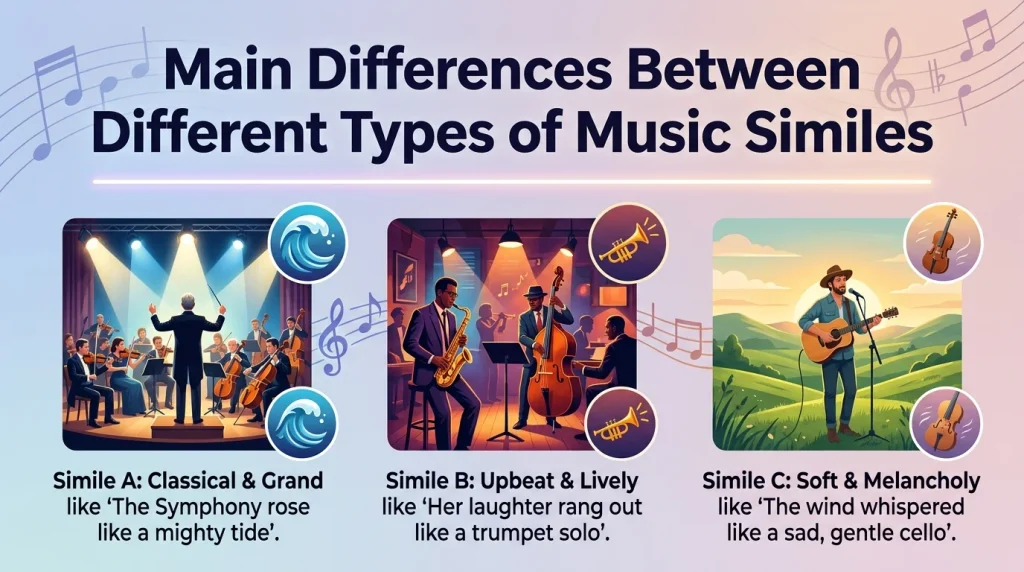
Because “Similes for Music” is a broad phrase rather than a comparison between two separate vocabulary words, the most useful distinction is between the different ways similes can describe music.
Sound-Based Similes
These focus directly on what the music sounds like.
Examples:
- The guitar sounded like a buzzing bee.
- The drums crashed like thunder.
- The flute sounded like a singing bird.
Mood-Based Similes
These describe the emotional effect of music.
Examples:
- The melody felt like a warm blanket on a cold night.
- The song was like a lonely walk through an empty street.
- The chorus felt like sunshine after a storm.
Rhythm-Based Similes
These compare the movement or beat of music to an action or physical motion.
Examples:
- The beat moved like a heartbeat.
- The rhythm raced like a horse.
- The drums marched like soldiers.
Voice-Based Similes
These describe a singer’s vocal quality.
Examples:
- Her voice was as smooth as silk.
- His voice was like gravel.
- The singer’s high notes were as clear as glass.
Volume-Based Similes
These compare loudness or quietness to familiar sounds.
Examples:
- The orchestra was as loud as thunder.
- The lullaby was as quiet as falling snow.
- The final chord hit like a cannon.
Style-Based Similes
These describe the overall character or atmosphere of a piece.
Examples:
- The jazz performance flowed like a conversation.
- The rock song hit like a wave.
- The classical piece unfolded like a beautiful story.
Grammar Guide
Similes for music generally follow the same grammatical patterns as other English similes.
The two most common structures are:
like + noun/noun phrase
The drums sounded like thunder.
as + adjective + as + noun/noun phrase
Her voice was as smooth as silk.
A simile can function as part of a larger sentence rather than standing alone.
The melody floated like a feather through the quiet room.
How Each Term Is Used in Sentences
There are several useful patterns for creating musical similes.
Pattern 1: Subject + verb + like + noun
The piano sounded like rain.
The drums crashed like thunder.
The melody flowed like water.
This pattern is simple and natural when describing a sound or action.
Pattern 2: Subject + be + as + adjective + as + noun
Her voice was as clear as crystal.
The rhythm was as steady as a heartbeat.
The song was as peaceful as a quiet lake.
This pattern is useful when the focus is on a specific quality.
Pattern 3: Subject + verb + like + noun + verb
The melody moved like a bird flying across the sky.
The rhythm bounced like a ball on a hard floor.
This structure creates a more detailed image.
Pattern 4: Subject + felt + like + noun
The song felt like a warm embrace.
The final chorus felt like a burst of sunlight.
This pattern is particularly useful for describing emotional reactions.
Common Mistakes Learners Make
Mistake 1: Forgetting “like” or “as”
Incorrect:
The music a river.
Better:
The music was like a river.
A simile needs a clear comparison.
Mistake 2: Using an unnatural comparison
A technically grammatical simile may still sound confusing.
For example:
The melody was like a refrigerator.
Unless the music actually resembles a refrigerator’s noise or some specific quality associated with it, the comparison does not communicate much.
A stronger example is:
The melody was like a gentle stream.
Mistake 3: Mixing similes and metaphors
A simile commonly uses like or as:
The song was like a storm.
A metaphor makes the comparison directly:
The song was a storm.
Both can be effective, but they are different forms of figurative language.
Mistake 4: Using “as” incorrectly
The standard pattern is:
as + adjective + as
For example:
Her voice was as soft as a whisper.
Not:
Her voice was as a whisper.
Mistake 5: Choosing a comparison that does not match the music
If a song is slow and peaceful, saying it is “like a racing motorcycle” creates a contradictory image unless that contrast is intentional.
The comparison should normally reflect the musical quality you want to communicate.
Simple Rules to Remember
Remember these four rules:
- Use “like” to compare one thing with another.
- Use “as + adjective + as” to compare qualities.
- Choose an image that matches the sound, mood, rhythm, or voice.
- Make the comparison understandable to your audience.
A simple formula is:
Music + like + familiar image
or:
Music + as + quality + as + familiar image
Quick Tips for Writing and Speaking
When creating a simile for music, first identify the quality you want to describe.
Ask:
- Is the music loud or quiet?
- Is it fast or slow?
- Is it happy or sad?
- Is it smooth or rough?
- Is it relaxing or energetic?
- Does it remind you of nature?
- Does it create a strong emotional reaction?
Then choose an image that communicates that quality.
For example:
Quality: peaceful
Image: calm lake
Simile: The melody was like a calm lake.
Quality: powerful
Image: thunder
Simile: The drums were like thunder.
When to Use Similes for Music
Similes are useful whenever literal descriptions do not fully capture the musical experience.
In Creative Writing
Writers can use musical similes to make descriptions more vivid.
The violin sang like a bird above the orchestra.
In Music Reviews
A reviewer can use a simile to communicate the character of a song.
The bass line rolls through the track like a slow-moving wave.
In School Assignments
Students can use similes when discussing figurative language, poetry, music, or descriptive writing.
The singer’s voice was as clear as a bell.
In Everyday Conversation
Similes can make casual descriptions more expressive.
That song hit me like a wave of nostalgia.
In Poetry
Music-related similes can create rhythm, imagery, and emotion.
The melody drifted like clouds across a summer sky.
In Songwriting
Songwriters can use comparisons to create memorable images and emotional associations.
Your voice is like sunlight through my window.
In Teaching
Teachers can use musical similes to help students understand abstract qualities such as rhythm, tone, pitch, and mood.
When NOT to Use Similes for Music
Similes are not necessary in every situation.
When Precise Technical Language Is Required
A musicologist, audio engineer, or musician may need exact terminology instead of figurative language.
For example, instead of:
The sound was like a deep cave.
A technical description might specify:
The recording has strong low-frequency emphasis and reduced high-frequency content.
When the Comparison Is Too Vague
Avoid comparisons that do not help the reader understand the music.
The song was like something.
This gives the reader no useful image.
When the Comparison Is Overused
Too many similes can make writing feel crowded.
Instead of:
The drums were like thunder, the guitar was like lightning, the singer was like a bird, and the melody was like a river…
Choose the most important comparison and develop it.
When Literal Accuracy Matters
In technical instructions, academic definitions, or factual reports, figurative comparisons can sometimes create ambiguity.
Use direct terminology when precision is more important than imagery.
Which One to Use: Decision Guide
Since “Similes for Music” describes a category rather than two competing vocabulary terms, choose your simile according to the musical feature you want to communicate.
| What you want to describe | Useful comparison | Example |
| Loudness | Thunder, explosion, roar | The drums were like thunder. |
| Quietness | Whisper, falling snow | The piano was as quiet as a whisper. |
| Speed | Racing car, train, horse | The rhythm moved like a racing train. |
| Smoothness | Silk, water, honey | Her voice was as smooth as silk. |
| Sadness | Rain, empty road, fading sunset | The melody was like rain on a window. |
| Happiness | Sunshine, birds, celebration | The song was like sunshine. |
| Energy | Fireworks, lightning, waves | The chorus burst like fireworks. |
| Peacefulness | Calm lake, breeze, cloud | The melody floated like a gentle breeze. |
| Power | Thunder, storm, earthquake | The bass hit like thunder. |
| Repetition | Heartbeat, ticking clock | The beat was steady like a heartbeat. |
A good decision process is:
Step 1: Identify the musical quality.
2: Choose something familiar that has the same quality.
3: Connect the two with “like” or “as.”
4: Read the sentence aloud.
5: Ask whether the reader can immediately imagine the sound or feeling.
Real-World Practical Examples
Similes for Sound
- Education:
The classroom piano sounded like a gentle rainstorm. - Daily life:
The radio crackled like an old fireplace. - Science:
The low-frequency sound felt like distant thunder. - Business:
The advertisement’s jingle was as catchy as a popular nursery rhyme. - Writing:
The melody floated through the story like a soft breeze. - Technology:
The synthesized sound pulsed like a digital heartbeat. - Conversation:
That singer’s voice is like velvet.
Rhythm
- Education:
The students clapped to a rhythm as steady as a heartbeat. - Daily life:
The song’s beat moved like footsteps on a busy sidewalk. - Science:
The repeating pulse was like a regular wave pattern. - Business:
The commercial uses a beat that moves like a ticking clock. - Writing:
The rhythm marched through the poem like soldiers. - Technology:
The electronic beat repeated like a programmed signal. - Conversation:
The drummer played like a machine.
Melody
- Education:
The melody climbed like a bird rising into the sky. - Daily life:
The tune stayed in my head like a familiar memory. - Science:
The melody rose and fell like a wave. - Business:
The brand’s melody was as memorable as a familiar ringtone. - Writing:
The violin melody wandered like a traveler through an unfamiliar city. - Technology:
The digital melody flowed like a stream of data. - Conversation:
That tune is like a little ray of sunshine.
For a Singer’s Voice
- Education:
Her voice was as clear as a bell. - Daily life:
His voice sounded like warm coffee on a cold morning. - Science:
The high note was as sharp and clear as a pure tone. - Business:
The narrator’s voice was as smooth as silk. - Writing:
Her voice floated through the room like a feather. - Technology:
The digitally recorded voice sounded as clean as polished glass. - Conversation:
His voice is like gravel.
Similes for Loud Music
- The drums were as loud as thunder.
- The concert sounded like an explosion of energy.
- The bass hit like a powerful wave.
- The final chord crashed like a storm.
- The speakers roared like a giant engine.
Soft Music
- The piano was as soft as a whisper.
- The melody floated like a feather.
- The flute sounded like a distant bird.
- The music was as gentle as falling snow.
- The song drifted through the room like a quiet breeze.
Fill in the Blanks
- I will use ______ when comparing a loud drumbeat to a storm.
The correct word or phrase is ______ because it creates an image of powerful sound. - I will use ______ when describing a singer’s extremely smooth voice.
The correct phrase is ______ because silk is commonly associated with smoothness. - I will use ______ when comparing a peaceful melody to moving water.
The correct phrase is ______ because flowing water suggests calm, continuous movement. - I will use ______ when describing a very fast rhythm.
The correct comparison is ______ because a racing train suggests speed. - I will use ______ when describing a quiet piano performance.
The correct comparison is ______ because a whisper represents very soft sound. - I will use ______ when describing a powerful bass line.
The correct comparison is ______ because thunder suggests strength and depth. - I will use ______ when describing a cheerful song.
The correct comparison is ______ because sunshine commonly suggests happiness and warmth. - I will use ______ when describing a repeating beat.
The correct comparison is ______ because a heartbeat has a recognizable repeating pulse. - I will use ______ when describing a melody that suddenly becomes energetic.
The correct comparison is ______ because fireworks suggest a sudden burst of energy. - I will use ______ when describing a sad piano melody.
The correct comparison is ______ because rain can create a melancholy image. - I will use ______ when describing a gentle flute sound.
The correct comparison is ______ because a bird’s song can suggest a light and beautiful sound. - I will use ______ when describing a rough vocal quality.
The correct comparison is ______ because gravel suggests a rough texture. - I will use ______ when describing music that moves continuously and smoothly.
The correct comparison is ______ because a river suggests continuous movement. - I will use ______ when describing a dramatic musical ending.
The correct comparison is ______ because thunder suggests a powerful final impact. - I will use ______ when describing a delicate melody.
The correct comparison is ______ because a feather suggests lightness. - I will use ______ when describing a song that feels comforting.
The correct comparison is ______ because a warm blanket suggests comfort and safety. - I will use ______ when describing an extremely energetic chorus.
The correct comparison is ______ because a wave can represent powerful movement. - I will use ______ when describing a very clear singing voice.
The correct comparison is ______ because a bell can produce a clear, ringing sound. - I will use ______ when describing a rhythm that moves at a steady pace.
The correct comparison is ______ because footsteps can represent regular movement. - I will use ______ when describing a mysterious melody.
The correct comparison is ______ because an unfamiliar or shadowy image can create a sense of mystery.
Answers
- like thunder: It creates an image of loud, powerful sound.
- as smooth as silk: Silk represents smoothness.
- like flowing water: Flowing water suggests calm movement.
- like a racing train: A racing train represents speed.
- as quiet as a whisper: A whisper is very soft.
- like thunder: Thunder suggests a deep and powerful sound.
- like sunshine: Sunshine commonly suggests happiness and warmth.
- like a heartbeat: A heartbeat has a regular repeating pulse.
- like fireworks: Fireworks suggest sudden energy and excitement.
- like rain: Rain can create a quiet, melancholy atmosphere.
- like a singing bird: Birds can represent light, beautiful sounds.
- like gravel: Gravel suggests roughness.
- like a river: A river suggests continuous flowing movement.
- like thunder: Thunder can represent a dramatic impact.
- like a feather: A feather suggests delicacy and lightness.
- like a warm blanket: A warm blanket suggests comfort.
- like a powerful wave: Waves can represent strong movement and energy.
- like a bell: A bell can produce a clear, ringing tone.
- like steady footsteps: Footsteps can suggest a regular rhythm.
- like a mysterious shadow: A shadow can create an image of mystery.
Final Verdict
Similes for music are comparisons that make musical descriptions more vivid and understandable. The most common structures use “like” or “as … as.” The best simile depends on what you want to describe: use thunder for power, silk for smoothness, a heartbeat for steady rhythm, sunshine for happiness, rain for sadness, and a breeze or flowing water for gentle movement.
The key is to match the comparison with the musical quality. A strong simile should help the reader hear, see, feel, or imagine the music rather than simply adding decorative language. Once you identify the sound, rhythm, mood, voice, or energy you want to describe, choosing an effective simile becomes much easier.
Conclusion
Similes for music are a simple yet powerful way to turn sounds, rhythms, melodies, and voices into vivid descriptions that readers can easily imagine. By comparing music to familiar things such as thunder, sunshine, rain, silk, rivers, birds, or a heartbeat, writers can communicate qualities that are often difficult to explain with literal language. Whether you are writing a poem, school assignment, song review, story, or casual description, the right simile can make your words more expressive and memorable.
The key is to choose a comparison that naturally matches the musical quality you want to describe. Think about the music’s mood, volume, speed, rhythm, texture, or emotional effect, then connect it with a familiar image using “like” or “as.” With practice, creating effective similes for music becomes an enjoyable way to make musical descriptions clearer, warmer, and more engaging.
FAQs
What is a simile for music?
A simile for music is a figurative comparison that describes a musical sound, rhythm, melody, voice, or mood by comparing it with something familiar. Similes commonly use words such as “like” or “as.” For example, “The drums sounded like thunder” compares the powerful sound of drums with thunder to help readers imagine their intensity.
What are some good similes for music?
Good similes for music include “The melody flowed like a river,” “Her voice was as smooth as silk,” and “The drums crashed like thunder.” The best comparison depends on the quality being described. Thunder works well for powerful sounds, silk for smooth voices, a heartbeat for steady rhythm, and sunshine for cheerful or uplifting music.
How do you describe music using a simile?
Start by identifying the musical quality you want to describe, such as speed, volume, mood, rhythm, or tone. Then think of something familiar with a similar quality. Connect the two using “like” or an “as…as” structure. For example, “The melody floated like a gentle breeze” describes music that feels light, soft, and peaceful.
What is an example of a simile for a beautiful song?
A beautiful song can be described with a simile such as, “The melody was like sunlight filtering through the trees.” This comparison creates an image of something gentle, warm, and pleasant. Another option is, “The singer’s voice was as clear as a bell,” which emphasizes clarity and beauty in the vocal performance.
What is a simile for a sad song?
A sad song can be compared to rain, an empty road, a fading sunset, or a quiet winter evening. For example, “The piano sounded like rain against a lonely window.” This simile creates a melancholy image while connecting the emotional quality of the music with something familiar and visually understandable.
What is a simile for loud music?
Loud music can be compared to thunder, an explosion, a storm, or a roaring engine. For example, “The drums were as loud as thunder.” This comparison immediately communicates power and volume. The most effective simile should match the particular type of loudness you want to emphasize, whether it feels dramatic, exciting, aggressive, or overwhelming.
What is a simile for a singer’s voice?
A singer’s voice can be compared with objects or experiences that represent its particular quality. For example, “Her voice was as smooth as silk” emphasizes smoothness, while “His voice sounded like gravel” suggests a rough or raspy quality. Choose the comparison according to whether the voice is soft, powerful, clear, deep, warm, or distinctive.
Can similes be used in music reviews?
Yes, similes are very useful in music reviews because they help readers understand the character of a song without hearing it themselves. A reviewer might write, “The guitar solo soared as an eagle” or “The bass moved like a slow wave.” These comparisons communicate musical qualities while making the review more vivid and engaging.
What is the difference between a simile and a metaphor in music?
A simile makes a comparison using words such as “like” or “as,” while a metaphor makes the comparison directly. For example, “The melody is like a river” is a simile, whereas “The melody is a river” is a metaphor. Both can create strong imagery, but their grammatical structures and effects are different.
How can I create my own similes for music?
To create your own simile, listen carefully and identify one quality of the music. Decide whether it is fast, slow, loud, soft, smooth, rough, joyful, sad, mysterious, or energetic. Then choose a familiar image with the same quality. Finally, connect them with “like” or “as.” For example, a steady rhythm can become “like a heartbeat.”