
Similes for strength help writers describe physical power, emotional resilience, determination, and impressive abilities in vivid, memorable ways. By comparing strength to familiar objects, animals, and natural forces, similes make descriptions easier to understand and more engaging. Whether you are writing a school assignment, a story, a speech, or everyday conversation, choosing the right simile makes your message clearer and more expressive.
Comparison Overview
The phrase “similes for strong” refers to expressions that compare a person, object, or idea to something powerful. These comparisons typically use the words “like” or “as” to communicate strength in a creative and understandable way.
Unlike ordinary descriptions such as “very strong” or “extremely powerful,” similes help readers visualize what strength looks like. For example, describing someone as “as strong as an ox” suggests considerable physical strength, while describing someone as “like an unbreakable rock” emphasizes firmness and resilience.
There is no single correct simile for strong. The best choice depends on the type of strength you want to communicate, the audience you are addressing, and the tone of your writing.
Common similes for strong include:
- As strong as an ox: Describes great physical strength.
- As strong as a lion: Suggests power, courage, and confidence.
- As solid as a rock: Emphasizes stability and reliability.
- Like an iron wall: Suggests toughness and resistance.
- As tough as nails: Describes someone resilient and difficult to discourage.
- Like a mighty oak: Suggests endurance, stability, and long-lasting strength.
- As powerful as a storm: Highlights overwhelming force.
- As unbreakable as steel: Emphasizes determination and resilience.
These expressions are related, but each creates a slightly different impression.
Definition of Similes for Physical Strength
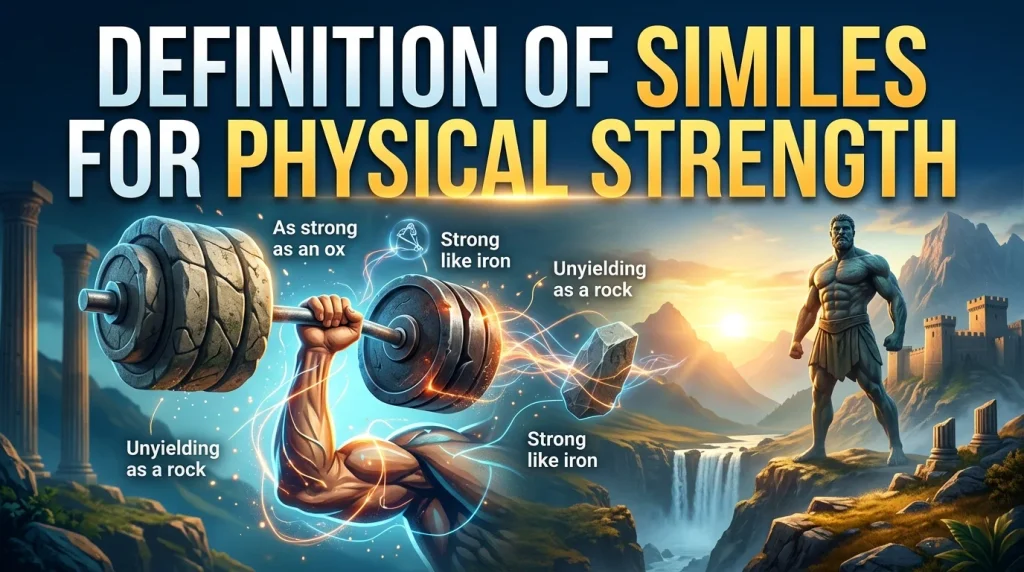
Similes for physical strength compare a person, animal, or object to something known for its power, size, or ability to withstand force.
Their primary purpose is to help readers imagine how strong something is without relying on a plain statement.
For example:
- “He is as strong as an ox.”
- “The weightlifter is like a human bulldozer.”
- “Her grip was as firm as steel.”
- “The athlete was as powerful as a charging bull.”
- “The giant stood like a mountain.”
In these examples, the comparisons emphasize physical power, force, or impressive size.
When physical-strength similes work best
Physical-strength similes are particularly useful in sports writing, action stories, descriptions of athletes, children’s stories, and everyday conversation.
For instance, a sports commentator might say, “The wrestler was as strong as an ox,” to communicate exceptional physical power. A novelist might describe a giant as “standing like a mountain” to suggest enormous size and an imposing presence.
The important point is that the comparison should match the type of physical strength being described.
Definition of Similes for Mental and Emotional Strength
Similes for mental and emotional strength describe determination, courage, patience, confidence, and the ability to overcome difficulties.
These expressions focus less on physical force and more on a person’s character or ability to remain steady under pressure.
Examples include:
- “She is as tough as nails.”
- “He stood firm like a rock during the crisis.”
- “Her determination was as strong as steel.”
- “He faced the challenge like a fearless lion.”
- “She remained steady as an oak tree in the storm.”
These comparisons help readers understand how a person responds to stress, disappointment, fear, or adversity.
When emotional-strength similes work best
Emotional-strength similes are useful in motivational speeches, personal essays, biographies, novels, workplace communication, and descriptions of people overcoming challenges.
For example, “She was as tough as nails during the difficult project” emphasizes perseverance rather than muscle strength.
Similarly, “He stood firm like a rock when everyone disagreed” suggests that the person remained confident in their position.
These expressions are particularly effective when the surrounding context explains what challenge the person faced.
Definition of Similes for Strength and Durability
Similes for strength and durability describe objects, structures, materials, or systems that can withstand pressure, damage, or repeated use.
They are useful when the emphasis is on resistance, stability, reliability, or long-lasting performance.
Examples include:
- “The bridge was as strong as steel.”
- “The old tree stood like an unbreakable pillar.”
- “The protective wall was solid as a rock.”
- “The reinforced frame was as tough as iron.”
- “The connection held firm like a steel cable.”
These comparisons help readers visualize structural strength without requiring technical explanations.
However, figurative comparisons should not replace scientific measurements. Calling a material “as strong as steel” is an expressive description, not a precise statement about its tensile strength or load-bearing capacity.
When durability similes work best
Durability similes can appear in product descriptions, engineering stories, advertising, technical introductions, and creative writing.
For example, a marketing writer might describe a rugged backpack as “tough as nails.” A science writer, however, should use actual test results when making factual claims about material performance.
The distinction is important: a simile creates an impression, while scientific evidence establishes measurable properties.
Main Differences Between Similes for Strength
The main difference between similes for strength is the particular quality of strength each expression emphasizes. Some suggest physical power, others communicate courage or resilience, and still others highlight stability and durability.
Comparison Table
| Simile | Main meaning | Best context | Example |
| As strong as an ox | Great physical strength | Sports, everyday speech | He is as strong as an ox. |
| As strong as a lion | Power and courage | Stories, motivational writing | She fought as bravely as a lion. |
| As tough as nails | Resilience and toughness | Conversation, biographies | He is as tough as nails. |
| As solid as a rock | Stability and reliability | Relationships, leadership | Her support was as solid as a rock. |
| As unbreakable as steel | Determination or resistance | Motivation, fiction | His resolve was as unbreakable as steel. |
| Like a mighty oak | Endurance and stability | Poetry, descriptive writing | She stood like a mighty oak. |
| As powerful as a storm | Overwhelming force | Fiction, dramatic descriptions | The team attacked like a storm. |
| Like an iron wall | Resistance and protection | Conflict, sports, storytelling | The defenders formed an iron wall. |
Physical power versus emotional resilience
Physical power concerns the ability to exert force, lift weight, or perform demanding physical tasks. Emotional resilience concerns the ability to handle challenges and recover from setbacks.
Compare these examples:
- Physical: “The weightlifter is as strong as an ox.”
- Emotional: “She is as tough as nails.”
Both communicate strength, but the first typically suggests muscular power, whereas the second usually describes toughness and perseverance.
Context can change the meaning, so neither expression is limited to only one interpretation.
Strength versus stability
Strength and stability are related but not identical.
- “As strong as an ox” suggests power.
- “As solid as a rock” suggests firmness and reliability.
- “Like a mighty oak” suggests endurance and a stable presence.
A person might be physically powerful but unreliable. Another person might have little physical strength but be dependable during a crisis.
Choosing the appropriate simile helps communicate the intended quality more accurately.
Literal strength versus figurative strength
A literal description reports a measurable or observable quality. A figurative description uses imagery to create an impression.
For example:
- Literal: “The machine can lift 500 kilograms.”
- Figurative: “The machine is as strong as a bull.”
The first gives a measurable specification. The second creates a vivid mental picture.
In technical writing, factual descriptions should take priority when precision matters. In creative writing, figurative descriptions can make the message more engaging.
More Popular Similes for Strength

The following expressions expand your vocabulary and help you choose a comparison that suits your purpose.
Similes for extreme physical strength
- As strong as a bull.
- As powerful as a charging rhino.
- As mighty as a giant.
- As strong as a bear.
- Like a human powerhouse.
- As powerful as a locomotive.
- Like a mountain of muscle.
These expressions are useful for describing athletes, fictional heroes, powerful characters, and physically demanding performances.
Similes for inner strength
- As tough as nails.
- As steady as a rock.
- As unbreakable as steel.
- Like a tree weathering a storm.
- As resilient as a spring that returns to shape.
- As firm as an oak tree.
- Like a flame that refuses to die.
These comparisons emphasize courage, persistence, and the ability to recover after hardship.
Similes for strength in leadership
- As steady as a lighthouse in a storm.
- As firm as an iron pillar.
- Like a rock in turbulent waters.
- As dependable as a mountain.
- As unshakable as an ancient oak.
These expressions work well in speeches, biographies, workplace writing, and descriptions of trusted leaders.
Similes for strength in nature
- As powerful as a waterfall.
- Like a mountain against the sky.
- As fierce as a thunderstorm.
- As enduring as an ancient tree.
- As relentless as ocean waves.
Natural imagery helps writers communicate different forms of strength, from overwhelming force to lasting endurance.
Grammar Guide
A simile is a figure of speech that compares two different things using a recognizable point of similarity. Similes for strength commonly use the adjective “strong,” other adjectives with related meanings, and comparison patterns involving “as” or “like.”
Understanding the grammatical structure helps you use these expressions correctly.
How each term is used in sentences
1. The “as + adjective + as” pattern
This is one of the most common structures for expressing strength.
Pattern: Subject + be + as + adjective + as + comparison.
Examples:
- He is as strong as an ox.
- She is as tough as nails.
- The wall is as solid as a rock.
- Their determination is as firm as steel.
The first “as” introduces the adjective, and the second “as” introduces the comparison.
2. The “like + noun” pattern
This pattern compares someone or something to a noun.
Pattern: Subject + verb + like + noun phrase.
Examples:
- He fights like a lion.
- She stands like a mountain.
- The defenders moved like an iron wall.
- The team charged like a powerful storm.
The word “like” introduces the comparison. The noun phrase supplies the image that communicates strength.
3. Using similes after linking verbs
A simile can appear after linking verbs such as “is,” “was,” “seems,” and “remains.”
Examples:
- Her confidence was as strong as steel.
- The foundation seems as solid as a rock.
- His resolve remained as firm as an iron pillar.
The expression describes the subject rather than an action.
4. Using similes to describe actions
Similes can also describe how an action is performed.
Examples:
- The athlete lifted the weight like a machine.
- She stood firm like a rock.
- The boxer fought as fiercely as a lion.
Here, the comparison helps readers imagine the manner or intensity of the action.
5. Understanding nouns, adjectives, and verbs
The word “strong” is an adjective. It describes a person, object, or quality.
- Adjective: “She is strong.”
- Noun: “Her strength impressed everyone.”
- Verb: “The supports strengthen the structure.”
- Adverb: “The team performed strongly.”
These words are related, but they have different grammatical functions.
A simile is not a verb or a noun category. It is a figure of speech that can be built into a sentence using different parts of speech.
Common mistakes learners make
Mistake 1: Confusing a simile with a literal description
Incorrect explanation: “As strong as an ox” is a scientific measurement.
Correct explanation: It is a figurative comparison that usually suggests exceptional physical strength.
Mistake 2: Using the wrong comparison structure
Incorrect: “He is strong like an ox as.”
Correct: “He is as strong as an ox.”
Alternatively, “He is strong like an ox” is understandable and grammatical, although “as strong as an ox” is the more familiar expression.
Mistake 3: Confusing similes with metaphors
Simile: “She is as strong as steel.”
Metaphor: “She is a pillar of strength.”
A simile makes an explicit comparison, usually using “like” or “as.” A metaphor describes one thing in terms of another without using that explicit comparison structure.
Mistake 4: Choosing an image that does not fit the meaning
“As strong as an ox” usually emphasizes physical power. Using it to describe someone’s patience may sound less natural than saying “as steady as a rock.”
Choose an expression that reflects the specific quality you want to highlight.
Mistake 5: Taking figurative language too literally
A person described as “unbreakable as steel” is not literally made of steel. The expression communicates resilience or determination.
Mistake 6: Overusing similes
Using several comparisons in a single sentence can make writing feel crowded.
Overloaded: “He was as strong as an ox, tough as nails, solid as a rock, and powerful as a storm.”
Clearer: “He was as strong as an ox and as tough as nails.”
Choose the strongest image for your intended meaning.
Simple rules to remember
- Use “as strong as an ox” when emphasizing physical strength.
- Use “as tough as nails” when emphasizing toughness and resilience.
- Use “as solid as a rock” when emphasizing reliability or stability.
- Use “as unbreakable as steel” when emphasizing determination or resistance.
- Use “like a mighty oak” when emphasizing endurance and steadiness.
- Use “as powerful as a storm” when emphasizing overwhelming force.
- Use “like an iron wall” when emphasizing protection or resistance.
- Remember that “strong” is an adjective, “strength” is a noun, and “strengthen” is a verb.
Quick tips for writing and speaking
- Match the simile to the message. Decide whether you mean physical power, courage, endurance, or reliability.
- Consider your audience. Familiar expressions such as “as strong as an ox” are easy for most readers to understand.
- Use vivid imagery in stories. More imaginative expressions can make fictional characters and dramatic scenes memorable.
- Prefer clarity in formal writing. A direct description may be better than a simile in technical reports or academic explanations.
- Avoid exaggeration when accuracy matters. A product described as “unbreakable” may still fail under certain conditions.
- Read your sentence aloud. If the comparison sounds unnatural, choose a simpler expression.
- Vary your vocabulary. Repeating “as strong as an ox” throughout a piece can make the writing predictable.
Self-Assessment (Fill in the Blanks)
Complete each sentence with the most suitable simile or expression. Use the context clue to identify the intended kind of strength.
For each question, the correct answer should fit the meaning of the sentence, rather than simply repeating the same expression.
- I will use ______ when referring to a weightlifter who can lift extremely heavy weights.
- I will use ______ when referring to a person who remains determined through repeated setbacks.
- I will use ______ when referring to a reliable friend who always provides support.
- I will use ______ when referring to a leader who remains steady during difficult times.
- I will use ______ when referring to a powerful force that overwhelms everything in its path.
- I will use ______ when referring to a courageous hero who faces danger fearlessly.
- I will use ______ when referring to a protective barrier that resists an opposing force.
- I will use ______ when referring to a person who shows exceptional perseverance.
- I will use ______ when referring to a dependable business foundation.
- I will use ______ when referring to a person whose determination cannot easily be shaken.
- I will use ______ when referring to a fictional giant with extraordinary physical power.
- I will use ______ when referring to someone who remains emotionally resilient during hardship.
- I will use ______ when referring to a person whose strength comes from stability and endurance.
- I will use ______ when referring to a powerful athlete in an informal conversation.
- I will use ______ when referring to a character who inspires courage and confidence.
- I will use ______ when referring to an object whose actual load-bearing capacity must be established scientifically.
- I will use ______ when referring to a person who provides unwavering support during a crisis.
- I will use ______ when referring to a forceful, dramatic action in a story.
- I will use ______ when referring to the quality of being strong, using a noun rather than an adjective.
- I will use ______ when referring to the action of making a structure stronger, using a verb rather than a noun or adjective.
Answers
- As strong as an ox: because the context emphasizes exceptional physical strength.
- As tough as nails: because the person continues despite repeated setbacks.
- As solid as a rock: because the friend is dependable and supportive.
- Like a mighty oak: because the leader demonstrates steadiness and endurance.
- As powerful as a storm: because the comparison suggests overwhelming force.
- As strong as a lion: because the expression conveys strength and courage.
- Like an iron wall: because the comparison suggests protection and resistance.
- As tough as nails: because perseverance is the central quality.
- As solid as a rock: because the phrase communicates stability and reliability.
- As unbreakable as steel: because the comparison emphasizes unwavering determination.
- As strong as an ox: because the intended meaning is extraordinary physical power.
- As tough as nails: because the person demonstrates emotional resilience.
- Like a mighty oak: because the image emphasizes endurance and stability.
- As strong as an ox: because it is a familiar, informal expression for physical power.
- As strong as a lion: because the expression suggests courage and confidence.
- A measured load-bearing capacity or tested strength value: because scientific and engineering claims require measurable evidence, not just a simile.
- As solid as a rock: because the person provides dependable support.
- As powerful as a storm: because the comparison creates a dramatic impression of force.
- Strength: because it is the noun form of the adjective “strong.”
- Strengthen: because it is the verb meaning to make something stronger.
Final Verdict
Similes for strong help you express physical power, emotional resilience, determination, stability, and endurance in vivid language. Although these expressions share a general theme, they are not interchangeable in every situation.
Use “as strong as an ox” for physical power, “as strong as a lion” for strength associated with courage, “as tough as nails” for perseverance, “as solid as a rock” for reliability, and “as unbreakable as steel” for determination. Choose “like a mighty oak” when you want to emphasize endurance and stability.
Remember that a simile is a figure of speech, not a literal measurement. The most effective expression is the one that communicates your intended meaning naturally and clearly.
Ultimately, there is no single correct simile for strength. The right choice depends on the person or object you are describing, the quality of strength you want to highlight, and the context in which the expression appears.
Conclusion
Similes for strength are a wonderful way to make your writing more descriptive, expressive, and memorable. Whether you want to describe physical power, emotional resilience, courage, or lasting determination, the right comparison helps readers understand exactly what you mean. Expressions such as “as strong as an ox” highlight physical strength, while “as tough as nails” describes someone who keeps going through difficult situations. Similarly, “as solid as a rock” suggests reliability, and “as unbreakable as steel” communicates a powerful sense of determination.
The best simile depends on your message, audience, and writing style. You can use familiar expressions in everyday conversations, school assignments, and speeches, or choose creative comparisons involving mountains, storms, trees, and steel to make stories more vivid. Remember that similes are figurative expressions rather than literal measurements of strength.
Ultimately, learning different similes for strong helps you expand your vocabulary, improve your descriptive writing, and express ideas with greater confidence. Choose comparisons that sound natural, match your meaning, and leave your readers with a clear, lasting impression.
FAQs
What is a simile for strong?
A simile for strong is a figure of speech that compares strength to something familiar using words such as “like” or “as.” For example, “as strong as an ox” describes someone with considerable physical power. These comparisons make descriptions more vivid and help readers understand different types of strength, including courage, resilience, stability, and determination.
What is the most common simile for strong?
One of the most common similes for strong is “as strong as an ox.” This familiar expression describes someone with exceptional physical strength. It is widely understood and works well in everyday conversation, school assignments, and creative writing. However, other similes may be more appropriate when you want to emphasize emotional resilience, courage, or dependability instead.
What are some good similes for strong?
Good similes for strong include “as strong as an ox,” “as tough as nails,” “as solid as a rock,” “as unbreakable as steel,” and “like a mighty oak.” Each expression highlights a different quality. Choose the one that best matches your meaning, whether you are describing physical power, emotional toughness, reliability, determination, or long-lasting endurance.
What is a simile for emotional strength?
“As tough as nails” is a popular simile for emotional strength because it describes someone who remains determined during difficult circumstances. Another option is “as unbreakable as steel,” which emphasizes perseverance and resolve. These expressions work well when describing people who overcome challenges, recover from setbacks, or continue pursuing their goals despite disappointment.
What is a simile for someone very strong?
“As strong as an ox” is an effective simile for someone who is physically powerful. For a more dramatic description, you could say someone is “as powerful as a charging bull.” These expressions are particularly useful in sports writing, character descriptions, and informal conversations where you want to emphasize impressive physical strength.
What is the difference between a simile and a metaphor for strength?
A simile compares two things explicitly, usually using “like” or “as.” For example, “She is as strong as steel” is a simile. A metaphor describes something in terms of another thing without an explicit comparison, such as “She is a pillar of strength.” Both figures of speech make descriptions more expressive, but they use different grammatical structures.
How do you use similes for strength in a sentence?
Place the simile naturally within a sentence so that it describes the person, object, or action you want to emphasize. For example, “The athlete was as strong as an ox” highlights physical power. “She remained as tough as nails during the difficult project” emphasizes perseverance. Choose a comparison that fits the sentence’s meaning and tone.
What is a simile for strength and determination?
“As unbreakable as steel” is a useful simile for strength and determination because it suggests that someone’s resolve cannot easily be shaken. You might write, “Her determination was as unbreakable as steel.” This expression is particularly effective in motivational writing, personal stories, speeches, and descriptions of people who continue working toward their goals despite obstacles.
Can similes for strength describe objects and materials?
Yes, similes for strength can describe objects, structures, and materials as well as people. For example, “The wall was as solid as a rock” suggests stability, while “The cable was as tough as steel” conveys an impression of durability. In scientific or engineering writing, however, figurative comparisons should not replace actual measurements or tested material properties.
How can I choose the best simile for strength in my writing?
Start by identifying the quality you want to communicate. Use “as strong as an ox” for physical power, “as tough as nails” for perseverance, “as solid as a rock” for reliability, and “like a mighty oak” for endurance. Consider your audience and tone, too. The best simile makes your meaning clearer without making the sentence unnecessarily complicated.