
Similes for problems help readers understand difficult situations by comparing them to familiar experiences. Expressions such as “a problem is like a mountain,” “a problem is like a tangled knot,” and “a problem is like a puzzle” create different images of challenges and how people respond to them. Learning these comparisons makes writing more descriptive, engaging, and meaningful.
Comparison Overview
Similes for problems are expressions that compare a difficulty, challenge, or obstacle to something familiar using the words “like” or “as.” They help readers imagine the size, complexity, emotional impact, or possible solution to a problem.
Unlike ordinary descriptions, similes make abstract difficulties easier to understand. For example, describing a problem as a mountain suggests that it is difficult to overcome, while comparing it to a puzzle suggests that it requires careful thinking.
Here are three useful similes for problems and what they communicate.
| Simile | Meaning | Best use |
| A problem is like a mountain | The problem feels large and difficult to overcome. | Major challenges, personal struggles, ambitious goals |
| A problem is like a tangled knot | The problem is complicated to understand. | Confusing situations, disagreements, complicated tasks |
| A problem is like a puzzle | The problem requires thought, investigation, and finding the right pieces. | Education, science, research, troubleshooting |
These expressions are not competing grammatical forms. They are different figurative comparisons, and each is correct when it communicates the intended meaning.
Definition of a Problem Like a Mountain
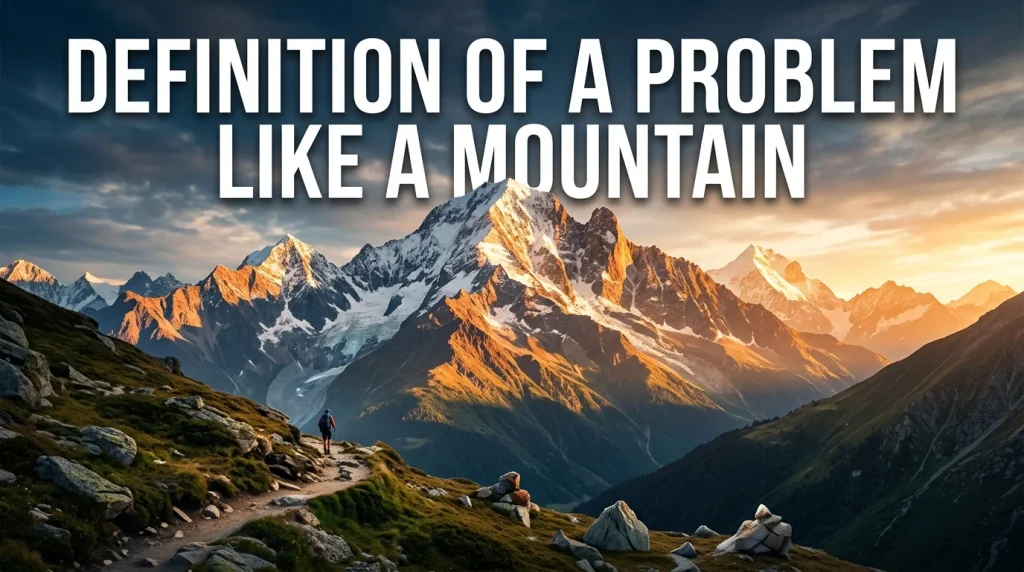
A problem like a mountain is a simile that describes a challenge as something large, imposing, and difficult to overcome. Mountains can be steep, high, and exhausting to climb, so they provide a powerful image of a difficult situation.
This simile is particularly useful when a person faces a major obstacle that requires courage, patience, and sustained effort.
Example: The mountain of unpaid bills stood before him like a giant wall.
The comparison suggests that the bills feel overwhelming. Just as climbing a mountain requires effort and determination, resolving the financial problem may require careful planning and persistence.
What This Simile Communicates
- Size: The problem feels enormous.
- Difficulty: Overcoming it requires considerable effort.
- Persistence: Progress may be slow, but continued effort can help.
- Achievement: Reaching the top of a mountain can symbolize successfully overcoming a challenge.
When This Simile Is Most Effective
Use a mountain comparison when describing a major personal, academic, professional, or financial challenge. It is especially effective in motivational writing because it suggests that difficult situations can be overcome one step at a time.
Definition of a Problem Like a Tangled Knot
A problem like a tangled knot is a simile that describes a complicated situation in which different issues are connected and difficult to separate.
A tangled knot can be frustrating because pulling one strand may tighten another. Similarly, a complicated problem may involve several causes, conflicting interests, or consequences that make it difficult to solve.
Example: The disagreement between the two departments was like a tangled knot that became tighter every time they argued.
This comparison emphasizes confusion and complexity rather than the sheer size of the problem.
What This Simile Communicates
- Complexity: Several parts of the problem are connected.
- Confusion: It may be difficult to identify the main issue.
- Interdependence: Changing one part may affect another.
- Patience: Careful analysis is often more effective than rushing.
When This Simile Is Most Effective
Use the tangled-knot simile when writing about misunderstandings, complicated relationships, organizational difficulties, technical issues, or situations involving multiple connected causes.
It works particularly well when the solution requires separating the different parts of a problem and addressing them individually.
Definition of a Problem Like a Puzzle
A problem like a puzzle is a simile that presents a challenge as something that can be understood or solved by finding the correct pieces and arranging them appropriately.
Puzzles often require observation, logical thinking, experimentation, and patience. In the same way, many real-world problems become easier when people collect information, recognize patterns, and consider possible solutions.
Example: Solving the mystery of the missing data was like completing a puzzle with several important pieces missing.
The comparison emphasizes investigation and discovery. Rather than presenting the problem as an overwhelming obstacle or a confusing tangle, it suggests that a solution may emerge when the available information is assembled correctly.
What This Simile Communicates
- Investigation: More information may be needed.
- Reasoning: The solution requires thought and analysis.
- Discovery: Individual clues can reveal a larger pattern.
- Progress: Each new piece of information can bring the solution closer.
When This Simile Is Most Effective
Use the puzzle comparison in education, science, research, detective stories, technology, business analysis, and other situations in which solving a problem involves finding clues or connecting information.
Main Differences Between a Problem Like a Mountain, a Tangled Knot, and a Puzzle
Although all three similes describe problems, each creates a different mental image. Choosing the right one depends on what aspect of the difficulty you want readers to notice.
| Feature | Mountain | Tangled knot | Puzzle |
| Main idea | A major obstacle | A complicated situation | A challenge requiring reasoning |
| Focus | Size and difficulty | Confusion and connections | Clues and solutions |
| Emotional tone | Overwhelming or inspiring | Frustrating or confusing | Curious or analytical |
| Typical response | Show determination | Untangle the different issues | Find and connect the missing pieces |
| Common contexts | Personal goals, debt, examinations | Relationships, negotiations, management | Science, education, research |
| Implied solution | Climb step by step | Separate and resolve connected issues | Gather evidence and assemble the answer |
| Example | The task was like climbing a mountain. | The dispute was like a tangled knot. | The mystery was like a puzzle. |
Difference in Meaning
The mountain simile emphasizes how difficult a problem feels. The tangled-knot simile emphasizes how complicated it is. The puzzle simile emphasizes the thinking and investigation needed to solve it.
Consider these three sentences:
- Mountain: Finishing the project in one day was like climbing a mountain.
- Tangled knot: Resolving the team’s conflicting priorities was like untangling a knot.
- Puzzle: Identifying the cause of the software failure was like solving a puzzle.
All three sentences describe problems, but they highlight different aspects of the situation.
Difference in Emotional Tone
The mountain simile can communicate fear, determination, or accomplishment. The tangled-knot simile often communicates frustration or confusion. The puzzle simile usually suggests curiosity, investigation, or intellectual effort.
Writers should consider this emotional effect when selecting a comparison. A motivational speech may benefit from the mountain image, while a scientific explanation may benefit from the puzzle image.
Difference in Problem-Solving Approach
Each comparison suggests a different response:
- Mountain: Break the challenge into smaller steps and keep moving forward.
- Tangled knot: Identify the connected issues and separate them carefully.
- Puzzle: Collect relevant information, identify patterns, and test possible answers.
These approaches are useful metaphors rather than strict rules. Real problems can involve all three characteristics at once.
Other Effective Similes for Problems
Writers can use many other similes to describe difficulties. The best choice depends on the kind of problem and the effect the writer wants to create.
| Simile | Meaning | Example |
| A problem is like a storm | A difficult situation feels intense or chaotic. | The crisis was like a storm sweeping through the office. |
| A problem is like a maze | It is difficult to find the correct path. | The application process was like a maze with no clear exit. |
| A problem is like a locked door | Progress is blocked until a solution is found. | The missing password was like a locked door preventing access to the files. |
| A problem is like a ticking clock | Time is running out. | The approaching deadline was like a ticking clock. |
| A problem is like a heavy burden | The difficulty creates emotional or practical pressure. | Caring for everyone alone felt like carrying a heavy burden. |
| A problem is like a shadow | It continues to follow or affect someone. | The unresolved argument followed them like a shadow. |
| A problem is like a thorn in one’s side | It is a persistent source of irritation. | The repeated error was like a thorn in the team’s side. |
| A problem is like a slippery slope | One difficulty may lead to further difficulties. | Ignoring small security flaws was like stepping onto a slippery slope. |
| A problem is like a broken bridge | It interrupts a connection or prevents progress. | The communication gap was like a broken bridge between the teams. |
| A problem is like a leaking roof | It may appear manageable but continues causing damage. | The neglected maintenance issue was like a leaking roof during a storm. |
These comparisons expand a writer’s options beyond the three main similes and allow more precise descriptions of challenges.
Grammar Guide
A simile is a figure of speech that compares two different things to help explain an idea or create a vivid image. Similes commonly use “like” or “as” to make the comparison.
For example:
- The problem was like a mountain.
- Her worries were like storm clouds.
- The situation was as confusing as a maze.
The word problem is a noun. The words mountain, knot, and puzzle are also nouns. In these examples, the linking verb is or was connects the subject to a comparison.
How Each Term Is Used in Sentences
The three main similes can be used in several grammatical patterns.
Pattern 1: Subject + linking verb + like + noun phrase
- The challenge is like a mountain.
- The disagreement is like a tangled knot.
- The investigation is like a puzzle.
feels/seems + like + noun phrase
- The assignment feels like a mountain to me.
- The situation seems like a tangled knot.
- The search for the truth feels like a puzzle.
is/was + as + adjective + as + noun
- The problem is as difficult as climbing a mountain.
- The situation is as complicated as a tangled knot.
- The investigation is as challenging as a difficult puzzle.
The third pattern uses an adjective to express the shared quality. It is related to the same general idea but is not identical to the noun-based simile.
Pattern 4: Verb + object + like + noun phrase
- She approached the challenge like a climber facing a mountain.
- He worked through the disagreement like someone untangling a knot.
- The researcher examined the evidence like a person solving a puzzle.
These patterns can be adapted to past, present, and future situations.
Common Mistakes Learners Make
1. Confusing a simile with a literal statement
Incorrect: The problem is a mountain blocking the road.
This sentence sounds literal unless the surrounding context makes the figurative meaning clear.
Better: The problem was like a mountain standing in our way.
2. Using the wrong comparison for the intended meaning
If the problem is complicated, calling it a mountain may emphasize its difficulty but not its complexity. A tangled knot may be more precise.
If the challenge involves collecting clues, a puzzle may communicate the intended idea more clearly.
3. Forgetting the word “like”
Incorrect: The problem was a mountain of difficulty.
This may still work as a metaphor, but it is not a simile using like.
Better: The problem was like a mountain of difficulty.
4. Confusing “like” and “as”
Incorrect: The problem was as a mountain.
Better: The problem was like a mountain.
For a comparison with as, use a structure such as “as difficult as a mountain climb.”
5. Mixing incompatible images
A sentence such as “The problem was a mountain that needed untangling” mixes the mountain and knot images confusingly.
Better: “The problem was like a mountain we had to climb.”
Or: “The problem was like a knot we had to untangle.”
Mixing images can be intentional in creative writing, but it should not distract readers from the meaning.
Simple Rules to Remember
- Use mountain when you want to emphasize the size or difficulty of a challenge.
- Use tangled knot when you want to emphasize complexity or connected issues.
- Use puzzle when you want to emphasize reasoning, investigation, or finding answers.
- Use like to introduce a noun-based comparison.
- Use as … as to compare qualities, such as difficulty or complexity.
- Make sure the comparison communicates the intended idea clearly.
- Remember that a simile is figurative language, not a literal description.
Quick Tips for Writing and Speaking
- Identify the main quality of the problem. Ask whether it is overwhelming, complicated, or mysterious.
- Choose a familiar image. Readers understand common objects and experiences more easily.
- Avoid unnecessary exaggeration. A small inconvenience may not need a mountain comparison.
- Keep the sentence natural. Use one clear comparison instead of several competing images.
- Match the tone to the situation. A puzzle may sound analytical, while a storm may sound dramatic.
- Explain the comparison when necessary. In academic writing, make the intended meaning clear.
- Vary your language. Repeating the same simile can make a paragraph feel predictable.
When to Use Each One
When to Use a Mountain Simile
Use a mountain comparison when the problem is large, demanding, or intimidating.
Appropriate situations include:
- Preparing for a difficult examination.
- Paying off substantial debt.
- Recovering from a major setback.
- Completing a demanding project.
- Achieving a long-term personal goal.
Example: Learning an entirely new language seemed like climbing a mountain, but daily practice made the task manageable.
When to Use a Tangled-Knot Simile
Use a tangled-knot comparison when several issues are connected or when a situation is difficult to understand.
Appropriate situations include:
- Resolving family disagreements.
- Managing conflicting workplace priorities.
- Understanding complicated instructions.
- Negotiating a difficult agreement.
- Investigating a problem with multiple causes.
Example: The contract dispute was like a tangled knot because each clause affected several other parts of the agreement.
When to Use a Puzzle Simile
Use a puzzle comparison when a problem involves finding clues, connecting information, or discovering a solution.
Appropriate situations include:
- Solving mathematics questions.
- Conducting scientific research.
- Debugging software.
- Investigating a mystery.
- Analysing business performance.
Example: Finding the reason for the sudden drop in sales was like solving a puzzle, with each customer interview providing another clue.
When NOT to Use Each One

When Not to Use a Mountain Simile
Avoid using a mountain comparison when the problem is minor, and the image would make the situation sound unnecessarily dramatic.
For example, saying “Choosing what to eat for lunch was like climbing a mountain” may be humorous, but it would be excessive in a serious explanation unless the exaggeration is intentional.
A mountain simile is also less precise when the main issue is confusion rather than difficulty.
When Not to Use a Tangled-Knot Simile
Avoid a tangled-knot comparison when the problem is straightforward and has little complexity.
For example, “Adding two numbers was like untangling a knot” would sound unnatural in an ordinary mathematical explanation.
It is also not the best choice when the main challenge is simply the amount of effort required.
Self-Assessment: Fill in the Blanks
Complete each sentence by choosing the most appropriate simile: mountain, tangled knot, or puzzle. Some questions test the meaning of the comparison, while others test its suitability for a particular context.
For each question, identify the best answer and explain why it fits.
- Preparing for an extremely difficult professional examination felt like climbing a ______ because it required months of effort.
- The disagreement involved several connected misunderstandings, making it resemble a ______.
- The detective treated the collection of clues as a ______ that needed to be solved.
- Paying off a large amount of debt seemed like climbing a ______.
- The software failure involved several interacting components, so diagnosing it was like untangling a ______.
- The scientist compared the missing evidence to pieces of a ______.
- Finishing the enormous construction project felt like climbing a ______.
- Resolving the complicated contract dispute was like untangling a ______.
- Finding the hidden pattern in the research data was like solving a ______.
- The employee felt overwhelmed by the amount of work ahead, describing it as a ______ to climb.
- The family argument included years of unresolved issues, creating a ______ that required patience to untangle.
- Each new clue helped the investigator complete the ______.
- Understanding the many connected causes of the economic problem was like dealing with a tangled ______.
- The difficult personal challenge appeared to be a ______, but breaking it into smaller steps made it manageable.
- The technician examined logs, errors, and test results as pieces of a ______.
- When describing a challenge that is huge and intimidating, the most suitable comparison is a ______.
- When describing a confusing situation with several connected causes, the best comparison is a tangled ______.
- When describing a mystery that requires evidence and logical reasoning, the best comparison is a ______.
- The project seemed impossible at first, like a ______, but the team made progress by completing one stage at a time.
- The manager examined conflicting deadlines, budgets, and staff concerns as though they formed a tangled ______.
Answers
- Mountain: The examination requires sustained effort and feels like a major obstacle.
- Tangled knot: The misunderstandings are connected and difficult to separate.
- Puzzle: The detective must use clues to discover a solution.
- Mountain: The debt is a major challenge that requires persistence.
- Tangled knot: Several interacting components make the problem complicated.
- Puzzle: The missing evidence represents pieces needed to understand the larger picture.
- Mountain: The project is enormous and requires substantial effort.
- Tangled knot: The contract dispute contains connected issues that need careful resolution.
- Puzzle: The scientist must identify patterns in the data.
- Mountain: The amount of work feels overwhelming.
- Tangled knot: The family conflict contains several connected and unresolved issues.
- Puzzle: The investigator combines clues to conclude.
- Tangled knot: Multiple connected causes make the economic problem complicated.
- Mountain: The challenge initially seems large and difficult to overcome.
- Puzzle: The technician uses evidence from different sources to identify the cause.
- Mountain: A mountain conveys size, difficulty, and the effort needed to overcome an obstacle.
- Knot: A tangled knot conveys confusion and interconnected causes.
- Puzzle: A puzzle conveys investigation, reasoning, and the discovery of an answer.
- Mountain: The team overcomes a difficult challenge through steady progress.
- Knot: The manager must separate and resolve several connected concerns.
Final Verdict
The best simile for a problem depends on the quality you want to emphasize. A mountain, a tangled knot, and a puzzle are all correct comparisons, but they communicate different ideas.
- Choosing a problem is like a mountain when the challenge is large, difficult, or overwhelming.
- Choosing a problem is like a tangled knot when the situation is confusing or contains several connected issues.
- Choosing a problem is like a puzzle when the solution requires clues, reasoning, or careful investigation.
From a grammatical perspective, all three are valid similes when used naturally in a sentence. The word problem is a noun, and the comparison introduced by like helps explain its characteristics through a familiar image.
The key is to match the comparison to the meaning. When you want to express difficulty, choose a mountain. you want to express complexity, choose a tangled knot. you want to express investigation and discovery, choose a puzzle.
By selecting the most appropriate simile, you can make your writing clearer, more vivid, and more engaging while helping readers understand not only that a problem exists, but also what makes it challenging and how it might be approached.
Conclusion
Similes for problems are a creative and effective way to describe challenges, explain difficult situations, and make writing more interesting. By comparing problems to familiar things, such as mountains, tangled knots, puzzles, storms, or mazes, you can help readers understand not only what a problem feels like but also why it may be difficult to solve. Each simile has a different meaning and purpose. A mountain represents a major obstacle, a tangled knot suggests confusion and complexity, and a puzzle highlights the need for careful thinking and investigation.
When choosing similes for problems, consider the situation, the message you want to communicate, and the emotions you want your readers to experience. Using the right comparison can make school assignments, stories, conversations, and professional writing clearer and more engaging. With practice, you can use these figurative expressions naturally and confidently. Ultimately, the best simile is one that makes a problem easier to imagine, understand, and approach with a positive mindset.
FAQs
What are similes for problems?
Similes for problems are figurative expressions that compare difficulties to familiar objects, situations, or experiences using words such as “like” or “as.” They help readers understand challenges more clearly. For example, saying “the problem was like a mountain” suggests that the difficulty feels large and requires considerable effort to overcome.
What is a good simile for a difficult problem?
A good simile for a difficult problem is “the problem was like climbing a mountain.” This comparison communicates the effort, patience, and determination required to overcome a major challenge. It works well in personal writing, motivational speeches, school assignments, and everyday conversations about difficult tasks or demanding goals.
What is a simile for a complicated problem?
A useful simile for a complicated problem is “the situation was like a tangled knot.” This expression suggests that several issues are connected, making the situation confusing or difficult to resolve. It is particularly effective when describing disagreements, complicated relationships, workplace challenges, or problems involving multiple causes.
What is a simile for a problem that needs a solution?
“The problem was like a puzzle” is an effective simile for a challenge that requires careful thinking and investigation. It suggests that the solution can be discovered by gathering information, recognizing patterns, and connecting the relevant pieces. This comparison is especially useful in education, science, technology, and mystery writing.
How do similes help describe problems?
Similes make abstract problems easier to imagine by comparing them to familiar experiences. Instead of simply saying that a problem is difficult, a writer can compare it to a mountain, storm, or maze. These comparisons add descriptive detail, communicate emotions, and help readers understand the nature of a challenge more effectively.
What is the difference between a simile and a metaphor for a problem?
A simile compares a problem to something else using words such as “like” or “as,” as in “the problem was like a mountain.” A metaphor makes a direct comparison, as in “the problem was a mountain.” Both forms of figurative language make descriptions more vivid, but they express comparisons differently.
Can I use similes for problems in academic writing?
Yes, similes can be useful in academic writing when they clarify a difficult concept or make an explanation easier to understand. For example, describing a complex system as a tangled knot can help introduce its interconnected parts. However, formal writing should use figurative comparisons carefully and provide precise explanations when necessary.
What are some short similes for problems?
Short similes for problems include “like climbing a mountain,” “like solving a puzzle,” “like untangling a knot,” “like navigating a maze,” and “like weathering a storm.” Each expression highlights a different aspect of difficulty, from overwhelming obstacles to confusing situations. Choose the comparison that best fits your intended meaning.
How can students use similes for problems in sentences?
Students can use similes to make essays, stories, poems, and descriptive paragraphs more engaging. For example, “The mathematics assignment was like a puzzle waiting to be solved” describes a challenge that requires reasoning. Students should choose familiar comparisons, use appropriate grammar, and explain the intended meaning when clarity is important.
Which simile is best for describing an overwhelming problem?
“The problem was like a mountain” is often the best choice for describing an overwhelming problem because it emphasizes size, difficulty, and the effort needed to make progress. If the problem is confusing rather than overwhelming, a tangled knot may be more suitable. The best simile depends on the characteristic you want to emphasize.