
Knowing whether to say “thanks a lot” can help you sound polite, natural, and confident in everyday communication. This common expression is used to show appreciation, but its meaning can sometimes change depending on tone and context. Understanding when to use it, what it means, and how it compares with similar expressions will help you communicate more effectively.
Comparison Overview
“Thanks a lot” is a common English expression used to show gratitude. It is often used in conversations, emails, text messages, and other everyday situations. However, learners sometimes wonder whether it is grammatically correct, whether it sounds natural, and whether it is interchangeable with expressions such as “thank you very much” and “thanks so much.”
Although these expressions share a similar purpose, they can differ in tone, formality, and emotional emphasis.
This article compares three useful expressions:
- Thanks a lot: A friendly, conversational way to express gratitude.
- Thank you very much: A polite expression suitable for formal and informal situations.
- Thanks so much: A warm, friendly expression that often conveys enthusiasm or heartfelt appreciation.
The central question is whether you should say “thanks a lot” and when another expression might be a better choice.
Definition of Thanks a Lot

“Thanks a lot” is an informal or conversational expression used to show appreciation for someone’s help, kindness, support, gift, or service.
It is a natural and grammatically acceptable expression in English. People commonly use it when thanking friends, colleagues, family members, classmates, customers, and acquaintances.
Meaning of Thanks a Lot
The expression means approximately “thank you very much” or “I appreciate it a great deal.”
For example:
- “Thanks a lot for helping me with my homework.”
- “Thanks a lot for the birthday present.”
- “Thanks a lot for sending me the information.”
In each example, the speaker expresses gratitude for something another person has done.
Can Thanks a Lot Be Sarcastic?
Yes. Although “thanks a lot” normally expresses gratitude, it can also communicate annoyance, frustration, or sarcasm.
For example:
“Thanks a lot for telling everyone my secret!”
The speaker is probably not genuinely grateful. Instead, the expression suggests that the other person has done something upsetting.
Tone of voice, facial expression, punctuation, and the surrounding conversation help determine whether the expression is sincere or sarcastic.
Is Thanks a Lot Grammatically Correct?
Yes. “Thanks a lot” is a standard English expression. It is not grammatically incorrect simply because it is informal.
It works especially well in everyday conversations and friendly messages. In a formal letter or professional email, “Thank you very much” may be a more suitable choice.
Definition of Thank You Very Much
“Thank you very much” is a polite expression used to communicate strong appreciation. It is appropriate in both formal and informal English, making it a versatile option.
It is especially useful when speaking to someone you do not know well, addressing a customer, writing a professional email, or expressing gratitude in a respectful setting.
Meaning of Thank You Very Much
The expression means that you are sincerely grateful for something someone has done.
Examples include:
- “Thank you very much for your time.”
- “Thank you very much for considering my application.”
- “Thank you very much for your assistance.”
These sentences communicate appreciation clearly without relying on an informal conversational style.
When Is Thank You Very Much Most Appropriate?
Use “thank you very much” when you want to sound polite, professional, respectful, or particularly appreciative.
Common situations include:
- Writing a formal business email.
- Thanking a teacher for additional guidance.
- Expressing appreciation to a customer or client.
- Thanking an interviewer after a job interview.
- Responding politely to a generous offer.
The expression is not limited to formal settings. You can also use it with friends and family when you want to emphasize your gratitude.
Definition of Thanks So Much
“Thanks so much” is a friendly expression used to communicate sincere appreciation. It is common in everyday conversations, personal messages, workplace communication, and informal emails.
Like “thanks a lot,” it is generally conversational. However, “thanks so much” often sounds especially warm or enthusiastic.
Meaning of Thanks So Much
The expression means approximately “thank you very much” or “I really appreciate what you have done.”
Examples include:
- “Thanks so much for your help.”
- “Thanks so much for remembering my birthday.”
- “Thanks so much for sending those documents.”
The expression works particularly well when you want to sound friendly and appreciative.
Is Thanks So Much Formal or Informal?
“Thanks so much” is generally informal or semi-formal. It is acceptable in many professional emails, especially when communicating with colleagues, familiar clients, or people with whom you have an established relationship.
However, “Thank you very much” may be preferable in highly formal correspondence.
For example:
- Friendly workplace email: “Thanks so much for sharing the report.”
- Formal business correspondence: “Thank you very much for providing the report.”
Both sentences are correct, but the second has a more formal tone.
Main Differences Between Thanks a Lot, Thank You Very Much, and Thanks So Much
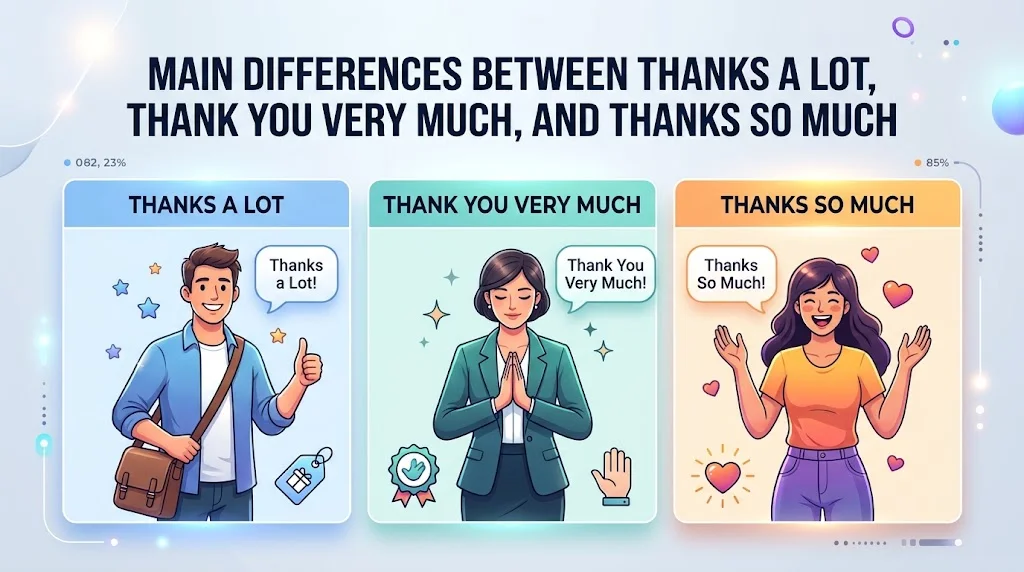
All three expressions communicate gratitude, but they differ slightly in tone, formality, and the situations in which they are most effective.
Comparison Table
| Feature | Thanks a Lot | Thank You Very Much | Thanks So Much |
| Main purpose | Express gratitude | Express polite gratitude | Express warm gratitude |
| Formality | Informal | Formal or informal | Informal or semi-formal |
| Tone | Friendly, sometimes sarcastic | Polite and respectful | Warm and enthusiastic |
| Common setting | Daily conversations | Professional and everyday communication | Conversations and friendly messages |
| Suitable for emails | Yes, especially informal emails | Yes, including formal emails | Yes, especially friendly or semi-formal emails |
| Can sound sarcastic? | Yes, particularly in negative contexts | Possible, but less commonly interpreted that way | Possible, depending on tone |
| Example | “Thanks a lot for the ride.” | “Thank you very much for your assistance.” | “Thanks so much for the lovely gift.” |
Difference in Meaning
The three expressions have nearly the same basic meaning. None is automatically more sincere than the others.
The difference is usually how the speaker presents their gratitude.
“Thanks a lot” is straightforward and conversational. “Thank you very much” sounds polite and somewhat more formal. “Thanks so much” often conveys warmth and personal enthusiasm.
For example:
- “Thanks a lot for the advice.” — Friendly and natural.
- “Thank you very much for the advice.” — Polite and respectful.
- “Thanks so much for the advice.” — Warm and appreciative.
All three sentences are correct.
Difference in Formality
Formality is one of the most useful ways to distinguish these expressions.
“Thank you very much” is generally the safest choice when writing to someone in a position of authority or someone you do not know well.
“Thanks a lot” is usually better suited to casual conversations, familiar colleagues, and informal messages.
“Thanks so much” sits between casual and semi-formal communication. It can be appropriate in many professional situations, provided the overall tone of the message is friendly.
Difference in Emotional Emphasis
“Thanks a lot” can express ordinary gratitude without adding much emotional emphasis.
“Thank you very much” emphasizes appreciation in a polite and respectful way.
“Thanks so much” often sounds enthusiastic or heartfelt, especially when responding to a thoughtful gesture.
However, these differences are not fixed rules. Context, relationship, and tone of voice matter more than the words alone.
Should You Say Thanks a Lot?
Yes, you can say “thanks a lot.” It is a correct, natural, and widely understood English expression.
The best choice depends on the situation and the impression you want to create.
Situations Where Thanks a Lot Works Well
You can comfortably use “thanks a lot” when:
- A friend helps you complete a task.
- A colleague sends you a useful document.
- Someone gives you directions.
- A family member brings you something you need.
- A classmate shares study notes.
- Someone helps you solve a technical problem.
For example:
“Thanks a lot for explaining that formula. I understand it now.”
This sounds natural and friendly.
When You Might Choose Another Expression
If you are writing a formal business letter, addressing a senior official, or thanking someone for a significant professional favor, you may prefer “Thank you very much.”
If you want to sound especially warm in a personal message, “Thanks so much” may be a better fit.
For example:
- Formal: “Thank you very much for your consideration.”
- Friendly: “Thanks a lot for picking me up.”
- Warm: “Thanks so much for making my birthday special.”
The goal is not to avoid “thanks a lot,” but to select the expression that fits the relationship and context.
Grammar Guide
Understanding the grammar behind these expressions makes it easier to use them correctly.
How Each Term Is Used in Sentences
1. Thanks a Lot
“Thanks a lot” is a fixed expression of gratitude.
A common pattern is:
Thanks a lot + for + noun or gerund
Examples:
- “Thanks a lot for the invitation.”
- “Thanks a lot for helping me.”
- “Thanks a lot for your support.”
You can also use it as a complete response:
“Thanks a lot!”
Here, “thanks” functions as an expression of gratitude, while “a lot” emphasizes its degree.
2. Thank You Very Much
“Thank you very much” is another established expression.
A common pattern is:
Thank you very much + for + noun or gerund
Examples:
- “Thank you very much for your advice.”
- “Thank you very much for attending the meeting.”
- “Thank you very much for helping us.”
You can also use it without adding an explanation:
“Thank you very much.”
This is a complete and grammatically correct expression.
3. Thanks So Much
“Thanks so much” follows a similar pattern.
A common structure is:
Thanks so much + for + noun or gerund
Examples:
- “Thanks so much for the recommendation.”
- “Thanks so much for checking the figures.”
- “Thanks so much for being there for me.”
It can also stand alone:
“Thanks so much!”
Common Mistakes Learners Make
Mistake 1: Using the Wrong Preposition
Incorrect: “Thanks a lot to helping me.”
Correct: “Thanks a lot for helping me.”
Use “for” before the noun or gerund that identifies what you are grateful for.
Mistake 2: Writing Thanks a Lot as One Word
Incorrect: “Thanksalot for your help.”
Correct: “Thanks a lot for your help.”
The expression consists of three separate words.
Mistake 3: Assuming Thanks a Lot Is Always Sarcastic
“Thanks a lot” is not inherently sarcastic.
It can be completely sincere:
“Thanks a lot for helping me move house.”
Sarcasm depends on the situation and how the words are delivered.
Mistake 4: Confusing Thanks With Thank
“Thanks” can stand alone as an expression of gratitude.
“Thank” is commonly used with an object, as in “I thank you for your support,” or in the fixed expression “Thank you.”
Both “Thanks a lot” and “Thank you very much” are correct. Do not combine their structures unnecessarily.
Mistake 5: Using a Gerund Incorrectly
Incorrect: “Thank you very much for help me.”
Correct: “Thank you very much for helping me.”
After “for” in these expressions, use a noun or a gerund, which is the -ing form of a verb functioning as a noun.
Mistake 6: Assuming Informal Expressions Are Grammatically Wrong
“Thanks a lot” and “thanks so much” are not incorrect simply because they are conversational.
They are suitable for many everyday situations. Formality is a question of style and context, not basic grammatical correctness.
Simple Rules to Remember
- Use “thanks a lot” for friendly, everyday gratitude.
- Use “thank you very much” when you want a polite and versatile expression.
- Use “thanks so much” when you want to sound warm and appreciative.
- Use “for” before the thing you are grateful for: “Thanks for helping.”
- Use a noun or an -ing verb after “for”: “for the advice” or “for explaining.”
- Remember that “thanks a lot” can be sincere or sarcastic, depending on context.
- Do not confuse informal language with incorrect grammar.
Quick Tips for Writing and Speaking
- For friends: “Thanks a lot for inviting me.”
- For professional emails: “Thank you very much for your assistance.”
- For a warm personal message: “Thanks so much for everything.”
- For a short text message: “Thanks a lot!”
- For a formal acknowledgment: “Thank you very much for your time and consideration.”
When in doubt, use “Thank you very much.” It is widely appropriate and unlikely to sound too casual.
Self-Assessment: Fill in the Blanks
Complete the following 20 questions by choosing the most suitable expression:
- A. Thanks a lot
- B. Thank you very much
- C. Thanks so much
Choose the expression that best fits the context. Some questions may allow more than one grammatically correct answer, but select the most appropriate option for the situation described.
- I am writing a formal letter to thank a university professor for reviewing my research. I will use ______ because the situation requires a polite and respectful tone.
- My friend helped me carry some heavy shopping bags. I will use ______ because this is an everyday conversation.
- My sister organized a surprise birthday party for me. I will use ______ because I want to express warm appreciation.
- I am writing to a company to acknowledge its consideration of my job application. I will use ______ because the communication is formal.
- My classmate shared their revision notes before an examination. I will use ______ because this is a friendly, informal situation.
- A colleague helped me prepare a presentation, and I want to sound especially appreciative. I will use ______ because it conveys warmth.
- I am thanking a customer for waiting while a technical issue is resolved. I will use ______ because professional politeness is important.
- My neighbour watered my plants while I was away. I will use ______ because a friendly expression is appropriate.
- My friend gave me a thoughtful gift, and I want to show heartfelt gratitude. I will use ______ because it sounds warm and enthusiastic.
- I am writing a formal email to thank a business partner for providing important documents. I will use ______ because it suits professional communication.
- Someone helped me fix my computer, and we are close friends. I will use ______ because a conversational expression is natural.
- My teacher gave me detailed feedback on an assignment. I will use ______ because I want to communicate respect and appreciation.
- My cousin helped me move into a new apartment. I will use ______ because the situation is personal and informal.
- A colleague stayed late to help me finish a difficult project. I will use ______ because I want to communicate genuine warmth.
- I am writing a formal acknowledgment to a conference organizer for an invitation. I will use ______ because the situation calls for professional courtesy.
- A friend sent me a useful website link. I will use ______ because a brief, friendly thank-you is appropriate.
- My family prepared a special dinner for me. I will use ______ because I want to sound heartfelt and appreciative.
- I am thanking a customer for providing feedback about a service. I will use ______ because the response should be polite and professional.
- My classmate explained a difficult science concept during a study session. I will use ______ because a casual expression suits the situation.
- A colleague supported me throughout a challenging week, and I want to express sincere appreciation. I will use ______ because it sounds warm and personal.
Answers
- Thank you very much: A formal letter to a professor benefits from a polite and respectful expression.
- Thanks a lot: This is a natural choice for an everyday interaction with a friend.
- Thanks so much: The expression conveys warmth and heartfelt appreciation.
- Thank you very much: It is appropriate for formal job application correspondence.
- Thanks a lot: It fits a friendly interaction between classmates.
- Thanks so much: It emphasizes warmth and appreciation for a colleague’s help.
- Thank you very much: It is suitable for professional customer communication.
- Thanks a lot: It sounds natural when thanking a neighbour for a practical favour.
- Thanks so much: It communicates warm appreciation for a thoughtful gift.
- Thank you very much: It maintains a professional tone in a business email.
- Thanks a lot: It is a natural conversational choice between close friends.
- Thank you very much: It expresses polite appreciation for a teacher’s feedback.
- Thanks a lot: It is suitable for an informal personal situation.
- Thanks so much: It communicates sincere gratitude for a significant favour.
- Thank you very much: It is appropriate for formal communication with an event organizer.
- Thanks a lot: It is a friendly, natural response to someone sharing a link.
- Thanks so much: It conveys warmth and heartfelt gratitude for the special dinner.
- Thank you very much: It is suitable for a polite professional response to customer feedback.
- Thanks a lot: It is appropriate for a casual study session with a classmate.
- Thanks so much — It expresses warm appreciation for ongoing personal or professional support.
Note: These answers identify the best expression for each stated context, not the only grammatically possible answer. All three expressions can be used sincerely in many situations.
Final Verdict
Yes, you should say “thanks a lot” when you want to express gratitude in a natural, friendly, and conversational way. It is grammatically correct, widely understood, and suitable for everyday communication. However, its tone can occasionally sound sarcastic, so context and delivery matter.
Choose “thanks a lot” for casual conversations, “thank you very much” for polite and formal communication, and “thanks so much” when you want to express warm or heartfelt appreciation.
The most important point is that all three expressions are correct. The best choice depends on your audience, the situation, and the tone you want to convey. Once you understand these small differences, you can use each expression confidently in conversations, emails, professional writing, and everyday life.
Conclusion
Understanding whether you should say “thanks a lot” helps you communicate gratitude naturally and confidently in everyday English. The expression is grammatically correct, friendly, and widely used in conversations, text messages, and informal workplace communication. However, its meaning can sometimes depend on your tone, as “thanks a lot” may express genuine appreciation or sarcasm in certain situations.
If you want a polite and professional expression, “thank you very much” is an excellent choice for formal emails, business correspondence, and respectful conversations. On the other hand, “thanks so much” is ideal when you want to express warmth, enthusiasm, and heartfelt appreciation. Although these expressions have similar meanings, choosing the right one can make your communication sound more appropriate and natural.
Ultimately, there is no need to avoid saying “thanks a lot.” Simply consider your audience, the situation, and your intended tone. By understanding these subtle differences, you can express gratitude clearly, improve your English communication skills, and choose the most suitable expression with confidence.
FAQs
Is “thanks a lot” grammatically correct?
Yes, “thanks a lot” is grammatically correct and commonly used in English. It is a conversational expression that communicates gratitude for someone’s help, kindness, or support. You can use it in everyday conversations, text messages, and informal emails. In more formal situations, “thank you very much” may be a more appropriate choice.
What does “thanks a lot” mean?
“Thanks a lot” means that you appreciate something someone has done for you. It can express gratitude for assistance, gifts, advice, kindness, or support. For example, “Thanks a lot for helping me with my homework” shows appreciation. Depending on the situation and tone of voice, the expression can also communicate sarcasm or frustration.
Is “thanks a lot” formal or informal?
“Thanks a lot” is generally considered informal or conversational. It works well when speaking with friends, family members, classmates, and familiar colleagues. Although it is not incorrect in professional communication, “thank you very much” may sound more polished in formal letters, business emails, job applications, and communications with people you do not know well.
Is “thanks a lot” sarcastic?
“Thanks a lot” is not inherently sarcastic. People frequently use it to express genuine appreciation. However, it can sound sarcastic when someone uses it after an unpleasant experience or speaks with an annoyed tone. For example, “Thanks a lot for losing my keys!” suggests frustration rather than gratitude. Context and delivery determine the intended meaning.
What is the difference between “thanks a lot” and “thank you very much”?
Both expressions communicate gratitude, but they differ slightly in tone and formality. “Thanks a lot” usually sounds conversational and friendly, while “thank you very much” often sounds more polite and professional. Both are grammatically correct. Choose the expression that best suits your relationship with the recipient and the situation in which you are communicating.
Is “thanks so much” better than “thanks a lot”?
Neither expression is universally better. “Thanks so much” often sounds warm, enthusiastic, and heartfelt, whereas “thanks a lot” is a natural conversational expression. Both can communicate sincere gratitude. If you are thanking someone for a thoughtful gift or meaningful favour, “thanks so much” may feel especially appropriate. Your intended tone should guide your choice.
Can I use “thanks a lot” in a professional email?
Yes, you can use “thanks a lot” in a professional email when the communication is friendly and informal. For example, “Thanks a lot for sending the report” works well with a familiar colleague. For formal business correspondence, client communications, or messages to senior officials, “thank you very much” is often a safer and more professional option.
Should I say “thanks a lot for” or “thanks a lot to”?
Use “thanks a lot for” when identifying what you appreciate. For example, say, “Thanks a lot for helping me,” or “Thanks a lot for the information.” You can also say, “Thanks a lot to everyone who helped,” when addressing the people receiving your gratitude. The correct preposition depends on the sentence structure and intended meaning.
Can I say “thanks a lot” in a text message?
Yes, “thanks a lot” is perfectly natural in text messages. It is short, friendly, and easy to understand. You can use it to thank someone for sharing information, making plans, giving advice, or helping with a task. For example, “Thanks a lot for sending me the address!” is appropriate for everyday digital communication.
What is the best alternative to “thanks a lot”?
The best alternative depends on the tone you want. “Thank you very much” is ideal for polite or formal communication, while “thanks so much” sounds warm and appreciative. Other alternatives include “I really appreciate it,” “many thanks,” and “I’m grateful for your help.” Each expression communicates gratitude, but some are better suited to particular audiences and situations.