
Understanding the difference between similar-sounding expressions is essential for writing clear and grammatically correct English. “Due to” and “do to” may sound alike, but they have different meanings and uses. Using the wrong phrase can change a sentence’s meaning or confuse readers. Learning when and how to use each expression will help you avoid common grammar mistakes and improve your writing skills.
If you’ve ever wondered which phrase is correct, you’re not alone. The difference between “due to” and “do to” often confuses English learners, students, and even experienced writers. Although “due to” expresses a reason or cause, “do to” typically appears in questions or statements about actions performed on someone or something. This guide explores their meanings, explains the rules for correct usage, and provides practical examples to help you confidently choose the right phrase in any context.
Comparison Overview
The expressions “due to” and “do to” sound similar, but they are not interchangeable. The main difference is that “due to” usually expresses a reason or cause, while “do to” is a combination of two separate words used in particular grammatical constructions.
“Due to” is a common expression in everyday conversations, academic writing, business communication, and formal documents. For example, you might write, “The meeting was postponed due to bad weather.”
“Do to” is less common as a standalone phrase. It generally appears when the verb “do” is followed by the preposition “to,” often in questions or negative sentences involving actions and effects. For example, “What did you do to your phone?”
Here is a quick overview of the two expressions:
| Feature | Due to | Do to |
| Meaning | Because of; caused by | Perform an action affecting someone or something |
| Grammatical function | Prepositional expression | Verb “do” followed by the preposition “to” |
| Typical purpose | Explaining reasons or causes | Describing or asking about an action or its effect |
| Common contexts | Delays, problems, explanations, results | Questions, actions, effects, and negative statements |
| Example | The delay was due to traffic. | What did you do to the computer? |
| Frequency | Very common | Less common as a fixed phrase |
| Can the words be interchanged? | No | No |
The key point is that both expressions can be grammatically correct, but they serve different purposes. Your intended meaning determines which one you should use.
Definition of Due To

“Due to” means “because of” or “caused by.” It is used to explain why something happens, why a situation exists, or what causes a particular result.
For example:
- The flight was delayed due to heavy rain.
- The event was canceled due to unforeseen circumstances.
- Her success was due to consistent effort.
- The website was unavailable due to a technical problem.
In each example, “due to” introduces a reason or cause.
Meaning and Purpose of Due To
The primary purpose of “due to” is to establish a relationship between an event, situation, or result and its cause.
Consider this sentence:
“The match was canceled due to bad weather.”
The sentence tells the reader why the match was canceled. Bad weather was the reason for the cancellation.
Similarly:
“His improvement was due to regular practice.”
This sentence explains the reason for his improvement: he practiced regularly.
“Due to” is useful because it allows writers to explain causes clearly and concisely without adding unnecessary words.
Is Due To One Word or Two Words?
“Due to” consists of two separate words. It should not be written as “dueto” or combined into a single word.
Correct: The delay was due to an accident.
Incorrect: The delay was dueto an accident.
The phrase is commonly used in both formal and informal English.
Is Due To a Preposition or a Verb?
In traditional grammar, “due” is an adjective and “to” is a preposition. Together, “due to” functions as a prepositional expression that introduces a cause or reason.
For example:
“The cancellation was due to a power failure.”
Here, “due” describes the reason associated with the cancellation, while “to” introduces the cause.
The expression is not a verb. It does not describe an action performed by a person.
Synonyms for Due To
Depending on the sentence, you can sometimes replace “due to” with:
- Because of
- Owing to
- As a result of
- Caused by
- On account of
Examples:
- The road was closed due to flooding.
- The road was closed because of flooding.
- The road was closed owing to flooding.
These sentences communicate essentially the same reason.
However, synonyms do not always fit every grammatical structure. Always check that the replacement sounds natural in the complete sentence.
Definition of Do To
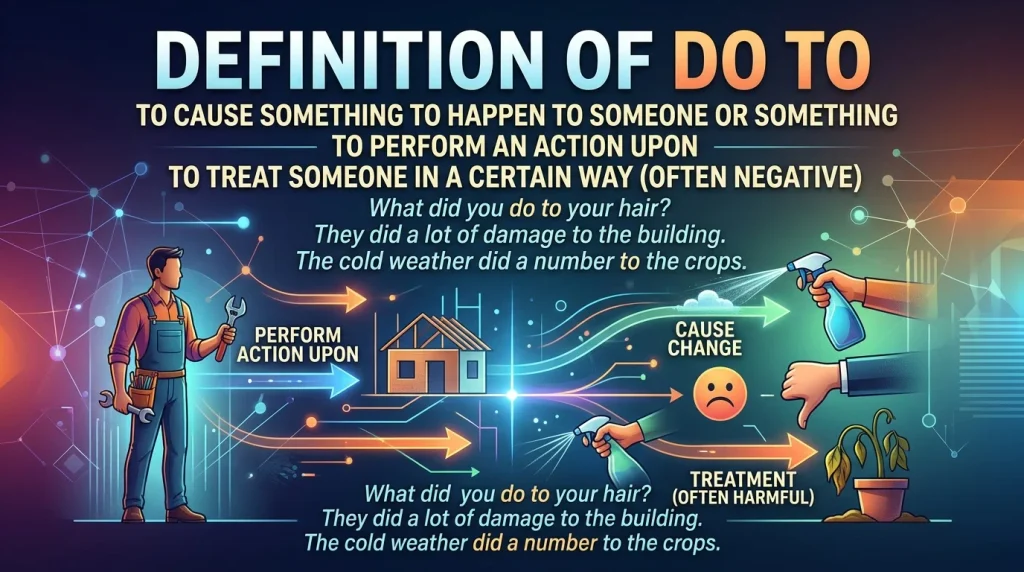
“Do to” combines the verb “do” with the preposition “to.” It commonly appears when describing an action that affects someone or something, or when asking what action caused a particular result.
For example:
- What did you do to my notebook?
- What can we do to improve the process?
- Don’t do to others what you would not want done to you.
- What did the storm do to the coastline?
In these sentences, “do” expresses an action, while “to” connects that action to its target or effect.
Unlike “due to,” the expression “do to” does not mean “because of.”
Meaning and Purpose of Do To
The verb “do” generally refers to performing, carrying out, or completing an action. When it is followed by “to,” the phrase can describe an action directed toward a person, object, situation, or process.
Consider this example:
“What did you do to the computer?”
The speaker is asking what action someone performed that affected the computer.
Now consider:
“What can we do to reduce costs?”
The speaker is asking what actions can be taken to achieve a particular result.
In both cases, “do” refers to an action rather than introducing a reason.
Is Do To a Verb or a Noun?
“Do to” is not a noun and is not a single verb. It consists of two grammatical elements:
- Do: A verb that can mean perform, carry out, or take action.
- To: A preposition that can indicate the person or thing affected by an action.
For example:
“What did the repair work do to the machine?”
The verb “do” appears in the past-tense construction “did … do,” and “to the machine” identifies what was affected.
In other sentences, “do” may be followed by an infinitive construction, such as “What can I do to help?” In this example, “to help” introduces the infinitive verb “help,” rather than a prepositional phrase referring to an affected object.
This distinction matters because the word “to” has more than one grammatical use in English.
Why Do To Is Less Common Than Due To
“Due to” is a familiar expression used to explain causes in many kinds of writing. “Do to,” by contrast, is a grammatical combination whose appearance depends on the sentence structure.
For example:
- The error was due to incorrect settings.
- What did you do to correct the error?
The first sentence explains the cause of an error. The second asks about an action taken to correct it.
The phrases may appear in similar discussions, but their grammatical purposes are different.
Main Differences Between Due To and Do To
The most important difference is that “due to” explains a cause, while “do to” describes or asks about an action or its effect.
Understanding this distinction makes it easier to choose the correct phrase.
1. Difference in Meaning
“Due to” answers questions such as “Why did this happen?” or “What caused this?”
Example: The school closed due to heavy snow.
The snow explains the reason for the closure.
“Due to” is associated with questions such as “What action was performed?” or “What effect did an action have?”
Example: What did the snow do to the roads?
The speaker wants to know how the snow affected the roads.
2. Difference in Grammatical Function
“Due to” functions as a prepositional expression introducing a cause.
Example: The problem was due to a software update.
“Do to” contains a verb and a preposition, although the exact grammatical role of “to” depends on the sentence.
Example: What did the update do to the software?
Here, “did” is the auxiliary verb, “do” is the base-form main verb, and “to the software” identifies what was affected.
3. Difference in Sentence Structure
“Due to” often follows a noun or a form of the verb “be.”
Common patterns include:
- Noun + be + due to + cause
- Event or situation + due to + cause
- Result + be + due to + reason
Examples:
- The cancellation was due to rain.
- The damage was due to a faulty component.
- The delay was due to a scheduling problem.
“Do to” often appears in questions, statements, and instructions involving an action.
Common patterns include:
- What + did + subject + do to + object?
- Subject + do/does + something + to + object
- What can + subject + do to + achieve a result?
Examples:
- What did you do to the door?
- What does stress do to the body?
- What can we do to improve customer service?
4. Difference in Context
“Due to” is commonly used when explaining causes in reports, essays, news stories, workplace communications, and everyday conversations.
Example: Production slowed due to a shortage of materials.
“Do to” is used when describing actions, effects, or possible interventions.
Example: What can the company do to prevent future shortages?
5. Difference in Formal Writing
“Due to” is suitable for formal writing when used appropriately.
Example: The application was rejected due to incomplete documentation.
“Do to” is also grammatically appropriate in formal writing when the intended meaning calls for it.
Example: The researchers investigated what prolonged exposure could do to the material.
Neither expression is universally more correct. The correct choice depends on the meaning and sentence structure.
Due To vs Do To: Comparison Table
The following table summarizes the differences in a practical format.
| Comparison point | Due to | Do to |
| Basic meaning | Because of | Perform an action affecting something |
| Primary role | Introduces a cause | Expresses an action with a related target or effect |
| Main grammatical element | Adjective plus preposition, functioning as a causal expression | Verb plus preposition, or a verb followed by an infinitive marker in other constructions |
| Typical question answered | Why? | What action? What effect? |
| Example | The failure was due to overheating. | What did overheating do to the machine? |
| Business use | The delay was due to supply problems. | What can we do to improve supply reliability? |
| Education use | The absence was due to illness. | What did the experiment do to the sample? |
| Common error | Using it where an action is intended | Using it where a cause is intended |
Paired Examples That Make the Difference Clear
Example 1: A delayed train
- Correct: The train was delayed due to bad weather.
- Correct: What did the bad weather do to the train schedule?
The first sentence explains a cause. The second asks about an effect.
Example 2: A broken phone
- Correct: The damage was due to water exposure.
- Correct: What did you do to the phone?
The first sentence identifies the cause of the damage. The second asks about an action that affected the phone.
Example 3: A business problem
- Correct: The decline in sales was due to reduced demand.
- Correct: What can the company do to increase sales?
The first sentence explains why sales declined. The second asks what action could improve the situation.
Why Do People Confuse Due To and Do To?

People often confuse these expressions because they sound similar when spoken quickly. In ordinary conversation, the difference between the vowel sounds in “due” and “do” may be less obvious to some listeners.
There is also a spelling-related problem: both expressions contain the word “to,” which can make them look similar when read quickly.
However, the most reliable way to distinguish them is to focus on meaning rather than sound.
If you are explaining a reason, “due to” is usually appropriate. If you are describing an action or asking what happened to someone or something, “do to” may be correct.
For example:
- The error occurred due to incorrect input.
- What did the incorrect input do to the results?
Both sentences discuss the same issue, but the first explains a cause and the second asks about an effect.
Grammar Guide
Understanding the grammar behind “due to” and “do to” helps you use them accurately in sentences.
How Each Term Is Used in Sentences
Using Due To in a Sentence
The expression “due to” commonly introduces a reason or cause.
Pattern 1: Subject + be + due to + cause
Examples:
- The delay was due to traffic.
- The cancellation is due to a technical issue.
- The improvement was due to better planning.
Pattern 2: Noun + due to + cause
Examples:
- Problems due to poor communication can affect productivity.
- Delays due to severe weather are sometimes unavoidable.
- Errors due to incorrect calculations can produce misleading results.
Pattern 3: A sentence describing a result caused by something
Examples:
- Attendance declined due to a scheduling conflict.
- The website crashed due to excessive traffic.
- The event succeeded partly due to careful preparation.
In each example, “due to” identifies a reason or contributing factor.
Using Do To in a Sentence
The phrase “do to” appears in several grammatical constructions.
Pattern 1: What + did + subject + do to + object?
Examples:
- What did you do to the equipment?
- What did the chemical do to the surface?
- What did the delay do to the project timeline?
The speaker is asking about an action or its effect.
Pattern 2: Subject + do/does + something + to + object
Examples:
- Excessive heat does damage to certain materials.
- Poor planning can harm a project.
- The procedure does little to address the underlying problem.
In these examples, “do” is part of a verb construction. The object may identify the effect, while “to” introduces what is affected.
Pattern 3: What can + subject + do to + achieve a goal?
Examples:
- What can we do to improve the results?
- What can the school do to support students?
- What can engineers do to reduce energy consumption?
Here, “to improve,” “to support,” and “to reduce” are infinitive constructions expressing a purpose. They are not examples of the fixed causal expression “due to.”
Common Mistakes Learners Make
English learners and native speakers alike sometimes confuse “due to” and “do to.” The following mistakes are especially common.
Mistake 1: Using do to when explaining a cause
Incorrect: The meeting was canceled do to heavy rain.
Correct: The meeting was canceled due to heavy rain.
The sentence explains why the meeting was canceled, so “due to” is required.
Mistake 2: Using due to when asking about an action
Incorrect: What did you due to my laptop?
Correct: What did you do to my laptop?
The sentence asks about an action that affected the laptop. The correct spelling is “do.”
Mistake 3: Assuming both expressions mean because of
Incorrect: The machine stopped working do to overheating.
Correct: The machine stopped working due to overheating.
Only “due to” expresses the intended cause in this example.
Mistake 4: Confusing do with due in questions
Incorrect: What due you do to fix the problem?
Correct: What do you do to fix the problem?
“Do” is a verb or auxiliary verb in the question. “Due” does not fit this grammatical structure.
Mistake 5: Combining the words into one
Incorrect: The failure was dueto overheating.
Correct: The failure was due to overheating.
Both expressions consist of separate words, and “due to” always remains two words.
Self-Assessment: Fill in the Blanks
Test your understanding of “due to” and “do to” by completing the following 20 sentences. Choose the expression that best fits each context. Some questions also test the related use of “due” or the infinitive construction “to + verb.”
Questions
- The outdoor concert was canceled ______ the severe storm.
- What did you ______ my notebook? It has several torn pages.
- The train arrived late ______ a signal failure.
- What can we ______ reduce the amount of waste produced by the factory?
- The website became unavailable ______ a server problem.
- What does excessive heat ______ certain types of plastic?
- The school closed early ______ the unexpected snowfall.
- What did the chemical reaction ______ the original sample?
- The project was delayed ______ a shortage of materials.
- What can the company ______ improve employee satisfaction?
- The road was blocked ______ a fallen tree.
- What did the strong winds ______ the roof of the building?
- The report was submitted late ______ an unexpected technical issue.
- What can students ______ prepare more effectively for their examinations?
- The match was postponed ______ poor weather conditions.
- What does prolonged exposure to sunlight ______ the color of fabric?
- The payment is ______ next Monday.
- What did you ______ to solve the problem yesterday?
- The experiment failed ______ incorrect measurements.
- What can engineers ______ make the system more reliable?
Answers
- Due to: The storm was the reason the concert was canceled.
- Do to: The sentence asks what action affected the notebook.
- Due to: The signal failure explains the train’s delay.
- Do to: “Do” describes an action, and “to reduce” expresses its purpose.
- Due to: The server problem was the cause of the website outage.
- Do to: The question asks about the effect of heat on plastic.
- Due to: The snowfall explains why the school closed early.
- Do to: The sentence asks about the reaction’s effect on the sample.
- Due to: The shortage of materials caused the project delay.
- Do to: The question asks what actions the company can take.
- Due to: The fallen tree caused the road blockage.
- Do to: The sentence asks how the winds affected the roof.
- Due to: The technical issue explains the late submission.
- Do to: “Do” describes actions students can take, while “to prepare” expresses their purpose.
- Due to: Poor weather was the reason for postponing the match.
- Do to: The question asks about sunlight’s effect on fabric color.
- Due: “Due” means expected or required by a particular time. The sentence does not need “due to.”
- Do: The correct construction is “What did you do to solve the problem?” The phrase “to solve” expresses purpose.
- Due to: Incorrect measurements caused the experiment to fail.
- Do to: The sentence asks what actions engineers can take, with “to make” expressing the intended result.
Conclusion
Understanding the difference between “due to” and “do to” can make your writing clearer, more accurate, and more professional. Although these expressions sound similar, they serve different purposes in English grammar. “Due to” means “because of” and is used to explain the reason or cause of something, such as a delay, problem, or unexpected event. For example, “The meeting was canceled due to bad weather.” On the other hand, “do to” combines the verb “do” with “to” and is commonly used when describing actions, asking about effects, or discussing ways to achieve a result.
For example, “What did you do to the computer?” The easiest way to remember the difference is to focus on the meaning of your sentence rather than how the words sound. If you are explaining why something happened, choose “due to.” If you are referring to an action, check whether “do to” fits the grammar. With regular practice, you can use both expressions confidently in everyday conversations, academic writing, and professional communication.
FAQs
Is it due to or do to?
Both expressions are correct, but they have different meanings. “Due to” means “because of” and explains a reason or cause. “Do to” combines the verb “do” with “to” in sentences about actions or effects. For example, “The delay was due to rain” explains a cause, while “What did you do to the door?” asks about an action.
What does due to mean in English?
“Due to” generally means “because of” or “caused by.” It introduces a reason for an event, situation, or result. For example, “The flight was delayed due to fog” explains why the flight arrived late. This expression is common in everyday conversations, academic writing, business emails, and formal reports when explaining causes clearly and concisely.
What does do to mean in a sentence?
“Do to” consists of the verb “do” and the preposition “to,” although “to” can introduce an infinitive in related constructions. The phrase often appears when asking about an action or its effect. For example, “What did you do to my phone?” asks about an action that affected the phone. Its meaning depends on the complete sentence.
Why do people confuse due to and do to?
People often confuse “due to” and “do to” because the expressions sound similar in spoken English. Their spelling also differs by only one letter in the first word. However, their meanings are different. Remembering that “due to” explains a cause, while “do to” involves an action or effect, makes it easier to choose the correct expression.
Can I use due to at the beginning of a sentence?
Yes, “due to” can appear at the beginning of a sentence when the construction is appropriate. For example, “Due to heavy rain, the outdoor event was postponed.” This sentence explains the reason for the postponement. Ensure that the phrase clearly connects to the situation it explains and that the sentence remains natural and grammatically complete.
Is it due to formal or informal English?
“Due to” is appropriate in both formal and informal English. You can use it in business emails, academic essays, reports, announcements, and everyday conversations. For example, “The delay was due to technical problems” works in a professional report or a casual explanation. Depending on the sentence, alternatives such as “because of” may sound more conversational.
Is do to grammatically correct?
Yes, “do to” is grammatically correct when the sentence requires the verb “do” followed by “to.” For example, “What did you do to the computer?” is correct because the speaker asks about an action. However, writing “The computer stopped working do to overheating” is incorrect. In that sentence, “due to” is needed to explain the cause.
How can I remember the difference between due to and do to?
Use a simple meaning-based rule: if you mean “because of,” choose “due to.” If you are describing an action or asking about its effect, check whether “do to” is appropriate. For example, “The problem was due to an error” explains a cause, while “What did the error do to the results?” asks about an effect.
What is the difference between due to and because of?
“Due to” and “because of” often communicate the same basic meaning: a reason or cause. For example, “The game was canceled due to rain” and “The game was canceled because of rain” express essentially the same idea. Their grammatical patterns can differ in some contexts, so choose the wording that makes your complete sentence clear and natural.
What is the correct phrase for explaining a reason in an essay?
“Due to” is often suitable when explaining a reason in an essay, provided it fits the sentence structure. For example, “The results varied due to temperature differences.” You can also use “because of” or “owing to,” depending on the context. Always ensure that the phrase accurately identifies the cause and supports the point you are making.