
“Too many” or “to many”—which expression is correct? These phrases may look almost identical, but they have different grammatical uses. Understanding the difference helps you write clear, correct English in emails, essays, messages, and everyday conversations. In this guide, you will learn their meanings, grammatical rules, common mistakes, and practical examples.
Comparison Overview
“Too many” and “to many” differ in meaning, grammar, and usage. Although they sound similar when spoken quickly, only one is normally used when describing an excessive number of people, objects, or things.
Too many is the correct expression when you mean more than necessary, desirable, or manageable. For example, “There are too many books on the table.”
Too many is not usually a standalone expression meaning an excessive number. However, it can be grammatically correct when “to” functions as a preposition and “many” is a determiner or pronoun within a larger sentence. For example, “The announcement came as a surprise to many.”
The key is to understand the purpose of each word rather than relying only on how the phrase sounds.
Definition of Too Many

“Too many” is an English expression used to describe a number that is greater than necessary, appropriate, or acceptable.
The word “too” means excessively or more than is desirable. The word “many” refers to a large number of countable people, animals, objects, or other items.
Together, “too many” expresses an excessive quantity of things that can be counted individually.
Examples of Too Many
- There are too many students in this classroom.
- I bought too many apples at the supermarket.
- She has too many assignments to finish tonight.
- Too many people were waiting outside the building.
- We made too many mistakes in the first draft.
In each example, “too many” communicates that the quantity exceeds what is needed, expected, or manageable.
Purpose of Too Many
The main purpose of “too many” is to express excess. It often appears in situations involving complaints, warnings, limitations, or observations.
For example:
- Education: There are too many questions on the test.
- Business: The company received too many customer complaints.
- Daily life: I have too many clothes in my wardrobe.
- Technology: Too many applications are running on my computer.
Remember that “too many” is generally used with countable plural nouns, such as books, chairs, people, and tasks.
Definition of To Many
“To many” consists of the preposition “to” and the word “many.” Unlike “too many,” it does not normally express an excessive quantity.
The preposition “to” can indicate direction, a recipient, a relationship, or the person or group toward whom something is directed. The word “many” can refer to a large number of people or things.
When used together, “to many” commonly appears in sentences such as:
- The news was surprising to many.
- This policy is unfair to many workers.
- The announcement came as a shock to many people.
- The new system is useful to many students.
- The experience was meaningful to many participants.
In these sentences, “to” connects the idea to the people affected, while “many” identifies a large number of people.
Purpose of To Many
The phrase “to many” is useful when explaining how something affects, concerns, or relates to a large number of people.
For example:
- Education: The new grading system seems unfair to many students.
- Business: The proposal is attractive to many investors.
- Daily life: This tradition is important to many families.
- Science: The discovery was significant to many researchers.
Notice that “to many” is followed by a noun in some sentences, such as “to many students,” but it can also stand without an explicit noun when the context is clear, as in “The result was unexpected to many.”
The phrase is grammatically correct when it fits the sentence structure. It simply has a different meaning from “too many.”
Main Differences Between Too Many and To Many
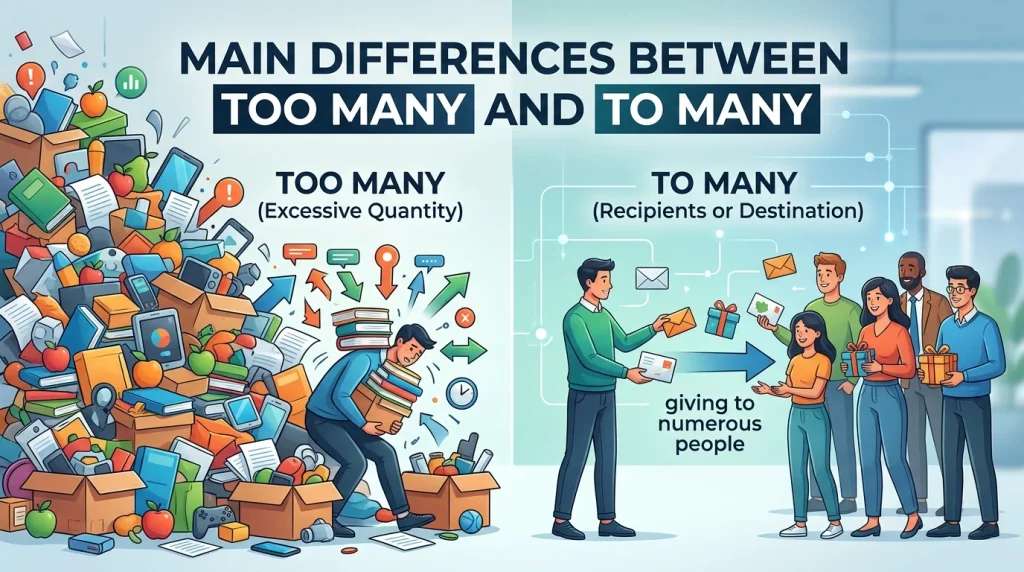
The main difference between “too many” and “to many” is that “too many” describes an excessive quantity, whereas “to many” usually connects an idea to a large number of people or things.
Comparison Table
| Feature | Too Many | To Many |
| Main meaning | More than necessary or desirable | In relation to, or affecting, many |
| Grammar | “Too” is an adverb; “many” is a determiner | “To” is a preposition; “many” follows it |
| Common purpose | Expressing excess | Identifying people or groups affected |
| Typical pattern | Too many + plural countable noun | Too many + noun or pronoun context |
| Example | There are too many cars. | The plan appeals to many drivers. |
| Negative meaning | Often suggests a problem or excess | Does not inherently suggest a problem |
| Common usage | Complaints, quantities, warnings | Opinions, effects, reactions, relationships |
Difference in Meaning
“Too many” means that a quantity is excessive.
Example: “There are too many advertisements on this website.”
This suggests that the number of advertisements is greater than desirable.
“To many” indicates a relationship between an idea and a group.
Example: “The website is useful to many readers.”
This means that a large number of readers find the website useful. It does not suggest that the number of readers is excessive.
Difference in Grammar
“Too” modifies “many” to express an excessive number. It answers the question, “How many is too many?”
“To” functions as a preposition that links a word or expression to another part of the sentence.
Compare:
- There are too many visitors at the museum.
- The exhibition is interesting to many visitors.
The first sentence describes an excessive number of visitors. The second describes the visitors’ response to the exhibition.
Difference in Tone
“Too many” often expresses dissatisfaction, inconvenience, or a warning, although its tone depends on context.
“Too many” is generally neutral. It identifies the people affected by an event, idea, decision, or experience.
Examples:
- “There are too many delays.” This expresses concern about excessive delays.
- “The delays were frustrating to many passengers.” This describes how passengers felt.
Why Do People Confuse Too Many and Too Many?
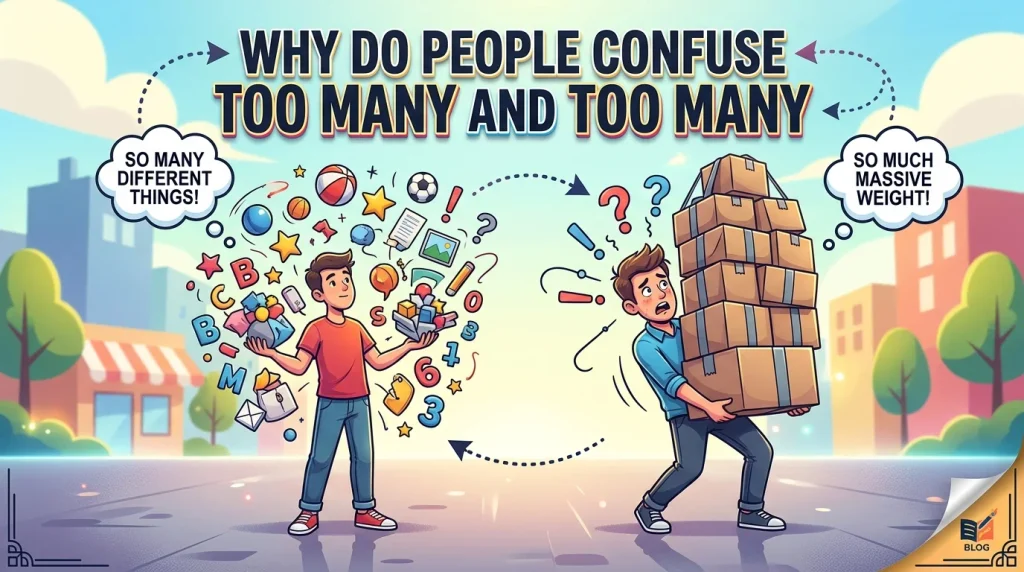
People often confuse these expressions because “too” and “to” are homophones in many English accents. Homophones are words that sound alike but have different meanings or grammatical functions.
The confusion becomes especially common when writing quickly, sending text messages, or using speech-to-text software.
The Sound Is Similar
When spoken aloud, “too” and “to” may sound almost identical. As a result, a writer may choose the wrong spelling even when the intended meaning is clear.
For example:
Incorrect for an excessive quantity: “There are to many cars.”
Correct: “There are too many cars.”
The Words Have Different Functions
The spelling difference reflects a grammatical difference.
- Too: An adverb meaning “excessively” or “also.”
- To: A preposition or part of an infinitive, as in “to school” or “to read.”
- Many: A determiner or pronoun used with countable plural nouns or understood groups.
Understanding these functions makes the correct choice easier.
Typing and Autocorrect Errors
Typing quickly can lead to mistakes because “to” is a common word that appears frequently in English. Spell-checkers may not identify the error if the incorrect word is still a valid English word.
For example, “There are to many problems” may pass a basic spelling check even though it does not express the intended meaning.
Always review the meaning of the sentence, not just its spelling.
Grammar Guide
Understanding the grammar of “too many” and “to many” will help you use each expression correctly.
How Each Term Is Used in Sentences
1. Using Too Many
The common sentence pattern is:
Too many + plural countable noun + verb
Examples:
- Too many people are talking.
- Too many cars are parked outside.
- Too many questions remain unanswered.
- Too many files are stored on the computer.
You can also use “too many” with a noun and an infinitive phrase to explain why the quantity creates a problem.
Examples:
- I have too many emails to answer.
- She has too many tasks to complete today.
- There are too many details to remember.
The word “too” expresses excess, while “many” indicates the number of countable items.
2. Using To Many
A common pattern is:
Verb or adjective + to many + plural noun
Examples:
- The decision matters to many families.
- The proposal appeals to many customers.
- The changes are confusing to many employees.
- The information is useful to many readers.
Another common structure is:
Sentence + to many
Examples:
- The result was unexpected to many.
- The announcement came as a surprise to many.
- The decision seemed reasonable to many.
In these examples, “to” connects the preceding idea with the people who experience, understand, or respond to it.
Common Mistakes Learners Make
Mistake 1: Using “to many” to describe an excessive quantity
Incorrect: There are to many students in the room.
Correct: There are too many students in the room.
Why? The sentence describes more students than the room can comfortably accommodate.
Mistake 2: Using “too many” when describing who is affected
Incorrect: The new policy is unfair too many employees.
Correct: The new policy is unfair to many employees.
Why? The preposition “to” connects the adjective “unfair” with the people affected.
Mistake 3: Confusing “too many” with “too much”
Incorrect: There is too many water in the bottle.
Correct: There is too much water in the bottle.
Why? “Water” is generally an uncountable noun, so “too much” is appropriate.
Mistake 4: Assuming “to many” is always incorrect
Incorrect explanation: “To many” is never grammatically correct.
Correct explanation: “To many” is correct when the preposition “to” is required by the sentence.
Example: The new rules are confusing to many people.
Mistake 5: Relying on pronunciation alone
Incorrect: I sent to many messages yesterday.
Correct: I sent too many messages yesterday.
Why? The intended meaning is that the number of messages was excessive.
Simple Rules to Remember
Use these easy rules to choose the correct expression.
- Use “too many” for excess. If you mean more than necessary, use “too many.”
- Use “too many” for a relationship. If something is important, useful, unfair, or surprising to a large group, use tooo many.”
- Check the sentence meaning. Ask whether you are describing a quantity or identifying the people affected.
- Remember countability. Use “too many” with countable plural nouns, such as books and chairs.
- Read the sentence aloud and check the grammar. Pronunciation alone will not reveal the correct spelling.
Quick Tips for Writing and Speaking
- Replace “too many” with “an excessive number of” to test whether the meaning remains correct.
- Replace “to many” with “for many people” when the sentence meaning permits it.
- Check whether a noun such as “students,” “problems,” or “questions” follows the expression.
- Review emails, assignments, reports, and articles before publishing.
- Remember that “too” can also mean “also,” as in “I want to come too,” but that is a separate use.
These techniques are particularly useful for English learners, students, bloggers, and professionals who want to improve their written communication.
When to Use Each One
When to Use Too Many
Use “too many” when the number of countable items exceeds what is appropriate, useful, or manageable.
Common situations include:
Education
- There are too many assignments due this week.
- Too many students missed the examination.
Business
- We received too many applications to review in one day.
- The department has too many meetings.
Daily Life
- I bought too many groceries.
- There are too many dishes in the sink.
Technology
- Too many browser tabs are open.
- Too many notifications interrupt my work.
Writing
- The paragraph contains too many unnecessary details.
- The report has too many repeated sentences.
When to Use Too Many
Use “too many” when the sentence connects an idea, decision, feeling, or experience to a large group of people or things.
Common situations include:
Education
- The explanation was helpful to many students.
- The new timetable is inconvenient to many teachers.
Business
- The opportunity is attractive to many investors.
- The policy seems unfair to many employees.
Daily Life
- This holiday is important to many families.
- The announcement was surprising to many residents.
Technology
- Online learning is convenient to many students.
- The new interface is confusing to many users.
Writing
- The story is meaningful to many readers.
- The conclusion seems persuasive to many reviewers.
When NOT to Use Each One
When Not to Use Too Many
Do not use “too many” when you are simply referring to people affected by a situation, without suggesting that their number is excessive.
Incorrect: The decision was disappointing too many employees.
Correct: The decision was disappointing to many employees.
Also, do not use “too many” with an uncountable noun when standard English requires “too much.”
Incorrect: There is too many sugar in the tea.
Correct: There is too much sugar in the tea.
However, a countable container or unit can change the wording:
Correct: There are too many spoonfuls of sugar in the tea.
When Not to Use Too Many
Do not use “to many” when your intended meaning is an excessive number.
Incorrect: There are to many cars on the road.
Correct: There are too many cars on the road.
Also, do not add “to” after a verb when the verb does not require it.
Incorrect: I have to many books.
Correct: I have too many books.
The first sentence can be interpreted as an incomplete or incorrectly constructed statement involving “have to.” The second clearly expresses excess.
Which One to Use: Decision Guide
Choosing between “too many” and “to many” becomes simple when you identify the meaning of your sentence.
Step 1: Identify Your Intended Meaning
Ask yourself: Am I saying that there is an excessive number of something?
- If yes, use too many.
- If no, continue to the next step.
Step 2: Check Whether You Are Referring to an Affected Group
Ask whether the sentence describes how an action, decision, event, or idea relates to a group.
- If yes, too many may be correct.
- If no, reconsider the sentence structure.
Step 3: Examine the Words Around the Expression
Look for the noun or adjective that determines the correct grammar.
Examples:
- “Too many books” — correct because the sentence describes excess.
- “Useful to many readers” — correct because “to” links “useful” to the readers.
- “Too many complaints” — correct because the number is excessive.
- “Unfair to many workers” — correct because the workers are affected by the unfairness.
Step 4: Use a Substitution Test
Try replacing the expression with another phrase.
If “more than necessary” works, choose “too many.”
Example: “There are too many cars.”
Substitution: “There are more cars than necessary.”
The meaning remains clear.
If “for a large number of people” works, “too many” may be appropriate, depending on the sentence.
Example: “The rule seems unfair to many workers.”
Substitution: “The rule seems unfair for many workers.”
The meaning is similar, although the original phrasing is more natural in this context.
Quick Decision Table
| Intended meaning | Correct choice | Example |
| An excessive number of items | Too many | There are too many files. |
| An excessive number of people | Too many | Too many people arrived. |
| Something affects a large group | To many | The rule is confusing to many users. |
| Something is important to a group | To many | The tradition matters to many families. |
| Something is surprising to a group | To many | The result was surprising to many. |
Self-Assessment: Fill in the Blanks
Complete the following 20 sentences by choosing either “too many” or “to many.” Pay attention to the meaning, grammar, and surrounding words.
- There are ______ cars on the road during rush hour.
- The new teaching method is helpful ______ students.
- I have ______ emails to answer before the meeting.
- The announcement came as a surprise ______ employees.
- We made ______ mistakes in the final report.
- This public library is important ______ residents.
- There are ______ advertisements on this webpage.
- The new policy seems unfair ______ workers.
- She bought ______ vegetables for one small meal.
- The discovery was significant ______ scientists.
- There are ______ files stored in the folder.
- The online course is useful ______ beginners.
- The company received ______ complaints last month.
- The decision was disappointing ______ customers.
- You have opened ______ browser tabs.
- The historical event remains meaningful ______ many families.
- There are ______ chairs in this small room.
- The new timetable is convenient ______ teachers.
- He asked ______ questions during the interview.
- The final result was unexpected ______ the participants.
Answers
- Too many: The sentence describes an excessive number of cars.
- Too many: The teaching method is helpful to a group of students.
- Too many: The speaker has an excessive number of emails to answer.
- Too many: The preposition connects the surprise with the employees.
- Too many: The report contains more mistakes than desirable.
- Too many: The library is important to a group of residents.
- Too many: The number of advertisements is excessive.
- Too many: The workers are the people affected by the policy.
- Too many: The number of vegetables exceeds what is needed for the meal.
- Too many: The discovery is significant to the scientists.
- Too many: The folder contains an excessive number of files.
- Too many: The course is useful to beginners.
- Too many: The company received an excessive number of complaints.
- Too many: The customers are the people who feel disappointed.
- Too many: The number of browser tabs is excessive.
- Too many: The event is meaningful to a group of families.
- Too many: The number of chairs exceeds what is appropriate for the room.
- Too many: The timetable is convenient to the teachers.
- Too many: The speaker asked an excessive number of questions.
- Too many: The result was unexpected to the participants.
Final Verdict
The correct choice between “too many” and “to many” depends on what you want to say.
Use “too many” when you mean an excessive number. It is appropriate for countable plural nouns such as books, people, questions, mistakes, and emails.
Example: “There are too many tasks to complete today.”
Use “to many” when the preposition “to” connects an idea or experience to a large group. It commonly appears after adjectives and expressions such as “important to many,” “useful to many,” “unfair to many,” and “a surprise to many.”
Example: “The announcement was surprising to many employees.”
The easiest way to remember the difference is to associate “too many” with excess and “to many” with a relationship to a group.
Once you understand this distinction, you can confidently choose the correct expression in everyday conversations, academic writing, professional emails, blog posts, and other forms of communication.
Conclusion
Understanding the difference between “too many” and “to many” is a simple but valuable step toward improving your English grammar and writing skills. Although these expressions sound alike, they serve different purposes in a sentence. “Too many” describes an excessive number of countable people or things, while “to many” connects an idea, feeling, or situation to a group of people.
For example, you would write, “There are too many books on the table” when the number of books exceeds what is needed. However, you would say, “The new rules seem unfair to many employees” when describing how a group feels about a decision.
The easiest way to remember the difference is to associate “too many” with excess and “to many” with a relationship to a group. By practicing these expressions in everyday conversations, emails, essays, and professional documents, you can avoid common spelling mistakes and communicate more confidently. Always consider the meaning of your sentence before choosing the correct expression.
FAQs
Is it too many or to many?
“Too many” is correct when describing an excessive number of countable items or people. For example, “There are too many people in the room.” “To many” is also grammatically correct in sentences such as “The decision seems unfair to many workers.” The right choice depends on the intended meaning and grammatical structure.
What is the main difference between too many and to many?
The main difference is their meaning and grammatical function. “Too many” means more than necessary, desirable, or manageable. “To many” connects an idea or experience to a group of people or things. For example, “Too many cars cause congestion” describes excess, while “The change is helpful to many drivers” describes a benefit.
Is too many grammatically correct?
Yes, “too many” is grammatically correct when used with countable plural nouns to express an excessive quantity. Examples include “too many books,” “too many questions,” and “too many mistakes.” It can also appear before an infinitive phrase, as in “I have too many tasks to complete.” Use “too much” with most uncountable nouns instead.
Is to many ever correct in English?
Yes, “to many” is correct when the preposition “to” is needed to connect an idea with a group. For example, “The new policy is confusing to many employees.” Here, “to” links the adjective “confusing” to the people experiencing the confusion. Therefore, “to many” is not inherently incorrect; its use depends on context.
Why do people confuse too and to?
People often confuse “too” and “to” because they sound alike in many English accents. However, their meanings and grammatical roles differ. “Too” can mean excessively or also, while “to” commonly expresses direction, relationships, or infinitives. Since both spellings are valid English words, spell-checkers may not identify an incorrect choice automatically.
Should I use too many or too much?
Use “too many” with countable plural nouns, such as books, chairs, questions, and people. Use “too much” with uncountable nouns, such as water, sugar, information, and traffic in its general sense. For example, write “too many bottles” but “too much water.” Choosing the correct expression depends on whether the noun is countable.
Can I say there are too many people?
No, not when you mean that the number of people is excessive. The correct sentence is “There are too many people.” The word “too” expresses excess, while “many” refers to the countable plural noun “people.” Remember this pattern whenever you describe a crowded room, a busy event, or an excessive number of visitors.
What is an example of to many in a sentence?
An example is “The new educational program is beneficial to many students.” In this sentence, “to many” identifies the group that benefits from the program. Other examples include “The announcement was surprising to many people” and “The decision seems unfair to many employees.” Each sentence connects an idea or experience to a group.
How can I remember the difference between too many and to many?
Remember that “too many” means an excessive number, while “to many” connects an idea to a group. Try replacing “too many” with “more than necessary.” If that substitution makes sense, “too many” is probably correct. When describing how something affects a group, check whether the sentence requires the preposition “to.”
Which is correct in formal writing: too many or to many?
Both expressions are acceptable in formal writing when used correctly. “Too many” is appropriate for describing excessive quantities, such as “The report contains too many unnecessary details.” “To many” is suitable for describing relationships or reactions, such as “The findings are significant to many researchers.” Always select the expression that accurately communicates your intended meaning.