
“Soo” and “so” look almost identical, but they do not have the same status in standard English. So is the normal, correct spelling used in formal and everyday writing, while soo is usually an informal internet spelling used to stretch or emphasize the sound of “so.” Understanding this difference helps you write clearly and naturally.
Comparison Overview
The main difference between soo and so is standard usage.
| Term | Standard English? | Main use | Example |
| So | Yes | Adverb, conjunction, intensifier, and other grammatical functions | “She is so happy.” |
| Soo | Generally no | Informal spelling used to emphasize or lengthen “so” | “I’m soo tired!” |
In standard English, so is the correct choice. You will find it in academic writing, business communication, books, newspapers, professional emails, and formal documents.
Soo is generally a deliberate informal spelling. Someone might write “soo” in a text message, social-media post, chat, or playful conversation to show extra emphasis, emotion, or a drawn-out pronunciation.
For example:
- Standard: “That movie was so good.”
- Informal: “That movie was soo good!”
The second sentence is understandable, but soo is not normally appropriate in formal English.
Definition of Soo

Soo is generally an informal or nonstandard spelling of “so.” It is often used online to imitate the way a speaker might stretch the vowel sound for emphasis.
For example:
“I’m soo excited!”
Here, soo does not introduce a new grammatical meaning. It normally means the same thing as so, but the extra “o” communicates extra emotion or emphasis.
Why do people write “soo”?
People may write soo because they want to make a statement sound:
- More emotional
- More enthusiastic
- More dramatic
- Playful
- Casual
- Like spoken language
Compare:
“I’m so happy.”
with:
“I’m soo happy!”
The second version visually suggests that the speaker is stretching the word: “sooooo.”
Is “soo” a correct English word?
In ordinary standard English spelling, soo should not replace so.
However, context matters. Soo can appear as a proper name, part of a name, or in specialized uses unrelated to the ordinary English word so. When someone simply means the common English word expressing degree, consequence, or agreement, so is the standard spelling.
Definition of So
So is a standard English word with several grammatical functions. Its meaning depends on the sentence.
It can express degree:
“The water is so cold.”
It can express result or consequence:
“It was raining, so we stayed home.”
It can refer back to something already mentioned:
“I think so.”
It can also be used in questions and short responses:
“So, what happened?”
Because so has many functions, it is an extremely common word in English.
Main Differences Between Soo and So
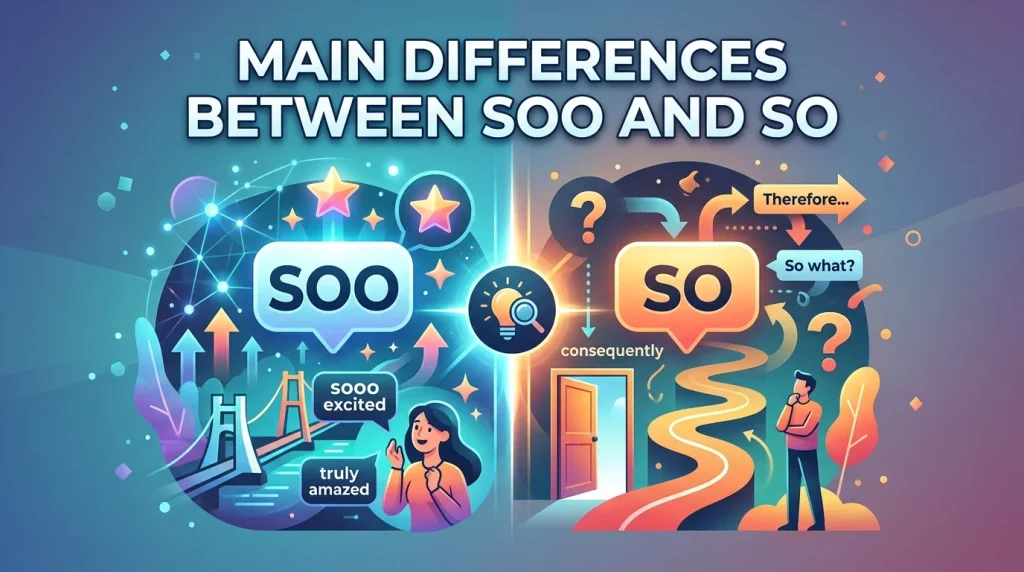
The most important distinction is that so is the standard spelling, while soo is generally an informal spelling variation.
| Difference | So | Soo |
| Standard spelling | Yes | No, in ordinary usage |
| Formal writing | Appropriate | Usually inappropriate |
| Academic writing | Appropriate | Avoid |
| Business writing | Appropriate | Avoid |
| Text messages | Appropriate | Sometimes used informally |
| Social media | Appropriate | Sometimes used for emphasis |
| Meaning | Depends on grammatical context | Usually the same as “so” |
| Extra letters | No | Used to exaggerate or stretch pronunciation |
| Example | “She is so kind.” | “She is soo kind!” |
Meaning
So has established grammatical meanings.
Soo usually does not create a separate grammatical meaning. Instead, it changes the tone.
Spelling
The standard spelling is:
so
Adding another “o” is generally an informal stylistic choice:
soo
You can also see even longer forms online:
sooooo
soooooo
sooooooooo
These spellings are intentionally exaggerated rather than standard English spelling.
Context
Use so when you need normal English.
Use soo only when you intentionally want an informal, expressive, or playful tone.
Is “Soo” Ever Correct?
Yes, but this requires an important distinction.
If Soo is being used as a proper name, place name, brand name, surname, or another specific term, it can be correct because proper names do not have to follow the spelling of the common English word “so.”
For example, if a person’s name is Soo, you should preserve that spelling.
But if you are trying to write:
“She is so beautiful.”
writing:
“She is soo beautiful.”
is an informal stylistic choice, not the standard spelling.
Why “Soo” Is Common Online
Internet communication often imitates speech.
When people speak, they can lengthen a sound:
“I’m sooooo tired.”
Writing does not normally show this pronunciation. Online, however, people frequently manipulate spelling to communicate emotion.
For example:
“That was so funny!”
sounds relatively neutral.
“That was sooo funny!”
sounds more enthusiastic.
“That was SO funny!”
uses capitalization for emphasis.
These are stylistic choices rather than different standard grammatical forms.
Grammar Guide
How Each Term Is Used in Sentences
So has several legitimate grammatical patterns.
1. So + adjective
Use so to emphasize an adjective.
Pattern:
so + adjective
Examples:
- “The test was so difficult.”
- “She is so kind.”
- “This computer is so fast.”
- “The weather is so cold.”
In these sentences, so acts as an intensifier.
2. So + adverb
So can also emphasize an adverb.
Examples:
- “He runs so quickly.”
- “She speaks so clearly.”
- “They worked so efficiently.”
3. So + clause
So can introduce a result.
Example:
“I was tired, so I went to bed.”
Here, so means approximately “therefore” or “as a result.”
4. Think so / hope so / believe so
So can stand for an idea already mentioned.
Examples:
- “Will it rain?” — “I think so.”
- “Is she coming?” — “I hope so.”
- “Is the information correct?” — “I believe so.”
5. “So” at the beginning of a conversation
So can also introduce a topic or transition.
Examples:
- “So, what are we doing today?”
- “So, let’s begin the meeting.”
- “So, how was your trip?”
What About “Soo” Grammatically?
Soo generally does not have a separate grammatical role in standard English.
When someone writes:
“I’m soo hungry.”
they normally intend:
“I’m so hungry.”
The additional “o” changes the style and emotional emphasis, not the underlying grammar.
Common Mistakes Learners Make
Mistake 1: Using “soo” in formal writing
Incorrect for standard formal writing:
“The experiment was soo successful.”
Better:
“The experiment was so successful.”
Mistake 2: Thinking “soo” is a stronger grammatical form
“Soo” does not normally represent a different grammatical degree of “so.”
The extra letter is stylistic.
Mistake 3: Assuming pronunciation determines spelling
English speakers may stretch “so” when speaking:
“That was sooooo good!”
That does not mean standard spelling requires extra letters.
Mistake 4: Using “soo” in academic work
Academic writing should normally use:
“The results were so significant that further research was required.”
Not:
“The results were soo significant…”
Simple Rules to Remember
Remember these four rules:
- Use “so” in standard English.
- Use “so” in school and university writing.
- Use “so” in professional communication.
- Use “soo” only when deliberately writing informally or expressively.
A simple memory trick is:
One “o” = normal English. Extra “o” = informal emphasis.
Quick Tips for Writing and Speaking
If you are unsure, choose so.
For example:
- Email → so
- Essay → so
- Report → so
- Job application → so
- Business proposal → so
- Text message → so or informal soo, depending on tone
- Social-media caption → either, depending on the intended style
- Academic assignment → so
- Formal presentation → so
In speech, you can emphasize so through your voice without changing its spelling.
When to Use Each One
When to Use “So”
Use so when you are writing normal standard English.
It is appropriate for:
- Academic writing
- Professional emails
- Business documents
- Essays
- Reports
- News-style writing
- Formal conversations
- Everyday conversation
- Standard text messages
- Correct grammar exercises
Examples:
“The lecture was so interesting.”
“I was late, so I took a taxi.”
“I think so.”
When to Use “Soo”
Use soo only when the informal style is intentional.
It can appear in:
- Text messages
- Casual chats
- Social media
- Online comments
- Informal captions
- Playful conversations
- Fictional dialogue when representing an informal voice
Example:
“That puppy is soo cute!”
Here, the writer is intentionally exaggerating the word.
When NOT to Use Each One
When Not to Use “Soo”
Avoid soo when you need standard English.
Do not normally use it in:
- Academic assignments
- Research papers
- Formal reports
- Job applications
- Resumes or CVs
- Business letters
- Professional emails
- Official documents
- Formal presentations
- Grammar tests
For example, write:
“The results were so important.”
rather than:
“The results were soo important.”
When Not to Use “So”
There are very few situations where so should be avoided simply because of spelling.
Instead, make sure that so actually fits the intended meaning.
For example, if you mean “therefore,” use so appropriately:
“The store was closed, so we went home.”
But don’t insert so randomly into a sentence merely because it is common.
Soo Vs So: Decision Guide
Use this quick decision process:
Are you writing standard English?
Yes → Use “so.”
Are you writing an academic or professional document?
Yes → Use “so.”
Are you taking a grammar or spelling test?
Yes → Use “so.”
Are you texting a friend?
Usually → Use “so.”
You can use soo if you deliberately want an exaggerated, playful tone.
Are you writing a social-media post?
Either can work, depending on style.
“I’m so excited!”
is standard and natural.
“I’m soo excited!”
is informal and more expressive.
Is “Soo” someone’s actual name?
Keep “Soo” if it is the person’s established name.
Real-World Practical Examples
Soo Examples
Because Soo is generally an informal spelling, these examples demonstrate contexts where people might intentionally use it.
- Daily life:
“I’m soo tired after walking all day.” - Conversation:
“You are soo funny!” - Social media:
“This sunset is so beautiful!” - Text messaging:
“I’m so excited to see you tomorrow!” - Informal writing:
“That was so unexpected!” - Entertainment:
“The ending was so surprising!” - Personal reaction:
“I’m so happy right now!”
The important point is that the extra o is being used for emphasis. In standard writing, replace soo with so.
So Examples
1. Education
“The lesson was so interesting that I took several pages of notes.”
Here, so intensifies the adjective “interesting.”
2. Daily life
“I was so hungry after work.”
Here, so means “to a great degree.”
3. Science
“The temperature was so high that the material began to change.”
Here, so emphasizes “high” and contributes to the result structure.
4. Business
“The company received so many orders that it needed additional staff.”
Here, so is part of the structure so many + plural noun.
5. Writing
“The author was so careful with word choice that every sentence felt deliberate.”
Here, so intensifies “careful.”
6. Technology
“The application loads so quickly that users rarely notice the startup process.”
Here, so modifies the adverb “quickly.”
7. Conversation
“So, what are you doing this weekend?”
Here, so introduces a conversational topic rather than intensifying an adjective.
8. Expressing agreement or belief
“Do you think they will arrive on time?”
“I think so.”
Here, so replaces the idea “they will arrive on time.”
So vs. So in Different Types of Writing
| Type of writing | Recommended form |
| Academic essay | so |
| School assignment | so |
| Scientific paper | so |
| Business email | so |
| Resume/CV | so |
| Formal letter | so |
| News article | so |
| Everyday conversation | so |
| Text message | so normally |
| Social media | So or informal soo |
| Casual online chat | So or informal soo |
| Playful dialogue | Soo can be stylistically appropriate |
Soo vs So in Formal and Informal English
The distinction is particularly important when considering register.
Register means the style of language appropriate for a particular situation.
Formal register generally favors standard spelling:
“The findings were so significant that additional studies were recommended.”
Informal digital communication may intentionally change spelling:
“The findings were soo interesting!”
The second sentence might work in a casual social-media context, but it would normally be unsuitable for an academic paper.
Is “Soo” a Typo?
It depends on context.
If someone writes:
“I am soo tired.”
they may not have made an accidental spelling mistake. They may intentionally be stretching the word to express emotion.
However, if the writer is expected to use standard English, soo should normally be corrected to so.
Therefore, context is important:
- Formal context: likely considered an incorrect/nonstandard spelling.
- Casual online context: may be intentional stylistic spelling.
Soo vs So in SEO and Online Writing
For standard SEO content, so should normally be used according to standard English grammar.
If an article is specifically targeting the keyword “Soo Vs So,” the phrase can appear in the title and relevant sections because it represents the search query. However, that does not mean soo should be substituted for so throughout the article.
For example:
“Soo Vs So: What Is the Difference?”
can be used as a keyword-focused title.
But normal sentences should generally use:
“So is the standard English spelling.”
This keeps the content both search-focused and grammatically correct.
Self-Assessment (Fill in the Blanks)
Complete each sentence with so or soo based on standard usage and context.
- I will use ______ when writing a formal academic essay.
- I will use ______ when I want to express ordinary degree or intensity in standard English.
- I will use ______ in “The weather is ______ cold today.”
- I will use ______ in “It was raining, ______ we stayed home.”
- I will use ______ in “I think ______.”
- I might use ______ in a playful text message to exaggerate emotion.
- I will use ______ in a professional business email.
- I will use ______ in “She is ______ intelligent.”
- I will use ______ in “The computer works ______ quickly.”
- I would normally change “The movie was ______ good” to ______ in formal writing.
- I will use ______ rather than “soo” in a university assignment because it is the standard spelling.
- I might write “I’m ______ excited!” on social media when deliberately stretching the pronunciation.
- I will use ______ in “He was tired, ______ he went to bed.”
- I will use ______ in “Do you think they are coming?” — “I think ______.”
- I will normally choose ______ when completing a standard English grammar test.
- I might see ______ in an informal internet conversation because the writer wants extra emphasis.
- I will use ______ in “This book is ______ interesting.”
- I will use ______ in a formal scientific report.
- If I want to imitate an exaggerated spoken “so,” I might informally write ______.
- The standard English spelling of the common word meaning “to a great degree” is ______.
Answers
- So: “So” is the standard form for formal academic writing.
- So: “So” is the standard English word for expressing degree or intensity.
- So: The correct standard pattern is “so cold.”
- So: Here, “so” introduces a result or consequence.
- So: “I think so” is the standard expression.
- Soo: “Soo” can be used informally to exaggerate or stretch the sound.
- So: Professional writing normally requires standard spelling.
- So: The standard pattern is “so + adjective.”
- So: “So quickly” uses “so” to intensify an adverb.
- So: “Soo” should normally become “so” in formal writing.
- So: “So” is the standard spelling.
- Soo: In this context, the extra “o” can deliberately communicate excitement.
- So: “So” can connect an action with its consequence.
- So: “I think so” is the standard construction.
- So: Standard grammar tests expect standard spelling.
- Soo: Informal internet writing may use “soo” for emphasis.
- So: “So interesting” is the standard construction.
- So: Scientific and professional writing should normally use standard English.
- Soo: The extra letters can imitate an exaggerated pronunciation.
- So: “So” is the standard English spelling.
Final Verdict
The difference between soo and so is mainly a difference between standard English and informal stylistic spelling.
So is the correct standard form. It can function in several grammatical ways, including as an intensifier, conjunction, and part of expressions such as “I think so.”
Soo is generally an informal spelling used to make so look longer, stronger, or more emotional. It is common in casual online communication but should normally be avoided in academic, professional, and formal writing.
The easiest rule is:
Use “so” for standard English. Use “soo” only when you intentionally want an informal, exaggerated style.
So, when in doubt, choose so.
Conclusion
Understanding Soo Vs So is simple once you know the difference between standard English and informal online writing. So is the correct and widely accepted spelling used to express degree, introduce a result, connect ideas, or form common expressions such as “I think so.” It is suitable for everyday conversation as well as academic, professional, and formal writing.
Soo, on the other hand, is generally an informal spelling used to stretch or emphasize the sound of “so,” especially in texts, social media, and casual conversations. While “soo” can add emotion or a playful tone, it should normally be avoided in formal writing. When choosing between the two, the safest rule is simple: use so for standard English and use soo only when an intentionally informal style is appropriate. Keeping this distinction in mind will help you communicate naturally, clearly, and confidently.
FAQs
Is “soo” a correct English word?
“Soo” is generally not the standard spelling of the common English word “so.” It is often used informally online to exaggerate pronunciation or emotion, such as “I’m soo excited!” In formal, academic, and professional writing, “so” is the appropriate spelling. However, “Soo” may be correct when it is used as a person’s name, place name, or another proper term.
What is the main difference between “soo” and “so”?
The main difference is standard usage and tone. So is the standard English spelling and has several grammatical functions, including showing degree and expressing a result. Soo is usually an informal variation used to make “so” appear longer or more expressive. It generally does not have a separate grammatical meaning from the standard word “so.”
Should I use “so” or “soo” in formal writing?
You should use so in formal writing. Academic essays, research papers, business emails, professional documents, applications, and official communication normally require standard English spelling. Although “soo” may be understandable, it can appear overly casual or nonstandard. If you are writing for school, work, or another formal setting, choosing “so” is the safest and grammatically appropriate option.
Can I use “soo” in text messages?
Yes, you can use soo in casual text messages when you intentionally want to emphasize emotion or exaggerate pronunciation. For example, “I’m soo happy!” can sound more enthusiastic than “I’m so happy!” However, “soo” is a stylistic choice rather than standard spelling. If you want neutral, correct English, simply use “so.”
Why do people write “soo” instead of “so”?
People often write “soo” to imitate the way they naturally stretch the word when speaking. The extra “o” can communicate excitement, surprise, affection, frustration, or emphasis. Similar informal spellings include “sooo” and “sooooo.” These forms are common in digital communication because written text does not include voice tone, so spelling can be altered to express emotion.
Is “soo” grammatically incorrect?
In ordinary standard English, soo is considered nonstandard when it is intended to mean the normal word “so.” It is usually better described as an informal or stylistic spelling rather than a separate grammatical form. In casual digital communication, it can be intentionally used for emphasis. In formal contexts, however, standard spelling requires so.
Is “so” a verb, noun, or adjective?
So can perform several grammatical functions depending on context. It commonly works as an adverb, as in “She is so happy,” and as a conjunction introducing a result, as in “It was late, so we left.” It can also appear in expressions such as “I think so,” where it refers back to an idea already mentioned.
Can “soo” mean something different from “so”?
Usually, no. When “soo” is used informally in phrases such as “That is soo funny,” it generally has the same basic meaning as “so.” The extra letter is mainly used to create emphasis or represent a stretched pronunciation. Therefore, the distinction is usually about spelling, tone, and context rather than a completely different meaning.
Which spelling should I use in an English exam?
Use so in an English exam unless the question specifically asks you to identify informal or nonstandard language. “So” is the standard spelling recognized in formal English. Writing “soo” may be treated as incorrect if the task tests spelling, grammar, or standard written usage. Remembering that “so” is the default form can prevent this common mistake.
How can I easily remember the difference between “soo” and “so”?
A simple rule is: one “o” means standard English; extra “o” means informal emphasis. Use “so” in essays, emails, reports, exams, and professional communication. If you see “soo” online, it is usually someone deliberately stretching the word for emotional or playful effect. When you are unsure which form to choose, “so” is the correct standard choice.