
“No difference” and “no different” may look similar, but they are used differently in English. One is a noun phrase that describes the absence of a distinction, while the other is a grammatical combination of an adverb and an adjective. Understanding no difference vs no different helps you choose the correct expression, write clearer sentences, and avoid common grammar mistakes in everyday communication.
Comparison Overview
The expressions “no difference” and “no different” are related to the idea of similarity, but they do not serve the same grammatical purpose. The main distinction is that “no difference” is a standard and complete expression, whereas “no different” usually needs a different sentence structure to be grammatically correct.
“No difference” means that two or more things are the same in a particular respect or that no distinction exists between them. For example, you might say, “There is no difference between these two products.”
“No different,” on the other hand, is generally used with a linking verb such as “is,” “are,” “was,” or “were,” often followed by “from” or “than” in a suitable construction. For example, “This product is no different from the other one.”
The expressions are connected because both can communicate similarity. However, they cannot always replace each other.
Here is a quick overview:
| Feature | No Difference | No Different |
| Grammatical role | Noun phrase | Adverb and adjective |
| Main meaning | No distinction or variation exists | Not different; essentially the same |
| Common pattern | There is no difference between A and B | A is no different from B |
| Common example | There is no difference between the results. | The results are no different from last year’s results. |
| Can follow “there is” directly? | Yes | No, not in the same construction |
| Can describe a person or object? | Indirectly, by describing a comparison | Yes, when used in a complete sentence |
| Is it grammatically correct? | Yes | Yes, when used in the right sentence structure |
The key is to understand the role each expression plays in a sentence rather than treating them as interchangeable phrases.
Definition of No Difference

“No difference” is a noun phrase used to indicate that there is no distinction, change, variation, or meaningful contrast between two or more things.
The word “difference” is a noun. It refers to the way in which people, objects, ideas, situations, or results are not the same.
When “no” comes before “difference,” it indicates that the distinction being discussed does not exist.
Meaning of No Difference
The expression “no difference” can communicate several related ideas:
- Identical results: Two experiments produce the same outcome.
- Equal value: Two products offer the same value for a particular purpose.
- No noticeable change: A person’s condition remains the same.
- No meaningful distinction: Two options are equivalent in the context being discussed.
- No practical effect: A particular action does not change the outcome.
For example:
“There is no difference between the two answers.”
This sentence means that the two answers are the same in the relevant respect.
Another example is:
“There was no difference in temperature between the two measurements.”
This means the measurements showed no variation in temperature.
Grammatical Structure of No Difference
“No difference” commonly appears in sentences with the following patterns:
Pattern 1: There is no difference between A and B.
Example: There is no difference between these two designs.
Pattern 2: There is no difference in something.
Example: There is no difference in quality.
Pattern 3: Make no difference to someone or something.
Example: The delay makes no difference to our plans.
Pattern 4: Notice no difference.
Example: I noticed no difference after changing the settings.
Pattern 5: It makes no difference whether…
Example: It makes no difference whether you arrive early or on time.
These structures are widely used in conversation, academic writing, business communication, and everyday English.
Why No Difference Is a Noun Phrase
The word “difference” names a concept, so it functions as a noun.
Consider this sentence:
“There is no difference between the two methods.”
The word “difference” is the central noun in the phrase “no difference.” The phrase identifies the absence of a distinction between the methods.
You can also use other words before “difference,” such as “significant,” “noticeable,” or “major.”
Examples:
- There is no significant difference between the results.
- We noticed no noticeable difference in performance.
- There is no major difference between the two plans.
However, avoid unnecessary repetition such as “no noticeable difference” when the intended meaning is simply that nothing changed.
Definition of No Different
“No different” is a combination of the word “no” and the adjective “different,” used in a sentence structure where the intended meaning is that something is not different from another thing.
In this expression, “different” describes a person, object, situation, result, or experience. The word “no” strengthens the idea that the thing being described is not different in the relevant respect.
The phrase is grammatically acceptable in appropriate contexts, but it does not normally work as a standalone replacement for the noun phrase “no difference.”
For example:
“This model is no different from the previous model.”
The sentence means that the current model is not different from the earlier one.
Meaning of No Different
“No different” generally communicates the following ideas:
- Similarity: Something is not different from something else.
- No change in characteristics: A new version has the same characteristics as an old one.
- Equivalent circumstances: One situation is essentially the same as another.
- No distinction in a particular respect: Two people, objects, or experiences are alike in the relevant way.
For example:
“Her experience is no different from mine.”
This means that her experience is not different from the speaker’s experience in the respect being discussed.
Another example is:
“The new policy is no different from the old one.”
This suggests that the new policy has not introduced a meaningful distinction from the old policy.
Grammatical Structure of No Different
“No different” is commonly used in these patterns:
Pattern 1: Subject + linking verb + no different from + comparison.
Example: This version is no different from the original.
Pattern 2: Subject + linking verb + no different than + comparison.
Example: The final result was no different than we expected.
This construction is used in English, although “different from” is often preferred in formal writing.
Pattern 3: Subject + be + no different in + characteristic.
Example: The two products are no different in quality.
Pattern 4: A person or thing is no different from another person or thing.
Example: My situation is no different from yours.
These examples show that “no different” normally functions as part of a larger sentence rather than standing alone as a noun phrase.
Why No Different Is Not a Direct Replacement for No Difference
The main reason is grammatical structure.
Compare these two sentences:
- Correct: There is no difference between the two photographs.
- Correct: The two photographs are no different from each other.
Both sentences express a similar idea, but they use different grammatical constructions.
In the first sentence, “difference” is a noun and is the main element of the phrase “no difference.”
In the second sentence, “different” is an adjective describing the photographs. The linking verb “are” connects the subject to that description.
Therefore, the choice depends on the sentence structure you want to use.
Main Differences Between No Difference and No Different
The most important difference between “no difference” and “no different” is their grammatical function. Although both expressions can communicate similarity, their placement in a sentence and the words surrounding them determine whether they are correct.
1. Difference in Meaning
“No difference” emphasizes the absence of a distinction.
Example: There is no difference between the two solutions.
“No different” describes something as not different from a comparison point.
Example: This solution is no different from the previous one.
The meaning is similar, but the emphasis and structure are different.
2. Difference in Grammar
“No difference” contains a noun.
Example: There is no difference in price.
“No different” contains an adjective.
Example: The prices are no different.
The noun “difference” names a distinction, while the adjective “different” describes whether two things vary.
3. Difference in Sentence Structure
“No difference” commonly appears after “there is,” “there was,” or a verb such as “make” or “notice.”
Examples:
- There is no difference between the options.
- The change makes no difference.
- I noticed no difference.
“No different” usually follows a linking verb and connects the subject to a comparison.
Examples:
- The options are no different from each other.
- The change is no different from the previous one.
- The two versions were no different in appearance.
4. Difference in Common Usage
“No difference” is common when discussing comparisons, outcomes, effects, measurements, and choices.
“No different” is common when describing the similarity of people, objects, situations, policies, and experiences.
For example:
“There is no difference in the results” focuses on the results themselves.
“The results are no different from last week’s results” describes the results in relation to an earlier set.
5. Difference in Sentence Completeness
“No difference” can appear as a complete noun phrase within a sentence.
Example: The test showed no difference.
“No different” normally requires a subject and a suitable verb to form a complete statement.
Example: The test results are no different from the previous results.
The expression “no different” by itself is generally incomplete in ordinary prose, although it may appear as a fragment in informal conversation or as part of a heading.
6. Difference in Formal Writing
Both expressions are acceptable in formal English when correctly constructed.
In academic or scientific writing, “no difference” is particularly common when reporting findings.
Example: The analysis found no statistically significant difference between the groups.
“No different” is also acceptable when describing a comparison.
Example: The measured response was no different from the expected response.
In scientific contexts, avoid assuming that an observed lack of difference proves that two things are identical. The evidence and the type of comparison matter.
Quick Comparison Table
| Situation | Correct Expression | Example |
| Describing an absence of distinction | No difference | There is no difference in quality. |
| Describing two things as alike | No different | The products are no different from each other. |
| Talking about the effect of an action | No difference | The change makes no difference. |
| Comparing a new version with an old one | No different | The new version is no different from the old one. |
| Reporting an experimental finding | No difference | The study found no difference between the groups. |
| Describing a person’s experience | No different | My experience is no different from yours. |
Other Expressions Related to No Difference and No Different
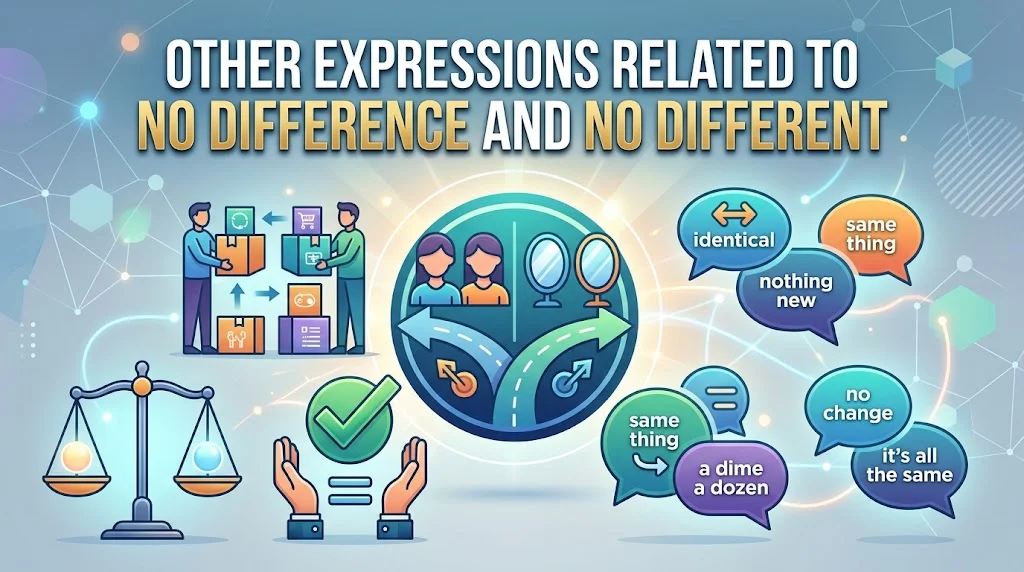
Several other English expressions communicate similar meanings. Understanding them can help you choose more precise language.
No Difference vs. Not Different
These expressions are closely related, but they use different grammatical structures.
“No difference” is a noun phrase.
Example: There is no difference between the two methods.
“Not different” is a negated adjective phrase.
Example: The two methods are not different in their results.
Both can express similarity, but the sentence structure changes.
No Difference vs. Same
“Same” is an adjective or determiner used to identify things as identical or equivalent in the relevant respect.
Example: We received the same result.
“No difference” emphasizes the absence of a distinction.
Example: There is no difference between the results.
The two expressions often communicate similar ideas, but they are not always interchangeable in every grammatical structure.
No Different vs. Not Any Different
“No different” is a natural construction in sentences such as:
“This design is no different from the original.”
“Not any different” can also be used in certain constructions, particularly with auxiliary verbs.
Example: This design is not any different from the original.
The latter may sound more emphatic or conversational in some contexts. In most ordinary writing, “no different from” is concise and natural.
No Difference vs. No Change
“No difference” means there is no distinction between the things being compared.
“No change” means that something has remained the same over time or that a change has not occurred.
Examples:
- There is no difference between the two samples.
- There has been no change in the sample’s temperature.
The first sentence compares two samples. The second describes the absence of change over time.
Grammar Guide
Understanding the grammatical roles of “difference” and “different” is the easiest way to use these expressions correctly.
The word “difference” is a noun, while “different” is an adjective. The word “no” can appear before both, but the grammatical role of the following word affects the structure of the entire sentence.
How Each Term Is Used in Sentences
Using No Difference
Use “no difference” when you want to refer to the absence of a distinction.
Common sentence patterns include:
- There is no difference between A and B.
- There was no difference in the results.
- A makes no difference to B.
- I can see no difference.
- It makes no difference whether A or B happens.
Examples:
- There is no difference between the two answers.
- The new software makes no difference to the speed.
- We found no difference in the measurements.
- It makes no difference which seat you choose.
- I noticed no difference in the final design.
In each sentence, “difference” functions as a noun.
Using No Different
Use “no different” when describing something as not different from another thing.
Common sentence patterns include:
- A is no different from B.
- A was no different from B.
- A and B are no different in a particular respect.
- A is no different than a comparison point.
Examples:
- This phone is no different from the older model.
- Her answer was no different from mine.
- The two approaches are no different in practice.
- His responsibilities are no different from those of his colleagues.
- The new process is no different than the previous process.
The adjective “different” describes the subject, and the comparison phrase supplies the reference point.
Self-Assessment (Fill in the Blanks)
Test your understanding by completing the following 20 sentences. Choose either “no difference” or “no different” for each blank. Pay attention to the surrounding words, the intended meaning, and the sentence structure.
- There is ______ between the two photographs because they are identical.
- This new phone is ______ from the model released last year.
- The software update made ______ to the computer’s speed.
- Her opinion is ______ from mine on this subject.
- We found ______ in the measurements recorded during the experiment.
- The revised business proposal is ______ from the original proposal.
- It makes ______ whether you choose the blue pen or the black pen.
- These two products are ______ from each other in terms of quality.
- The teacher noticed ______ between the two students’ answers.
- The latest version of the application is ______ from the previous version.
- There is ______ in price between the two tickets.
- His experience was ______ from the experience described by his colleague.
- The change in the schedule made ______ to our plans.
- This scientific result is ______ from the result obtained in the earlier experiment.
- The editor found ______ in meaning between the two sentences.
- The new company policy is ______ from the old policy in its main requirements.
- I can see ______ between these two designs.
- Their final decision was ______ from the decision they made last month.
- The test showed ______ in performance between the two machines.
- My daily routine is ______ from yours because we follow the same schedule.
Answers
Here is the answer key with explanations for all 20 questions.
- No difference: “There is no difference” is the correct noun phrase for stating that two photographs are identical.
- No different: “This new phone is no different from…” uses the adjective “different” after the linking verb “is.”
- No difference: The standard expression is “made no difference,” meaning the update did not affect speed.
- No different: “Her opinion is no different from mine” correctly describes the relationship between the two opinions.
- No difference: “We found no difference” uses the noun phrase to report the absence of variation.
- No different: “The proposal is no different from the original” is the correct comparison structure.
- No difference: The expression “it makes no difference whether…” is a standard construction.
- No different: “These two products are no different from each other” correctly describes the products.
- No difference: The verb “noticed” can take the noun phrase “no difference” as its object.
- No different: “The application is no different from…” uses the adjective phrase to describe the latest version.
- No difference: “There is no difference in price” is the correct grammatical pattern.
- No different: “His experience was no different from…” correctly compares two experiences.
- No difference: “Made no difference to our plans” means the schedule change did not affect the plans.
- No different: “This scientific result is no different from…” correctly compares the result with an earlier one.
- No difference: “Found no difference in meaning” uses the noun phrase to describe the absence of a distinction.
- No different: “The policy is no different from…” describes the new policy in comparison with the old one.
- No difference: “I can see no difference” is a standard construction using “difference” as a noun.
- No different: “Their final decision was no different from…” correctly describes the decision relative to an earlier one.
- No difference: “The test showed no difference in performance” reports the absence of an observed distinction.
- No different: “My daily routine is no different from yours” is a grammatically correct comparison.
How to Evaluate Your Score
- 18–20 correct: Excellent! You understand the grammatical difference between the two expressions.
- 15–17 correct: Good work. Review the sentence patterns and common mistakes.
- 10–14 correct: You understand the basic idea but should practise distinguishing nouns from adjectives.
- Fewer than 10 correct: Review the definitions and decision guide, then try the exercise again.
Remember that the goal is not simply to memorize the answers. It is to recognize which grammatical structure each sentence requires.
Final Verdict
The correct choice between “no difference” and “no different” depends on the meaning you want to communicate and the grammatical structure of your sentence.
Use “no difference” when referring to the absence of a distinction, variation, or effect. It is a noun phrase commonly used in constructions such as “There is no difference between the two options” and “The change makes no difference.”
Use “no different” when describing something as not different from another thing. It is used in constructions such as “This option is no different from the other one” and “The two results are no different from each other.”
Neither expression is universally incorrect. Both are standard English when used in the appropriate grammatical context.
The simplest rule to remember is:
- No difference = a noun phrase that identifies the absence of a distinction.
- No different = an adjective phrase that describes something as not different from a comparison point.
Once you understand this distinction, you can confidently choose between “no difference” and “no different” in everyday conversations, academic writing, professional communication, and other English-language contexts.
Conclusion
Understanding no difference vs no different is easier when you focus on grammar and sentence structure. Both expressions communicate similarity, but they are used in different ways. “No difference” is a noun phrase that refers to the absence of a distinction, change, or effect. For example, “There is no difference between the two answers” is a correct and natural sentence. In contrast, “no different” is used to describe something as not different from another thing, as in “This answer is no different from the original.”
The most helpful rule is to remember that difference is a noun, while different is an adjective. Use “no difference” when talking about a distinction, and use “no different” when describing a person, object, situation, or result in comparison with something else. By learning these simple patterns and practising with everyday examples, you can avoid common grammar mistakes and communicate more confidently. Whether you are writing professionally, studying English, or having a casual conversation, choosing the correct expression will make your sentences clearer and more natural.
FAQs
Is “no difference” grammatically correct?
Yes, “no difference” is grammatically correct. It is a noun phrase used to express the absence of a distinction, variation, or effect. For example, “There is no difference between the two answers” means the answers are the same in the relevant respect. It is commonly used in everyday conversations, academic writing, business communication, and scientific discussions.
Is “no different” grammatically correct?
Yes, “no different” is grammatically correct when used in an appropriate sentence structure. It usually follows a linking verb such as “is,” “are,” “was,” or “were.” For example, “This product is no different from the original” means the product is not different from the original in the respect being discussed.
What is the main difference between “no difference” and “no different”?
The main difference is grammatical. “No difference” is a noun phrase that refers to the absence of a distinction, while “no different” is an adjective phrase describing something as not different from another thing. For example, “There is no difference between them” and “They are no different from each other” communicate similar ideas using different sentence structures.
Should I write “there is no difference” or “there is no different”?
You should write “there is no difference.” The word “difference” is a noun, which fits this sentence structure. “Different” is an adjective and cannot replace the noun in this construction. Therefore, “There is no difference between the two products” is correct, while “There is no different between the two products” is grammatically incorrect.
Can I say “these two things are no different”?
Yes, you can say “these two things are no different.” The adjective “different” describes the things, and “are” connects the subject to the description. For additional clarity, you can write, “These two things are no different from each other.” This construction is natural in everyday English and appropriate for many formal contexts.
Is “no different from” correct English?
Yes, “no different from” is a standard and widely accepted English expression. It describes something as not different from a comparison point. For example, “The new policy is no different from the previous policy” means the two policies are alike in the relevant respect. “Different from” is a reliable choice in formal and academic writing.
What is the difference between “no difference” and “no change”?
“No difference” refers to the absence of a distinction between things being compared, whereas “no change” means that something has remained the same over time. For example, “There is no difference between the samples” compares two samples. “There has been no change in temperature” describes a measurement that has remained constant over a period.
Can “no difference” and “no different” be used interchangeably?
No, these expressions cannot be used interchangeably in every sentence because they have different grammatical functions. You can say, “There is no difference between the results,” or “The results are no different from each other.” Both sentences express similarity, but each follows a different grammatical pattern. Always consider the sentence structure before choosing an expression.
Which expression should I use in academic or professional writing?
Both expressions are suitable for academic and professional writing when used correctly. Use “no difference” when reporting a lack of distinction, such as “The analysis found no difference between the groups.” Use “no different” when comparing characteristics, such as “The response was no different from the expected response.” In scientific writing, ensure that your wording accurately reflects the evidence.
How can I remember when to use “no difference” or “no different”?
Remember that “difference” is a noun and “different” is an adjective. If your sentence refers to a distinction, use “no difference,” as in “There is no difference in price.” If your sentence describes something in comparison with another thing, use “no different,” as in “This product is no different from the original.” Practising these patterns will make the choice easier.