
“My wife and I” or “my wife and me”—which expression is grammatically correct? Both phrases are correct in English, but they are used in different situations. The right choice depends on whether the phrase acts as the subject or the object of a sentence. Understanding this simple grammar rule will help you speak naturally, write confidently, and avoid common mistakes.
Comparison Overview
“My wife and I” and “my wife and me” are two common English expressions used when referring to yourself and your wife together. Although they communicate a similar idea, their grammatical functions are different.
The main difference is that “my wife and I” is generally used as a subject, while “my wife and me” is generally used as an object.
Consider these examples:
- My wife and I went to the restaurant. (Correct)
- The restaurant owner welcomed my wife and me. (Correct)
In the first sentence, “my wife and I” act like going to the restaurant. In the second sentence, “my wife and me” receive the action of being welcomed.
Neither expression is universally better than the other. The correct choice depends on how the phrase functions within the sentence.
Definition of My Wife and I

“My wife and I” is a phrase that refers to a married man or woman and their wife, with the speaker included as one of the people performing an action or being described as the subject.
The pronoun “I” is a subject pronoun. It is used when the speaker performs an action or serves as the subject of a sentence.
Meaning of My Wife and I
The phrase combines two people:
- My wife: The speaker’s wife.
- I: The speaker, referring to themselves as the subject.
Together, they form a compound subject.
For example:
- My wife and I live in London.
- My wife and I enjoy traveling.
- My wife and I are planning a holiday.
- My wife and I attended the conference.
- My wife and I bought a new house.
In each example, the phrase identifies the people who perform the action or experience the situation described by the verb.
Why Is “My Wife and I” Used?
English grammar distinguishes between subject pronouns and object pronouns. “I” is used for the subject position, just as “he,” “she,” “we,” and “they” are used as subjects.
For instance:
- I work from home.
- My wife works from home.
- My wife and I work from home.
The compound phrase follows the same grammatical pattern as the individual pronouns.
However, “my wife and I” is not automatically correct just because it sounds formal or polite. If the phrase functions as an object, “my wife and me” is usually the correct choice.
Definition of My Wife and Me
“My wife and me” is a phrase that refers to the speaker and their wife when they function as the object of a verb or preposition.
The pronoun “me” is an object pronoun. It is used when the speaker receives an action or when a preposition requires an object.
Meaning of My Wife and Me
The phrase contains two people:
- My wife: The speaker’s wife.
- Me: The speaker, referring to themselves as an object.
Together, they form a compound object.
For example:
- The manager invited my wife and me.
- Our friends visited my wife and me.
- The teacher spoke to my wife and me.
- This gift is for my wife and me.
- The organizers thanked my wife and me.
In these examples, the phrase receives an action or follows a preposition.
Why Is “My Wife and Me” Used?
English uses object pronouns such as “me,” “him,” “her,” “us,” and “them” after many verbs and prepositions.
Compare the following sentences:
- The company hired me.
- The company hired my wife.
- The company hired my wife and me.
Because “me” is the object of the verb “hired,” it is the appropriate pronoun in the compound phrase.
Similarly:
- She spoke to me.
- She spoke to my wife.
- She spoke to my wife and me.
The preposition “to” takes an object, so “me” is correct.
Main Differences Between My Wife and I and My Wife and Me
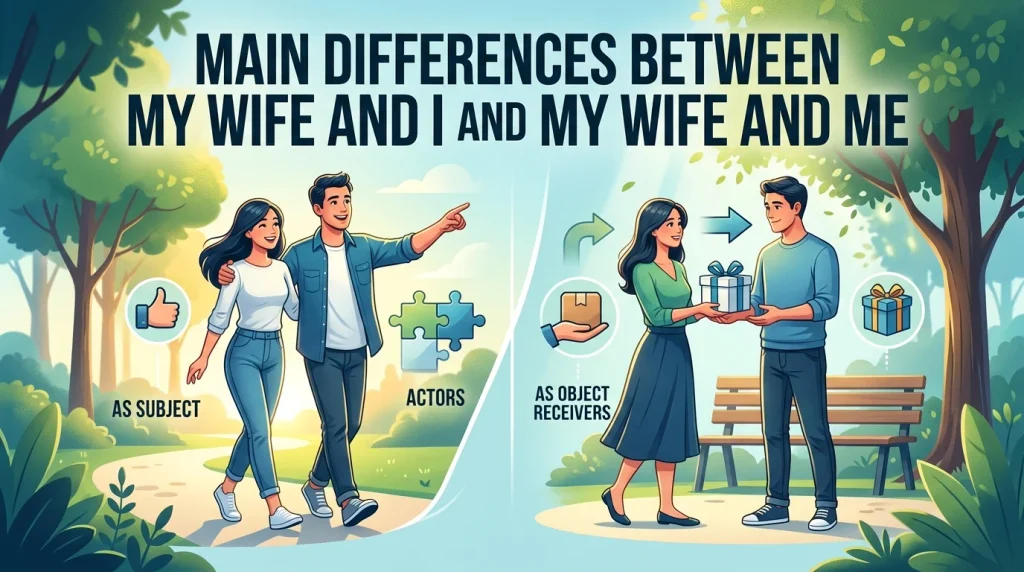
The primary difference between these expressions is their grammatical role. Both refer to the same two people, but they serve different purposes within a sentence.
Comparison Table
| Feature | My Wife and I | My Wife and Me |
| Pronoun type | Subject pronoun | Object pronoun |
| Grammatical role | Usually a compound subject | Usually a compound object |
| Common position | Before the main verb when serving as the subject | After a verb or preposition when serving as the object |
| Example | My wife and I cooked dinner. | They thanked my wife and me. |
| Correct after “to” | Usually incorrect when “to” is a preposition | Usually correct |
| Correct after an action verb | Depends on whether it is the subject | Correct when it is the object |
| Formal writing | Correct in subject position | Correct in object position |
| Everyday conversation | Common and correct | Common and correct |
Difference in Grammatical Function
The most important distinction is whether the phrase performs an action or receives one.
Subject example:
My wife and I organized the event.
Here, the speaker and their wife organized the event. They are the subjects of the verb “organized.”
Object example:
The committee congratulated my wife and me.
Here, the committee acted, while the speaker and their wife received the congratulations.
Difference in Sentence Position
“My wife and I” often appears before the verb when it functions as the subject.
Examples:
- My wife and I work together.
- My wife and I visited the museum.
- My wife and I understand the instructions.
“My wife and me” often appears after a verb or preposition when it functions as an object.
Examples:
- They called my wife and me.
- The invitation was sent to my wife and me.
- He sat between my wife and me.
However, position alone is not a perfect test. The phrase’s grammatical function matters more than its location.
Difference in Formal and Informal English
Both expressions are appropriate in formal and informal English when used correctly.
For example, a formal business email might say:
“My wife and I would like to thank you for your hospitality.”
Another formal email might say:
“Thank you for inviting my wife and me to the event.”
Neither expression is more formal than the other. Correct grammar depends on the sentence structure, not the level of formality.
Why Do People Confuse My Wife and I With My Wife and Me?
Many English speakers use “my wife and I” in situations where “my wife and me” is grammatically correct. This often happens because “my wife and I” sounds more polished or formal to them.
However, a phrase does not become correct simply because it sounds sophisticated.
For example:
- Incorrect in standard English: The manager invited my wife and I.
- Correct: The manager invited my wife and me.
The mistake becomes easier to identify when the other person is removed:
- The manager invited I. (Incorrect)
- The manager invited me. (Correct)
The same test works in the opposite situation:
- My wife and I attended the meeting. (Correct)
- Me attended the meeting. (Incorrect in standard formal English)
Removing “my wife and” helps reveal which pronoun fits the sentence.
Grammar Guide
Understanding subject pronouns, object pronouns, verbs, and prepositions makes it easier to choose between “my wife and I” and “my wife and me.”
How Each Term Is Used in Sentences
1. Using “My Wife and I” as the Subject
Use “my wife and I” when the phrase functions as the subject of a sentence.
Basic pattern:
My wife and I + verb + the rest of the sentence.
Examples:
- My wife and I enjoy cooking.
- My wife and I visited our parents.
- My wife and I are learning Spanish.
- My wife and I have completed the project.
- My wife and I will attend the meeting.
In each sentence, the compound subject acts or is described by the verb.
2. Using “My Wife and Me” as the Object
Use “my wife and me” when the phrase functions as the object of a verb.
Basic pattern:
Subject + verb + my wife and me.
Examples:
- Our neighbors invited my wife and me.
- The doctor examined my wife and me.
- The company congratulated my wife and me.
- Our friends helped my wife and me.
- The photographer photographed my wife and me.
The phrase receives the action of the verb.
3. Using “My Wife and Me” After a Preposition
Use “my wife and me” after a preposition when the phrase is its object.
Common prepositions include “to,” “for,” “with,” “between,” “from,” and “about.”
Examples:
- She gave the documents to my wife and me.
- This house is for my wife and me.
- He traveled with my wife and me.
- The disagreement was between my wife and me.
- They received a message from my wife and me.
A useful rule is that a preposition is normally followed by an object pronoun, not a subject pronoun.
4. Using the Phrase After a Linking Verb
Some sentences use linking verbs such as “is,” “was,” “are,” and “were.” In these cases, the grammar can be more complicated because a phrase after a linking verb may describe or identify the subject.
For example:
- My wife and I are responsible for the project.
- The people responsible for the project are my wife and me.
The first sentence uses a subject phrase. The second uses an object-form pronoun in a complement construction, which is standard in everyday English.
Traditional formal grammar sometimes prefers subject pronouns in certain identifying constructions, especially after “be.” For clear, natural writing, it is usually best to restructure a sentence if the pronoun choice sounds awkward.
Common Mistakes Learners Make
Mistake 1: Using “My Wife and I” as an Object
Incorrect: The receptionist called my wife and I.
Correct: The receptionist called my wife and me.
Why? The phrase is the object of “called.”
Mistake 2: Using “My Wife and Me” as a Subject
Incorrect: My wife and me went shopping.
Correct: My wife and I went shopping.
Why? The phrase is the subject of “went.”
Mistake 3: Assuming “I” Is Always More Polite
Incorrect: Please send the report to my wife and I.
Correct: Please send the report to my wife and me.
Why? Politeness does not change the grammatical role of a pronoun.
Mistake 4: Forgetting the Preposition Rule
Incorrect: The gift is for my wife and I.
Correct: The gift is for my wife and me.
Why? The preposition “for” requires an object in this construction.
Mistake 5: Thinking the Phrase Must Always Come First
Incorrect reasoning: “My wife and I” is correct because it appears at the beginning of a sentence.
Correct reasoning: The phrase is correct when it functions as the subject, regardless of its exact position.
For example:
- Yesterday, my wife and I visited the museum.
- Yesterday, the museum welcomed my wife and me.
Both sentences begin with “Yesterday,” but the pronouns differ because their grammatical roles differ.
Simple Rules to Remember
Remember these four simple rules:
- Use “I” for the subject.
Example: My wife and I are ready. - Use “me” for the object of a verb.
Example: They helped my wife and me. - Use “me” after a preposition.
Example: Come with my wife and me. - Remove the other person to test the pronoun.
If “I” works alone, use “I.” If “me” works alone, use “me.”
The fourth rule is particularly useful when you are unsure which expression to choose.
Quick Tips for Writing and Speaking
- Read the sentence without the words “my wife and.” This often reveals the correct pronoun.
- Identify the main verb and determine who acts.
- Check whether the phrase follows a preposition such as “to,” “with,” or “for.”
- Do not choose a pronoun based only on how formal the sentence sounds.
- When writing business emails, reports, academic assignments, or professional documents, apply the same grammatical rule.
- When speaking, prioritize natural, standard usage rather than overthinking every sentence.
When to Use Each One
Both expressions are correct, but they belong in different grammatical situations.
When to Use “My Wife and I”
Use “my wife and I” when you and your wife are the subjects of the sentence.
Common situations include:
Daily conversations
- My wife and I are going out for dinner.
- My wife and I need to buy groceries.
Education
- My wife and I attended the graduation ceremony.
- My wife and I discussed the assignment.
Business and professional communication
- My wife and I appreciate your assistance.
- My wife and I have reviewed the proposal.
Travel
- My wife and I visited Italy last summer.
- My wife and I are planning a trip abroad.
Writing and storytelling
- My wife and I moved to a new city.
- My wife and I started a small business.
In each example, the phrase acts as the subject.
When to Use “My Wife and Me”
Use “my wife and me” when you and your wife receive an action or follow a preposition.
Common situations include:
Daily conversations
- Our friends invited my wife and me to dinner.
- The neighbors visited my wife and me.
Education
- The teacher spoke to my wife and me.
- The school invited my wife and me to the ceremony.
Business and professional communication
- The director thanked my wife and me.
- Please send the contract to my wife and me.
Travel
- The tour guide showed my wife and me the city.
- The airline offered my wife and me assistance.
Writing and storytelling
- The author dedicated the book to my wife and me.
- The story reminded my wife and me of our childhood.
In these examples, the phrase is an object or the object of a preposition.
When NOT to Use Each One
Knowing when an expression is incorrect is just as important as knowing when to use it.
When Not to Use “My Wife and I”
Do not use “my wife and I” as the object of a verb in standard English.
Incorrect: The organizer welcomed my wife and I.
Correct: The organizer welcomed my wife and me.
Incorrect: They invited my wife and I to the party.
Correct: They invited my wife and me to the party.
Also avoid using “my wife and I” after a preposition when it is the preposition’s object.
Incorrect: The tickets were purchased for my wife and I.
Correct: The tickets were purchased for my wife and me.
When Not to Use “My Wife and Me”
Do not use “my wife and me” as the subject of a sentence in standard formal English.
Incorrect: My wife and me are traveling tomorrow.
Correct: My wife and I are traveling tomorrow.
Incorrect: My wife and me completed the project.
Correct: My wife and I completed the project.
Remember that “me” is not inherently incorrect or less formal. It is simply the object form of the first-person singular pronoun.
Avoid Overcorrecting Your English
A common problem is replacing every instance of “me” with “I” to sound more professional.
For example:
- Incorrect: The invitation was sent to my wife and I.
- Correct: The invitation was sent to my wife and me.
The second sentence is fully appropriate for professional writing.
Self-Assessment: Fill in the Blanks
Test your understanding by choosing the correct expression for each sentence. Use “my wife and I” or “my wife and me” as appropriate.
- ______ visited the art gallery last weekend.
- The manager invited ______ to the company dinner.
- The gift was intended for ______.
- ______ are planning a family holiday.
- The teacher spoke to ______ after the meeting.
- ______ completed the home renovation last month.
- Our neighbors invited ______ to their wedding.
- The travel agent helped ______ book our flights.
- ______ enjoy reading books together.
- The company sent a thank-you letter to ______.
- ______ attended the business conference.
- The photographer took pictures of ______.
- The decision was made by ______.
- The organizer provided refreshments for ______.
- ______ have been learning a new language.
- The doctor explained the treatment options to ______.
- ______ purchased a new car last week.
- The invitation came from ______.
- Our friends congratulated ______ on our anniversary.
- ______ hope to visit Japan next year.
Answers
- My wife and I: The phrase is the subject of “visited.”
- My wife and me: The phrase is the object of “invited.”
- My wife and me: The phrase follows the preposition “for.”
- My wife and I: The phrase is the subject of “are planning.”
- My wife and me: The phrase follows the preposition “to.”
- My wife and I: The phrase is the subject of “completed.”
- My wife and me: The phrase is the object of “invited.”
- My wife and me: The phrase is the object of “helped.”
- My wife and I: The phrase is the subject of “enjoy.”
- My wife and me: The phrase follows the preposition “to.”
- My wife and I: The phrase is the subject of “attended.”
- My wife and me: The phrase follows the preposition “of.”
- My wife and me: The phrase follows “by,” which introduces the agent in this passive construction.
- My wife and me: The phrase follows the preposition “for.”
- My wife and I: The phrase is the subject of “have been learning.”
- My wife and me: The phrase follows the preposition “to.”
- My wife and I: The phrase is the subject of “purchased.”
- My wife and me: The phrase follows the preposition “from.”
- My wife and me: The phrase is the object of “congratulated.”
- My wife and I: The phrase is the subject of “hope.”
Final Verdict
Both “my wife and I” and “my wife and me” are grammatically correct expressions. The difference lies in their function within a sentence, not their meaning, formality, or politeness.
Use “my wife and I” when you and your wife are the subject acting: “My wife and I visited the museum.”
Use “my wife and me” when you and your wife are the object of a verb or preposition: “The guide showed my wife and me the museum.”
When in doubt, remove “my wife and” and check whether “I” or “me” makes sense on its own. This simple technique will help you choose the correct expression in conversations, emails, academic writing, and professional communication.
The easiest rule to remember is this: Use “I” as the subject and “me” as the object. Once you understand that distinction, choosing between “my wife and I” and “my wife and me” becomes much easier.
Conclusion
Understanding the difference between “my wife and I” and “my wife and me” is a simple but valuable step toward improving your English grammar. Both expressions refer to you and your wife, but they serve different grammatical purposes in a sentence. The key is knowing whether the phrase acts as the subject or the object.
Use “my wife and I” when you and your wife perform an action, as in “My wife and I enjoy traveling together.” Choose “my wife and me” when someone performs an action toward you or when the phrase follows a preposition, as in “They invited my wife and me to dinner.”
If you ever feel uncertain, remove “my wife and” from the sentence and check whether “I” or “me” sounds grammatically correct on its own. This practical technique works in everyday conversations, professional emails, academic writing, and formal communication. With a little practice, choosing between these expressions will become natural and effortless.
FAQs
Is “My Wife and I” or “My Wife and Me” Correct?
Both expressions are correct in standard English, but they are used in different grammatical situations. “My wife and I” is appropriate when the phrase acts as the subject, such as “My wife and I went shopping.” “My wife and me” is correct when the phrase acts as an object, such as “They invited my wife and me.”
What Is the Main Difference Between “My Wife and I” and “My Wife and Me”?
The main difference is the grammatical role of the pronoun. “I” is a subject pronoun used by someone acting, while “me” is an object pronoun used when receiving an action or following a preposition. Both expressions refer to the same people, but the sentence structure determines which one is correct.
Should I Say “My Wife and I Went” or “My Wife and Me Went”?
You should say “My wife and I went” because the phrase is the subject of the verb “went.” The speaker and their wife are acting. In standard English, “My wife and me went” is incorrect in this context because “me” is an object pronoun, not the appropriate subject pronoun.
Is It Correct to Say “Between My Wife and I” or “Between My Wife and Me”?
The standard grammatical expression is “between my wife and me.” The word “between” is a preposition, and it normally takes an object pronoun such as “me.” For example, “The decision is between my wife and me” is correct. Using “I” after “between” is a common mistake, even among fluent English speakers.
Is “My Wife and Me” Unprofessional in Business Writing?
No, “my wife and me” is entirely appropriate in professional writing when it serves as an object. For example, “Please send the documents to my wife and me” is grammatically correct and professional. Using “my wife and I” instead would be incorrect in this sentence. Professional communication requires accurate grammar, not choosing “I” in every situation.
Why Do People Often Use “My Wife and I” Incorrectly?
Many people believe “my wife and I” sounds more polite, educated, or formal than “my wife and me.” As a result, they sometimes use it as an object when “me” is required. However, grammatical correctness depends on the pronoun’s function in the sentence, not on which expression sounds more sophisticated.
How Can I Easily Remember When to Use “My Wife and I”?
Remember that “I” is used for the subject, while “me” is used for the object. A helpful trick is to remove “my wife and” from the sentence. If “I” fits correctly, use “my wife and I.” If “me” fits correctly, use “my wife and me.” This simple test makes the choice much easier.
Should I Use “My Wife and I” or “My Wife and Me” After a Verb?
The correct choice depends on whether the phrase is the subject or the object of the verb. For example, “My wife and I called the office” uses a subject phrase, while “The office called my wife and me” uses an object phrase. Look at who acts to determine the correct pronoun.
Which Expression Is Correct in a Formal Letter: “My Wife and I” or “My Wife and Me”?
Both expressions are correct in formal letters when used in the appropriate grammatical position. You might write, “My wife and I appreciate your assistance,” or “Thank you for meeting with my wife and me.” The first phrase is the subject, while the second is the object of the preposition “with.”
Can I Use “My Wife and Me” at the Beginning of a Sentence?
Yes, if the sentence structure makes the phrase an object rather than a subject. For example, “For my wife and me, the experience was unforgettable” is correct because the phrase follows the preposition “for.” However, if the phrase acts as the subject, use “my wife and I,” as in “My wife and I enjoyed the experience.”