
“Persue ” and ” pursue” are often confused by English learners because they look similar and sound nearly identical when spoken. However, only pursue is the correct English spelling. Persue is a misspelling and should not be used in standard writing. Understanding the difference helps you write accurately in school, work, business, and everyday communication.
Comparison Overview
The comparison between persue and pursue is straightforward: pursue is the correct word, while persue is an incorrect spelling.
The confusion usually happens because English contains many words beginning with per-, and learners may naturally assume that “persue” follows the same pattern. The correct spelling, however, contains pur- at the beginning:
- Correct: pursue
- Incorrect: persue
- Correct form: pursue, pursued, pursuing, pursues
- Incorrect form: persue, persued, persuing, persues
The word pursue is a verb. It generally means to follow, seek, continue, or work toward something.
For example:
She decided to pursue a career in medicine.
Here, “pursue” means to work toward or seek a particular career.
Definition of Persue

Persue is not a standard English word. It is a common misspelling of pursue.
If you search for “persue” in a spelling checker or dictionary, it will usually direct you to the correct spelling: pursue.
For example:
- ❌ I want to persue my dreams.
- ✅ I want to pursue my dreams.
The intended meaning in both sentences is the same, but only the second sentence uses the correct English spelling.
Why Do People Spell It “Persue”?
The mistake is understandable because persue looks like a natural spelling based on other English words beginning with “per.” In addition, the pronunciation of pursue can make the spelling difficult to remember.
The important point is that the first syllable is spelled pur, not per.
Is “Persue” a Word?
No. In standard modern English, persue is considered a misspelling of pursue.
You should avoid using “persue” in:
- Academic assignments
- Resumes and CVs
- Cover letters
- Business emails
- Reports
- Blog posts
- Websites
- Formal documents
- Professional communication
Definition of Pursue
Pursue is a correctly spelled English verb meaning to follow, seek, continue, or work toward something.
Depending on the context, it can have several related meanings.
Pursue Meaning: To Work Toward a Goal
When you pursue a goal, ambition, dream, or career, you actively work toward achieving it.
Examples:
- She wants to pursue a career in engineering.
- He is pursuing his dream of becoming a writer.
- They pursued their long-term business goals.
Pursue Meaning: To Follow Someone or Something
“Pursue” can also mean to follow someone or something, especially when trying to catch them.
Example:
The police pursued the suspect.
Here, “pursued” means followed or chased.
Pursue Meaning: To Seek Something
You can pursue an opportunity, objective, solution, or course of action.
Example:
The company decided to pursue a new business opportunity.
Here, “pursue” means to actively seek or attempt to achieve the opportunity.
Pursue Meaning: To Continue an Activity
“Pursue” can also mean to continue with an activity, interest, or course of action.
Example:
She decided to pursue her studies abroad.
In this context, the word means to continue or undertake a particular course of study.
Main Differences Between Persue and Pursue
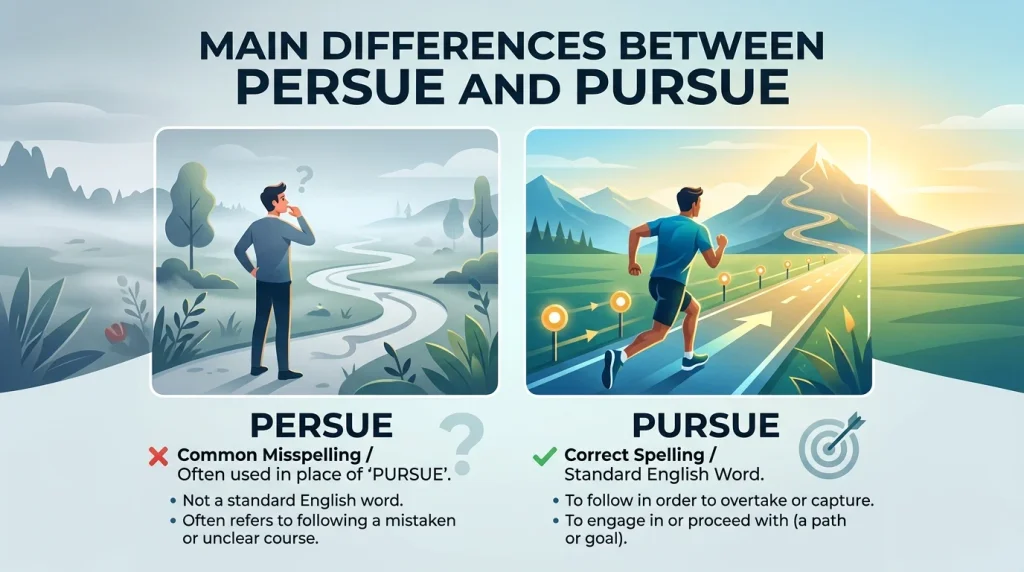
The biggest difference is simple:
| Feature | Persue | Pursue |
| Standard English word? | No | Yes |
| Correct spelling? | No | Yes |
| Part of speech | Intended as a verb, but incorrectly spelled | Verb |
| Meaning | No standard meaning | To follow, seek, or work toward |
| Used in formal writing? | No | Yes |
| Example | ❌ I want to persue my goal. | ✅ I want to pursue my goal. |
| Correct past tense | ❌ persued | ✅ pursued |
| Correct -ing form | ❌ persuing | ✅ pursuing |
| Correct third-person form | ❌ persues | ✅ pursues |
Therefore, whenever you intend to express the meaning of following, seeking, or working toward something, use pursue.
Persue vs Pursue: Spelling Difference
The key spelling difference is the vowel in the first syllable:
Persue → P-E-R-S-U-E ❌
Pursue → P-U-R-S-U-E ✅
A useful way to remember the correct spelling is to focus on the beginning:
PUR + SUE = PURSUE
Do not write:
PER + SUE = PERSUE ❌
The correct form always begins with pur.
Pursue: Meaning and Synonyms
Depending on context, synonyms for pursue can include:
- Follow
- Chase
- Seek
- Aim for
- Work toward
- Continue
- Undertake
- Strive for
- Go after
- Develop
However, these words are not always interchangeable.
For example:
She pursued a degree in biology.
You could say:
She worked toward a degree in biology.
But replacing “pursued” with “chased” would sound unnatural in this context.
The exact synonym depends on whether “pursue” means following something, seeking something, or working toward a goal.
Grammar Guide
Pursue is a verb.
Its basic grammatical forms are:
| Form | Word |
| Base form | pursue |
| Third-person singular | pursues |
| Present participle/gerund | pursuing |
| Past tense | pursued |
| Past participle | pursued |
Examples:
- I pursue my goals.
- She pursues her interests.
- They are pursuing a new opportunity.
- He pursued a career in finance.
- The company has pursued several strategies.
How Each Term Is Used in Sentences
Since persue is a misspelling, it should not normally appear in a correctly written English sentence.
Pursue can be used in several sentence patterns.
Pattern 1: Pursue + noun
She pursued a career in medicine.
He pursued an opportunity in technology.
Pattern 2: Pursue + goal
They pursued their goals with determination.
Pattern 3: Pursue + interest
She decided to pursue her interest in photography.
Pattern 4: Pursue + person or object
The police pursued the vehicle.
Pattern 5: Be + pursuing + noun
The company is pursuing a new strategy.
Pattern 6: Pursue + education or studies
He plans to pursue higher education.
Common Mistakes Learners Make
Mistake 1: Writing “persue”
❌ I want to persue my dreams.
Correct:
✅ I want to pursue my dreams.
Mistake 2: Writing “persued”
Because learners add “-ed” to the misspelled form, they may write:
❌ She persued her goal.
The correct form is:
✅ She pursued her goal.
Notice that the spelling changes from pursue to pursued.
Mistake 3: Writing “persuing”
Another frequent error is:
❌ He is persuing a degree.
Correct:
✅ He is pursuing a degree.
The correct spelling is pursuing, not “persuing.”
Mistake 4: Confusing Pursue With Peruse
Another word that can create confusion is peruse.
Peruse is a real English verb, but it has a different meaning from pursue.
- Pursue = follow, seek, or work toward something.
- Peruse = read or examine something carefully.
For example:
She wants to pursue a career in law.
But:
She perused the report before the meeting.
These are different words with different meanings.
Simple Rules to Remember
Use these simple rules:
- Pursue is correct.
- Persue is incorrect.
- Remember PUR at the beginning of pursue.
- If you mean “work toward,” use pursue.
- If you mean “follow” or “chase,” use pursue.
- If you mean “seek,” use pursue.
- The past tense is pursued, not “persued.”
- The -ing form is pursuing, not “persuing.”
A simple memory trick is:
PURsue your PURpose.
Both pursue and purpose begin with pur.
Quick Tips for Writing and Speaking
When writing quickly, pause briefly if you are unsure about the spelling.
Ask yourself:
“Am I talking about following, seeking, or working toward something?”
If the answer is yes, the word you need is almost certainly pursue.
For example:
I want to pursue my education.
She plans to pursue a new career.
The team pursued a solution.
When speaking, remember that correct pronunciation does not automatically make the spelling obvious. Always remember the written form: p-u-r-s-u-e.
When to Use Each One
When to Use Pursue
Use pursue when you mean:
- To work toward a goal
- To seek an opportunity
- To follow someone or something
- To chase someone or something
- To continue a particular activity
- To develop an interest
- To undertake education or a career
- To seek a solution or objective
Examples include:
I want to pursue a master’s degree.
She pursued her dream of becoming an artist.
The company is pursuing international expansion.
The officers pursued the vehicle.
He decided to pursue a new opportunity.
When to Use Pursue
There is no standard context in which persue should be used as the ordinary English spelling.
If you intend to use the verb meaning “to follow,” “seek,” or “work toward,” replace persue with pursue.
When NOT to Use Each One
When Not to Use Persue
Do not use persue in standard English writing.
Incorrect:
❌ I want to persue my education.
Correct:
✅ I want to pursue my education.
Incorrect:
❌ She persued her ambition.
Correct:
✅ She pursued her ambition.
Incorrect:
❌ He is persuing a new opportunity.
Correct:
✅ He is pursuing a new opportunity.
When Not to Use Pursue
Although pursue is the correct spelling, it should not be used simply because two words seem related.
For example, if you mean “read or examine,” you may need peruse, not pursue.
Incorrect meaning:
❌ I will pursue the document carefully.
If your intended meaning is “read or examine,” use:
✅ I will peruse the document carefully.
Similarly, do not use pursue when a completely different verb expresses your intended meaning more accurately.
Pursue vs Peruse: An Important Related Confusion
Because “persue” may arise from confusion between pursue and peruse, it is useful to distinguish them.
| Word | Meaning | Example |
| Pursue | Follow, seek, or work toward | She wants to pursue a career in medicine. |
| Peruse | Read or examine | He perused the document before signing it. |
| Persue | Incorrect spelling | ❌ She wants to persue a career. |
This distinction is particularly important for advanced English learners because peruse is a legitimate word, whereas persue is not.
When to Use “Pursue” in Education
“Pursue” is common when discussing education, degrees, subjects, and academic goals.
Examples:
She plans to pursue a bachelor’s degree.
He is pursuing a master’s degree in computer science.
Students can pursue their academic interests through research.
She decided to pursue higher education.
In educational contexts, “pursue” generally means to undertake or work toward a particular course of study or qualification.
When to Use “Pursue” in Business
Businesses can pursue:
- Goals
- Strategies
- Opportunities
- Growth
- Expansion
- Partnerships
- Solutions
- New markets
- Customers
- Projects
Examples:
The company is pursuing opportunities in international markets.
The team pursued a new business strategy.
Management decided to pursue a partnership with another company.
When to Use “Pursue” in Career Discussions
“Pursue” is especially common when discussing career choices.
Examples:
She wants to pursue a career in engineering.
He decided to pursue journalism.
They are pursuing careers in healthcare.
The phrase “pursue a career” is natural and widely used.
When to Use “Pursue” in Everyday Life
The word is not limited to formal situations.
Examples:
I want to pursue my passion for photography.
She pursued her hobby after retirement.
He decided to pursue a healthier lifestyle.
They pursued a solution to the problem.
Thus, “pursue” can be used in both formal and everyday English.
Which One to Use: Decision Guide
Use this quick decision process:
Step 1: Are you trying to spell the word meaning “follow,” “seek,” or “work toward”?
Use:
Pursue
Step 2: Are you considering “persue”?
Do not use it.
Persue = incorrect spelling
Step 3: Are you talking about the past?
Use:
Pursued
Example:
She pursued her goal.
Step 4: Are you describing an ongoing action?
Use:
Pursuing
Example:
She is pursuing her goal.
Step 5: Are you talking about someone who regularly does it?
Use:
Pursues
Example:
He pursues new opportunities.
Quick Decision Table
| If you mean… | Use |
| Work toward a goal | Pursue |
| Seek an opportunity | Pursue |
| Follow someone | Pursue |
| Chase something | Pursue |
| Continue a course of action | Pursue |
| Past action | Pursued |
| Ongoing action | Pursuing |
| Third-person singular | Pursues |
| “Persue” | Do not use |
Real-World Practical Examples
Pursue Examples
- Education:
Maria decided to pursue a master’s degree in education. - Career:
Ahmed wants to pursue a career in software development. - Business:
The company plans to pursue new opportunities in international markets. - Daily life:
She decided to pursue her passion for painting. - Science:
The researchers are pursuing a new approach to treating the problem. - Technology:
The startup is pursuing innovative solutions for data security. - Writing:
The author chose to pursue a different theme in her next novel. - Conversation:
“What career do you want to pursue?” - Law enforcement:
The officers pursued the vehicle after it left the scene. - Personal goals:
He continues to pursue his long-term goals.
Pursue Examples
Because persue is not the correct standard English spelling, no correct standard-English examples are using it.
The following examples demonstrate the errors learners should avoid:
- Education:
❌ She wants to persue a degree.
✅ She wants to pursue a degree. - Career:
❌ He plans to persue a career in medicine.
✅ He plans to pursue a career in medicine. - Business:
❌ The company will persue new opportunities.
✅ The company will pursue new opportunities. - Daily life:
❌ I want to persue my interests.
✅ I want to pursue my interests. - Technology:
❌ The team is persuing a new solution.
✅ The team is pursuing a new solution.
Commonly Confused Forms of Pursue
Pursue vs Pursued
Pursue is the base form.
I want to pursue my goal.
Pursued is the past tense and past participle.
I pursued my goal last year.
Pursue vs Pursuing
Pursuing is used for an ongoing action or as a gerund.
She is pursuing a degree.
Pursuing your goals requires patience.
Pursue vs Pursues
Pursues is used with third-person singular subjects in the simple present.
He pursues new opportunities.
She pursues her interests.
Pursue vs Peruse
These are different words.
Pursue means to follow, seek, or work toward.
Peruse means to read or examine.
Examples:
We should pursue a solution.
We should peruse the report.
SEO FAQ: Persue Or Pursue
Is “persue” correct?
No. Persue is a misspelling. The correct spelling is pursue.
What is the correct spelling: persue or pursue?
The correct spelling is pursue.
What does pursue mean?
Pursue is a verb meaning to follow, seek, chase, continue, or work toward something.
Is pursue a verb?
Yes. Pursue is a verb.
For example:
She wants to pursue a career in law.
What is the past tense of pursue?
The past tense is pursued.
Example:
He pursued his dream.
What is the present participle of pursue?
The present participle is pursuing.
Example:
She is pursuing a new opportunity.
How do you spell pursue?
The correct spelling is:
P-U-R-S-U-E
Why do people write “persue”?
“Persue” is a common spelling mistake. The error likely occurs because the pronunciation can make the vowel sequence difficult to remember and because “per-” is a common beginning in English words.
Is “persued” correct?
No. The correct past-tense spelling is pursued.
❌ persued
✅ pursued
Is “persuing” correct?
No. The correct form is pursuing.
❌ persuing
✅ pursuing
What is the easiest way to remember pursue?
Remember:
PURsue your PURpose.
The words pursue and purpose both begin with pur.
Self-Assessment: Fill in the Blanks
Complete each sentence with the correct form of the word. Pay attention to meaning, grammar, and spelling.
- I will use ______ when referring to working toward a career in medicine.
- I will use ______ because “persue” is not the standard English spelling.
- I will use ______ when referring to following or chasing a vehicle.
- I will use ______ when describing a past effort to achieve a goal.
- I will use ______ when describing an action that is happening now.
- I will use ______ when the subject is “she” and the sentence is in the simple present.
- I will use ______ when referring to seeking a new business opportunity.
- I will use ______ when referring to continuing a course of study.
- I will use ______ instead of “persue” in a formal essay.
- I will use ______ when saying that someone worked toward a dream in the past.
- I will use ______ when referring to an ongoing effort to find a scientific solution.
- I will use ______ when referring to someone who regularly seeks new opportunities.
- I will use ______ when writing “He wants to ______ his passion.”
- I will use ______ when writing “They are ______ a new strategy.”
- I will use ______ when writing “She ______ a career in journalism last year.”
- I will use ______ when referring to the correct spelling of the verb meaning “to seek or follow.”
- I will use ______ when referring to working toward personal goals.
- I will use ______ when the intended meaning is “follow or chase,” rather than “read or examine.”
- I will use ______ when referring to the word that is commonly confused with “peruse” but means “follow or seek.”
- I will use ______ because the correct spelling contains “pur” at the beginning.
Answers
- pursue: because it means working toward a career or goal.
- pursue: because “persue” is an incorrect spelling.
- pursue: because it can mean to follow or chase something.
- pursued: because it is the past tense of “pursue.”
- pursuing: because it describes an ongoing action.
- pursues: because “she” takes the third-person singular form in the simple present.
- pursue: because businesses can pursue opportunities.
- pursue: because the word can mean to undertake or continue a course of study.
- pursue: because it is the standard spelling.
- pursued: because the action happened in the past.
- pursuing: because it describes an action currently in progress.
- pursues: because it follows a third-person singular subject such as “someone.”
- pursue: because “want to” is followed by the base form of the verb.
- pursuing: because “are” is followed by the present participle in this construction.
- pursued: because the action occurred in the past.
- pursue: because this is the correct base form of the verb.
- pursue: because personal goals can be pursued.
- pursue: because “pursue” can mean follow or chase.
- pursue: because it means to follow, seek, or work toward something, while “peruse” has a different meaning.
- pursue: because the correct spelling begins with “pur.”
Final Verdict
The answer to “Persue or Pursue?” is simple: pursue is correct, and persue is incorrect in standard English.
Use pursue when you mean to follow, seek, chase, continue, or work toward something:
She wants to pursue her dreams.
Remember the main spelling:
P-U-R-S-U-E
The related forms are:
- Pursue — base form
- Pursues — third-person singular
- Pursued — past tense and past participle
- Pursuing — present participle/gerund
Conclusion
Understanding the difference between Persue and Pursue is simple once you remember that pursue is the correct English spelling, while persue is a common spelling mistake. The verb pursue means to follow, seek, chase, continue, or work toward something, such as a goal, career, education, opportunity, or personal ambition. Its main forms include pursue, pursues, pursued, and pursuing.
A useful memory trick is to connect pursue with purpose, as both begin with “pur.” Remembering this small spelling detail can make your writing more accurate and professional. Whether you are writing an academic assignment, business email, resume, blog post, or everyday message, choosing pursue will ensure your sentence is grammatically correct. Once this distinction becomes familiar, you will no longer need to hesitate when deciding between “persue” and “pursue.”
FAQs
Is “persue” a correct English word?
No, “persue” is not the standard English spelling. It is a common misspelling of pursue. If you want to express the idea of following, seeking, chasing, or working toward something, always use pursue. For example, “She wants to pursue a career in medicine” is correct, while “She wants to persue a career in medicine” is incorrect.
What is the correct spelling, persue or pursue?
The correct spelling is pursue. It is spelled P-U-R-S-U-E. The form “persue” is a spelling error and should be avoided in formal and informal English writing. You can use pursue when talking about following something, seeking an opportunity, working toward a goal, or continuing a particular activity or course of study.
What does pursue mean?
Pursue is a verb that generally means to follow, seek, chase, continue, or work toward something. Its meaning depends on context. For example, “pursue a career” means to work toward a career, while “pursue a vehicle” means to follow or chase it. The word is commonly used in education, business, careers, and everyday communication.
What is the past tense of pursue?
The past tense of pursue is pursued. For example, “She pursued her dream of becoming a writer.” Notice that the spelling changes from “pursue” to “pursued.” The incorrect form “persued” should not be used. Pursued can describe something that someone followed, sought, or worked toward in the past.
What is the difference between pursue and peruse?
Pursue and peruse are different words with different meanings. Pursue means to follow, seek, chase, or work toward something. Peruse generally means to read or examine something carefully. For example, “He pursued a career in law” differs from “He perused the legal document.” “Persue” is not the correct spelling of either word.
How do you use pursue in a sentence?
You can use pursue before a goal, career, opportunity, interest, or object that someone is following. Examples include “She plans to pursue higher education,” “He wants to pursue his passion,” and “The company will pursue new opportunities.” The exact meaning changes slightly according to context, but the central idea is actively seeking or following something.
Is pursue a verb or a noun?
Pursue is a verb. It describes an action, such as following, seeking, chasing, or working toward something. Its grammatical forms include pursue, pursues, pursued, and pursuing. For example, “They pursue their goals” uses the verb in the present tense, while “They pursued their goals” uses its past-tense form.
How can I remember the spelling of pursue?
A simple way to remember pursue is to connect it with the word purpose. Both words begin with “pur.” You can remember the phrase “pursue your purpose.” This helps distinguish the correct spelling from the common mistake “persue.” Also remember that the word begins with pur, not per.
Is “pursuing” spelled correctly?
Yes, pursuing is the correct spelling. It is the present participle or gerund form of pursue. For example, “She is pursuing a degree in engineering.” The spelling “persuing” is incorrect. When adding “-ing” to pursue, the final “e” is removed, producing pursuing, not “pursueing.”
Why is “persue” commonly confused with “pursue”?
The confusion occurs because persue looks like a natural spelling pattern in English, and the pronunciation of pursue does not make its written form immediately obvious. Learners may also confuse it with words beginning with “per-” or with the legitimate word peruse. Remembering “pur” at the beginning makes the correct spelling easier to recall.