
Gases and gasses look almost identical, but they do not have the same grammatical role in standard English. Both can be connected to the word gas, yet they are used differently depending on whether you are talking about multiple gases or describing an action. Understanding this small spelling difference can make your writing clearer and more accurate.
Comparison Overview
The words gases and gasses both come from the word gas, but their meanings and grammatical functions are different.
- Gases is normally the plural noun of gas. It refers to two or more gases or different types of gas.
- Gasses is normally the third-person singular present-tense form of the verb gas, meaning to expose something to gas or to fill something with gas.
- In standard modern English, gases is the usual spelling when you mean more than one gas.
- Gasses can occasionally appear as a plural noun in some dictionaries or specialized usage, but it is much less common than gases and can cause confusion.
For most everyday, academic, scientific, and professional writing, use gases when referring to multiple gases.
Definition of Gases
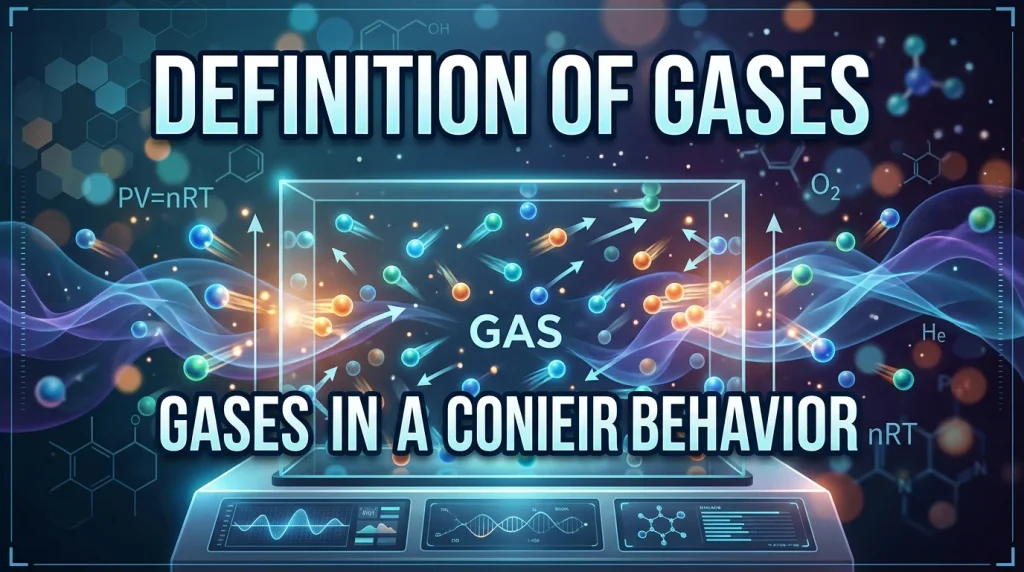
Gases is the plural form of the noun gas.
A gas is a state of matter in which particles are relatively far apart and can move freely. Unlike solids and liquids, gases do not have a fixed shape or fixed volume. They expand to fill the container available to them.
The word gases is used when talking about more than one gas, several types of gas, or gas substances collectively.
For example:
- Oxygen and nitrogen are gases.
- Several gases are present in Earth’s atmosphere.
- Greenhouse gases can affect Earth’s climate.
- Scientists study how different gases react under pressure.
Is “gases” a noun?
Yes. Gases is primarily a plural noun.
The singular form is:
gas → gases
For example:
Carbon dioxide is a gas.
Plural:
Carbon dioxide and methane are gases.
The plural spelling gases is pronounced with a long a sound followed by a z sound: roughly GAY-ziz.
Definition of Gasses
Gasses is most commonly the third-person singular present-tense form of the verb gas.
The verb gas can mean to expose something to gas, fill something with gas, or, in some contexts, overwhelm or exhaust someone with excessive talking or conversation.
For example:
The machine gasses the material before processing.
Here, gasses is a verb. It describes what the machine does.
Another example is:
The chemical process gasses the chamber.
In this sentence, gasses describes an action performed by the subject.
Is “gasses” a noun?
It can be used as a plural noun in some varieties or specialized contexts, but gases is overwhelmingly the normal choice when you simply mean multiple gases.
Therefore, if you are writing about oxygen, nitrogen, carbon dioxide, helium, methane, or other substances, gases is generally the word you want.
Main Differences Between Gases and Gasses
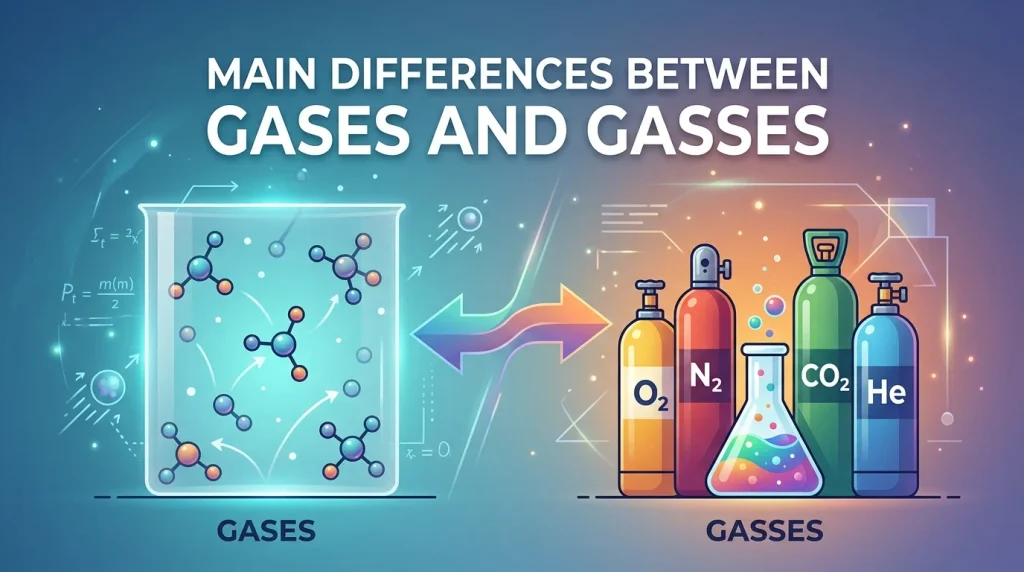
| Feature | Gases | Gasses |
| Base word | Gas | Gas |
| Most common grammatical role | Plural noun | Verb |
| Basic meaning | More than one gas | Performs an action involving gas |
| Singular/base form | Gas | Gas |
| Example | Oxygen and nitrogen are gases. | The machine gases the chamber. |
| Common in science | Very common | Uncommon |
| Common in everyday writing | Very common | Relatively uncommon |
| Best choice for multiple gases | Yes | No |
| Pronunciation | Usually “GAY-ziz” | Usually “GASS-iz” when used as a verb |
The most important distinction is simple:
Gases = more than one gas.
Gasses = performs an action involving gas.
Why Are “Gases” and “Gasses” Confusing?
The confusion comes from the fact that English has several words ending in -s and -es, and spelling rules do not always make pronunciation obvious.
The singular noun is gas.
Its standard plural is:
gas → gases
However, the verb gas follows a different pattern when its subject is he, she, it, or another singular third-person subject:
gas → gasses
Compare:
The laboratory stores several gases.
Here, gases is a plural noun.
The machine gasses the samples.
Here, gasses is a verb.
The extra s is not simply an alternative spelling of the plural noun. It generally signals a different grammatical function.
Grammar Guide
How Each Term Is Used in Sentences
Gases as a plural noun
The basic pattern is:
gas + plural meaning = gases
Examples:
These gases are highly reactive.
The atmosphere contains several gases.
Scientists measured the gases inside the container.
You can usually replace gases with “different types of gas” or “more than one gas.”
Gases as a verb
The basic pattern is:
subject + gasses + object
Examples:
The equipment gasses the chamber.
The factory gasses the material during processing.
The system gasses the product before packaging.
In these examples, gasses describes something that the subject does.
Common Mistakes Learners Make
Mistake 1: Using “gasses” for multiple gases
Incorrect or confusing:
Oxygen and nitrogen are gasses.
Preferred standard form:
Oxygen and nitrogen are gases.
When you mean multiple types or examples of the substance, use gases.
Mistake 2: Treating “gases” as a verb
Incorrect:
The machine gases the chamber every morning.
If you mean that the machine acts, the spelling gasses may be appropriate:
The machine gasses the chamber every morning.
Mistake 3: Assuming “gasses” is always wrong
It is not always wrong. Gasses has a legitimate grammatical use as a verb.
For example:
The system gasses the container.
The problem occurs when writers use gasses when they actually mean the plural noun gases.
Mistake 4: Confusing spelling with pronunciation
The two forms can also sound different.
Gases is generally pronounced approximately GAY-ziz.
Gasses, when it is the verb, is generally pronounced approximately GASS-iz.
Simple Rules to Remember
Use this rule:
If you mean more than one gas, write “gases.”
Use this rule:
If you mean that someone or something performs an action involving gas, “gasses” may be the correct verb form.
A quick memory trick is:
Gases = substances.
Gasses = action.
For example:
The gases escaped.
The gases are substances.
The machine gasses the chamber.
The machine is acting.
Quick Tips for Writing and Speaking
- Use “gases” in science writing when referring to multiple gases.
- Use “gases” for lists of substances, such as oxygen, nitrogen, and helium.
- Look for a subject acting as using “gasses.”
- If you can replace the word with “different types of gas,” use gases.
- If the word describes what a machine, person, or process does, check whether gases is appropriate.
- In technical writing, avoid unusual plural forms that may distract readers.
- Remember that gases is by far the more common spelling when the word is a plural noun.
When to Use Each One
When to Use “Gases”
Use gases when you are talking about:
- More than one gas
- Different types of gas
- Chemical substances in the gaseous state
- Atmospheric gases
- Industrial gases
- Greenhouse gases
- Gases in scientific experiments
- Gases stored in containers
- A collection of gaseous substances
Examples:
The atmosphere contains several gases.
The experiment involved three gases.
Certain gases absorb infrared radiation.
When to Use “Gasses”
Use gasses when it functions as a third-person singular verb derived from gas.
For example:
The machine gasses the chamber.
Here, the machine is the subject and gasses tells us what the machine does.
The form is especially relevant in technical or specialized contexts where a process involves treating something with gas.
When NOT to Use Each One
When Not to Use “Gases”
Do not use gases when you need a singular verb describing an action performed by a singular subject.
For example, if you mean:
The equipment performs a gas-treatment process.
Then gasses may be the appropriate verb form:
The equipment gasses the material.
Do not automatically use gases simply because the word “gas” appears in the sentence.
When Not to Use “Gasses”
Do not normally use gasses when you simply mean multiple gases.
For example:
Hydrogen and oxygen are gases.
Not:
Hydrogen and oxygen are gasses.
Similarly:
The atmosphere contains several gases.
Not:
The atmosphere contains several gasses.
For general scientific, educational, and everyday writing, gases is the standard plural form.
Gases vs. Gasses in Science
Science is one of the areas where the distinction matters most.
The word gases is extremely common in chemistry, physics, biology, environmental science, and atmospheric science.
Examples include:
- noble gases
- greenhouse gases
- atmospheric gases
- toxic gases
- reactive gases
- inert gases
- industrial gases
For example:
Noble gases are generally chemically unreactive.
Greenhouse gases include carbon dioxide and methane.
Different gases behave differently under changes in temperature and pressure.
In these sentences, gases is a plural noun.
The word gasses is much less likely to appear in ordinary scientific prose because it is a verb rather than the standard plural of gas.
Gases vs. Gasses in American and British English
Both gases and gasses can appear in English-language dictionaries and texts, but their functions matter more than regional spelling differences.
The standard plural noun is generally:
gas → gases
The verb can be:
gas → gasses
This distinction is useful in both American and British English.
There may be specialized or historical variations in how gas is pluralized, but writers who want clear modern standard English should generally use gases for the plural noun.
Gases vs. Gasses in Formal Writing
In essays, research papers, reports, textbooks, websites, and professional documents, use gases when referring to multiple gases.
For example:
Several gases were identified during the experiment.
This is clearer than:
Several gasses were identified during the experiment.
The first sentence follows the standard plural form and is immediately recognizable to readers.
If gases is being used as a verb, however, it can be correct:
The device gases the sample before analysis.
When to Use Each One: Quick Decision Guide
Ask yourself what you mean.
Question 1: Am I talking about more than one gas?
If yes, use:
Gases
Example:
Oxygen and hydrogen are gases.
Question 2: Am I describing an action?
If yes, check whether the verb gas is being used.
Example:
The machine gasses the chamber.
Question 3: Can I replace the word with “different types of gas”?
If yes, use:
Gases
Example:
Several gases were detected.
Question 4: Is a singular subject doing something involving gas?
If yes, gases may be correct.
Example:
The equipment gases the container.
Which One to Use (Decision Guide)
Use the following simple guide:
| What do you mean? | Correct choice | Example |
| More than one gas | Gases | Several gases were detected. |
| Different types of gas | Gases | The atmosphere contains many gases. |
| Chemical substances | Gases | These gases react with oxygen. |
| Atmospheric substances | Gases | Greenhouse gases affect the atmosphere. |
| A singular subject performing a gas-related action | Gasses | The machine gasses the chamber. |
| Plural noun in normal scientific writing | Gases | The gases were analyzed. |
The safest general rule is:
If you are asking how to spell the plural of “gas,” choose “gases.”
Real-World Practical Examples
Gases Examples
1. Education
Students learned that gases do not have a fixed shape.
Here, gases refers to multiple substances in the gaseous state.
2. Science
The researchers analyzed several gases in the laboratory.
Here, gases is a plural noun.
3. Daily life
Some gases can have strong odors.
The word refers to multiple gaseous substances.
4. Environmental science
Greenhouse gases contribute to changes in Earth’s climate system.
Again, gases refers to a category of substances.
5. Business
The company supplies industrial gases to manufacturing plants.
The company supplies multiple types of gas.
6. Technology
The sensor can detect several gases.
The sensor detects more than one type of gaseous substance.
7. Writing
The report explains how gases behave under pressure.
The word is a plural noun.
8. Conversation
What gases are present inside the container?
The speaker is asking about multiple gases.
Gasses Examples
1. Manufacturing
The machine gases the chamber before production begins.
Here, gases is a verb describing what the machine does.
2. Laboratory processing
The equipment gases the sample before the next stage.
The word functions as a verb.
3. Industrial process
The system gasses the material under controlled conditions.
Again, gasses describes an action.
4. Technical writing
The device gasses the container automatically.
The singular subject device acts.
5. Process description
The apparatus gasses each chamber before testing.
The apparatus is performing an action involving gas.
6. Passive-voice comparison
The chamber is gassed before testing.
Notice that the past participle is gassed, not gasses.
7. Present-tense process description
The equipment gasses the product before packaging.
The singular subject requires the third-person singular verb form.
8. Conversation
Does the machine gas the chamber automatically?
With does, the base form gas is used, not gasses.
This is an important grammar point:
The machine gasses the chamber.
But:
Does the machine gas the chamber?
A Closer Look at the Verb “Gas”
Understanding the verb forms makes gases easier to remember.
The base form is:
gas
With he, she, it, or another singular third-person subject:
gasses
The present participle is:
gassing
The past tense and past participle are:
gassed
Examples:
I gas the equipment.
They gas the chamber.
She gasses the chamber.
The machine is gassing the material.
The operator gassed the chamber yesterday.
This pattern explains why gasses is different from gases.
Gases or Gasses: A Simple Grammar Test
Try putting “many” before the word.
If the sentence works, you probably need gases:
Many gases are present.
You would not normally say:
Many gasses are present.
Now try putting a singular subject before the word and ask whether the word describes an action:
The machine gasses the chamber.
That works because gases is functioning as a verb.
Another useful test is to replace the word with “different types of gas.”
Different types of gas are present.
Therefore:
Several gases are present.
Search Intent and Common Questions
Is “gases” or “gasses” correct?
Both spellings can be grammatically valid, but they normally serve different purposes. Gases is the standard plural noun of gas, while gasses is commonly the third-person singular form of the verb gas.
What is the plural of gas?
The standard plural is gases.
Example:
One gas, several gases.
Is “gasses” a word?
Yes. Gasses is commonly used as a verb, as in:
The machine gasses the chamber.
Some dictionaries also record gasses as a less common plural form in certain contexts, but gases is the standard and much more common plural for general writing.
Why is the plural of gas “gases”?
The standard English plural spelling is formed by adding -es to gas, producing gases.
Are gases and gasses pronounced the same?
They are generally pronounced differently.
Gases is usually pronounced approximately GAY-ziz.
Gasses as the verb is usually pronounced approximately GASS-iz.
Should I write “greenhouse gasses” or “greenhouse gases”?
Use:
greenhouse gases
This is because gases is the plural noun referring to multiple gaseous substances.
Should I write “toxic gasses” or “toxic gases”?
In standard modern usage, write:
toxic gases
Here, gases is the plural noun.
Self-Assessment (Fill in the Blanks)
Complete each sentence with gases or gasses.
- I will use ______ when referring to oxygen, nitrogen, and carbon dioxide as multiple substances.
The correct word is ______ because ______. - I will use ______ when referring to several substances in the gaseous state.
The correct word is ______ because ______. - I will use ______ when describing what a machine does to a chamber.
The correct word is ______ because ______. - I will use ______ in the sentence “The atmosphere contains several ______.”
The correct word is ______ because ______. - I will use ______ when referring to greenhouse substances such as carbon dioxide and methane.
The correct word is ______ because ______. - I will use ______ in the sentence “The equipment ______ the chamber before testing.”
The correct word is ______ because ______. - I will use ______ when talking about different types of gas in a chemistry lesson.
The correct word is ______ because ______. - I will use ______ in the sentence “Scientists measured the ______ in the container.”
The correct word is ______ because ______. - I will use ______ when the word functions as the third-person singular present-tense verb of “gas.”
The correct word is ______ because ______. - I will use ______ when saying that hydrogen and oxygen are both substances in the gaseous state.
The correct word is ______ because ______. - I will use ______ in “The device ______ the chamber automatically.”
The correct word is ______ because ______. - I will use ______ in “Several ______ were released during the experiment.”
The correct word is ______ because ______. - I will use ______ when referring to multiple atmospheric substances.
The correct word is ______ because ______. - I will use ______ in “The machine ______ the material before processing.”
The correct word is ______ because ______. - I will use ______ when discussing noble substances such as helium, neon, and argon.
The correct word is ______ because ______. - I will use ______ in “These ______ can react under certain conditions.”
The correct word is ______ because ______. - I will use ______ when the word means that a singular machine performs a gas-related action.
The correct word is ______ because ______. - I will use ______ for the plural noun in “Different ______ have different properties.”
The correct word is ______ because ______. - I will use ______ when writing a science report about multiple types of gas.
The correct word is ______ because ______. - I will use ______ in “The apparatus ______ each chamber before the experiment.”
The correct word is ______ because ______.
Answers
- Gases: because it refers to multiple gaseous substances.
- Gases: because it is the standard plural noun of gas.
- Gasses: because it describes an action performed by a singular machine.
- Gases: because several different gaseous substances are being discussed.
- Gases: because greenhouse gases are multiple gaseous substances.
- Gasses: because the equipment is acting.
- Gases: because the sentence refers to different types of gas.
- Gases: because the scientists are measuring multiple gaseous substances.
- Gasses: because it is the third-person singular present-tense form of the verb gas.
- Gases: because hydrogen and oxygen are being identified as multiple gaseous substances.
- Gasses: because the device is a singular subject acting.
- Gases: because the word is a plural noun referring to multiple substances.
- Gases: because multiple types of atmospheric gas are being discussed.
- Gasses: because the machine acts.
- Gases: because helium, neon, and argon are multiple gases.
- Gases: because the sentence refers to multiple gaseous substances.
- Gasses: because it is functioning as a singular verb.
- Gases: because it is the plural noun following different.
- Gases: because a science report normally uses gases for multiple types of gas.
- Gasses: because the apparatus is a singular subject acting.
Final Verdict
When choosing between gases and gasses, the most important question is whether you are talking about multiple substances or describing an action.
Use gases when you mean more than one gas:
Oxygen, nitrogen, and carbon dioxide are gases.
Use gasses when it functions as a third-person singular verb meaning that something performs an action involving gas:
The machine gasses the chamber.
For ordinary plural usage, especially in science, education, environmental writing, technology, business, and everyday English, gases is the correct and standard choice.
The easiest rule to remember is:
Gases = more than one gas.
Gasses = an action performed by a singular subject.
So, if you are wondering whether to write “greenhouse gases”, “toxic gases”, “noble gases”, or “several gases,” choose gases.
Conclusion
Understanding the difference between gases and gasses becomes much easier once you focus on grammar and meaning. In most situations, gases is the correct choice because it is the standard plural form of gas and refers to more than one gaseous substance. You will see it frequently in science, education, environmental topics, technology, and everyday writing.
Gasses, on the other hand, is generally used as a verb. It describes an action performed by a singular subject, such as a machine or system that treats something with gas. Keeping this distinction in mind can prevent common spelling and grammar mistakes.
A simple rule is worth remembering: use “gases” for multiple substances and “gasses” for the verb describing an action. Once you recognize whether the word is acting as a noun or verb, choosing the correct spelling becomes straightforward.
FAQs
Is gases or gasses the correct spelling?
Both gases and gasses can be correct, but they normally have different grammatical functions. Gases is the standard plural form of gas, referring to multiple gaseous substances. Gasses is commonly the third-person singular form of the verb gas, describing an action. Therefore, the correct choice depends on the meaning and sentence structure.
What is the plural of gas?
The standard plural of gas is gases. For example, oxygen, nitrogen, and carbon dioxide are gases. The spelling gases is widely used in scientific, academic, professional, and everyday English when referring to more than one gas or different types of gas.
Is gasses a real word?
Yes, gasses is a real English word. It is commonly used as the third-person singular present-tense form of the verb gas. For example, “The machine gasses the chamber.” It should not normally be used as a replacement for gases when you mean multiple gaseous substances.
Should I write greenhouse gases or greenhouse gasses?
The standard expression is greenhouse gases. Here, gases is a plural noun referring to substances such as carbon dioxide, methane, and other atmospheric gases. Writing greenhouse gasses can create confusion because gasses is normally understood as a verb rather than the standard plural noun.
Why do people confuse gases and gasses?
The confusion happens because both words are based on gas and look very similar. Their grammatical roles are different, however. Gases normally function as a plural noun, while gasses generally function as a verb. Recognizing whether the word names substances or describes an action makes the distinction easier.
How do you pronounce gases?
Gases is generally pronounced approximately like “GAY-ziz.” The pronunciation differs from gasses, which is commonly pronounced approximately like “GASS-iz” when it functions as the verb form. Listening for the difference can help learners connect pronunciation with the correct spelling and grammatical meaning.
How do you use gasses in a sentence?
Use gasses when it functions as a third-person singular verb derived from gas. For example, “The machine gasses the chamber before testing.” Here, gasses describes what the singular machine does. With plural subjects, the base verb gas is normally used instead.
Is gases used in scientific writing?
Yes. Gases is extremely common in scientific writing because scientists frequently discuss multiple substances in the gaseous state. Expressions such as noble gases, greenhouse gases, atmospheric gases, and industrial gases are standard. In these expressions, gases is functioning as a plural noun.
Should I use gases or gasses in formal writing?
For formal writing, use gases when referring to multiple gases. It is the standard plural noun and is appropriate for essays, reports, academic writing, scientific articles, websites, and professional documents. Use gasses only when the grammatical context requires the verb form of gas.
What is an easy way to remember gases vs gasses?
Remember this simple rule: gases means more than one gas, while gasses describes an action. If you are naming substances, choose gases. If a singular person, machine, or system is performing an action involving gas, gasses may be appropriate. This quick distinction works in most everyday contexts.